Table of Contents
This analysis is brought to you by Inkwood Research, a leading market intelligence firm specializing in European renewable energy transitions, biogas technology advancements, and sustainable fuel ecosystems. Our research team combines extensive experience analyzing Germany biogas market dynamics, European Union decarbonization initiatives, and biomethane upgrade technologies. Based on our proprietary research methodologies and strategic partnerships with European energy cooperatives, government renewable programs, and biogas technology providers, we deliver actionable insights empowering strategic decision-making for global enterprises navigating Germany’s biogas policy landscape and renewable energy market expansion.
TLDR
Germany biogas market stands at US$8,128.50 million in 2026, projected to reach US$9,567.61 million by 2034 with a 2.06% CAGR. Renewable energy policies drive biomethane production for cooking gas, vehicle fuel, electricity, and heat applications. Air Liquide, EnviTec Biogas, and Scandinavian Biogas lead market innovation. Upgraded biogas supports national decarbonization targets. Regulatory frameworks shape investment opportunities. Businesses must navigate complex subsidy structures and environmental standards for market entry success.
Energy sector executives, renewable fuel investors, agricultural biogas developers, corporate sustainability officers, policy analysts, European market strategists, biomethane technology providers, cooking gas distributors, vehicle fuel suppliers, electricity generation companies, and international businesses exploring Germany biogas market opportunities will gain critical insights into regulatory frameworks, growth drivers, competitive positioning, and strategic entry pathways within Europe’s most dynamic renewable energy landscape.
Germany Biogas Market Overview and Growth Trajectory
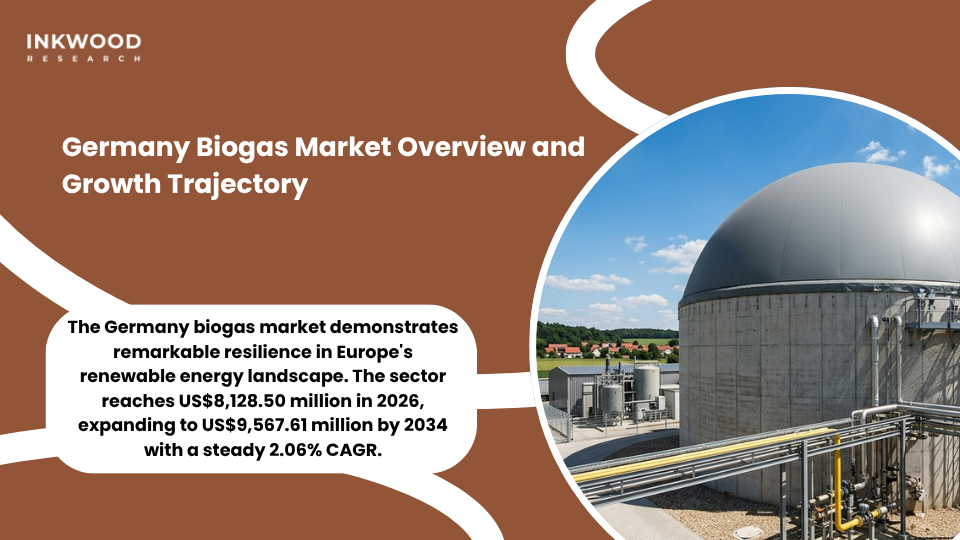
The Germany biogas market demonstrates remarkable resilience in Europe’s renewable energy landscape. The sector reaches US$8,128.50 million in 2026, expanding to US$9,567.61 million by 2034 with a steady 2.06% CAGR. Consequently, this growth reflects strategic government initiatives promoting decarbonization across multiple energy applications.
Moreover, upgraded biogas technologies enhance market competitiveness against conventional fossil fuels. Businesses entering this space encounter sophisticated regulatory environments requiring careful navigation. According to the Federal Ministry for Economic Affairs and Climate Action, renewable energy now supplies more than 50% of Germany’s electricity generation, creating substantial opportunities for biogas producers.
Market Foundation and Economic Significance
The Germany biogas market operates within Europe’s most ambitious renewable energy framework. Biogas production serves cooking gas needs, vehicle fuel applications, electricity generation, and heat distribution networks. Furthermore, agricultural waste conversion creates circular economy benefits beyond energy production.
Rural communities benefit from localized renewable energy infrastructure development. Meanwhile, urban centers receive consistent upgraded biogas supplies through established distribution networks. Industrial applications particularly value biogas as reliable baseload renewable energy.
Technology Evolution Driving Market Expansion
Advanced upgrading technologies transform raw biogas into pipeline-quality biomethane suitable for diverse applications. Membrane separation, pressure swing adsorption, and chemical scrubbing technologies achieve 98% methane purity.
These innovations enable direct injection into natural gas networks, expanding market reach significantly. Additionally, small-scale biogas plants now achieve economic viability previously limited to large installations. Modular systems allow progressive capacity expansion, matching demand growth patterns.
Policy Frameworks Shaping Germany Biogas Development
Renewable energy policies fundamentally shape the Germany biogas market landscape. The Renewable Energy Sources Act (EEG) establishes feed-in tariff structures guaranteeing long-term revenue stability. Subsequently, businesses gain investment confidence through predictable financial frameworks.
However, recent amendments shift focus from volume subsidies toward sustainability criteria and efficiency standards. Therefore, operators must optimize production processes, achieving higher biomethane yields from organic feedstocks.
Feed-in Tariff Structures and Revenue Models
The EEG guarantees electricity produced from biogas receives fixed compensation rates for 20-year periods. This mechanism de-risks capital-intensive biogas plant investments significantly. Consequently, financial institutions provide favorable lending terms for project development.
Moreover, bonus payments reward specific feedstock choices and technology implementations. Flexibility premiums incentivize on-demand electricity production, matching grid requirements. Thus, operators strategically structure production profiles, maximizing revenue potential.
Sustainability Certification Requirements
Environmental standards increasingly determine market access for Germany biogas producers. Certification schemes verify sustainable feedstock sourcing, greenhouse gas reduction achievements, and ecological impact assessments. Similarly, operators must demonstrate minimum carbon savings compared to fossil fuel alternatives.
These requirements create competitive advantages for efficiently managed facilities utilizing agricultural residues and organic waste streams. Conversely, plants relying on energy crops face stricter scrutiny regarding land use impacts.
Regional Implementation Variations
Federal states maintain authority in implementing additional biogas support mechanisms beyond national frameworks. Bavaria, Lower Saxony, and Baden-Württemberg offer supplementary investment grants for advanced upgrading equipment.
Meanwhile, regional energy agencies provide technical consulting services, assisting project development. Therefore, location decisions significantly impact overall project economics and regulatory complexity. Businesses must evaluate specific regional advantages before site selection.
Renewable Energy Integration and Decarbonization Goals
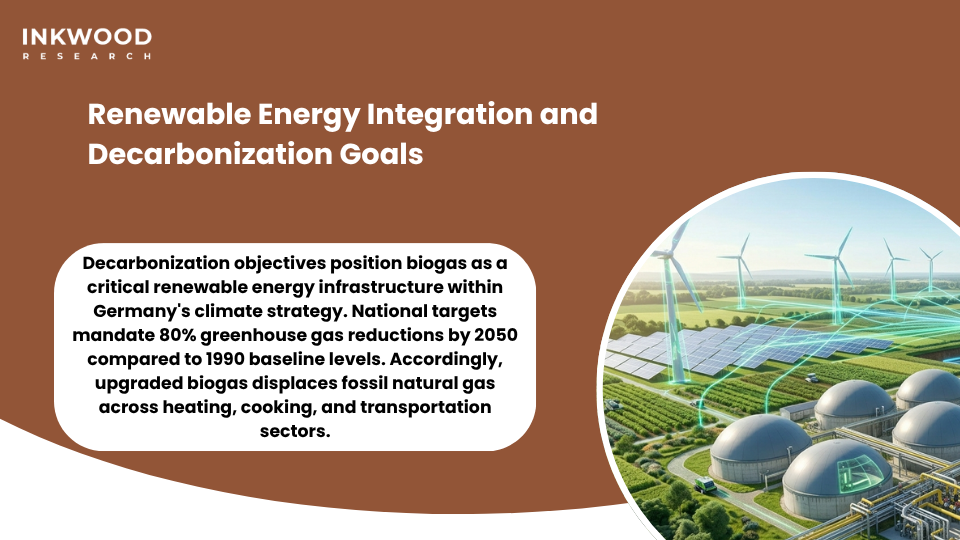
Decarbonization objectives position biogas as a critical renewable energy infrastructure within Germany’s climate strategy. National targets mandate 80% greenhouse gas reductions by 2050 compared to 1990 baseline levels. Accordingly, upgraded biogas displaces fossil natural gas across heating, cooking, and transportation sectors.
Furthermore, biogas plants provide flexible electricity generation, balancing intermittent wind and solar capacity. This complementary role enhances overall renewable energy system reliability and resilience.
Grid Integration Challenges and Solutions
Renewable energy systems require sophisticated balancing mechanisms addressing generation variability. Biogas installations offer controllable output, adjusting production in response to grid conditions. Consequently, operators receive premium compensation for providing flexibility services.
Advanced forecasting systems optimize production scheduling, maximizing economic returns. Additionally, combined heat and power configurations enhance overall energy efficiency, capturing thermal output value. These integrated approaches improve project economics while supporting grid stability.
Transportation Sector Transformation
Vehicle fuel applications represent significant growth opportunities for upgraded biogas producers. Compressed biomethane (Bio-CNG) and liquefied biomethane (Bio-LNG) substitute diesel in heavy-duty transportation fleets. Meanwhile, municipal bus operators increasingly adopt biomethane fuel, reducing urban air pollution. Corporate sustainability commitments accelerate this transition as logistics companies seek carbon-neutral operations.
Building Sector Heating Applications
Residential and commercial heating markets are increasingly adopting biogas as a renewable cooking gas alternative. District heating networks incorporate upgraded biogas, reducing fossil fuel dependency. Similarly, individual building retrofits install biogas-compatible heating systems supported by conversion incentive programs. These applications create stable long-term demand supporting investment in upgrading infrastructure. Moreover, seasonal heat storage technologies maximize biogas utilization efficiency throughout annual cycles.
Upgraded Biogas Applications Across Energy Sectors
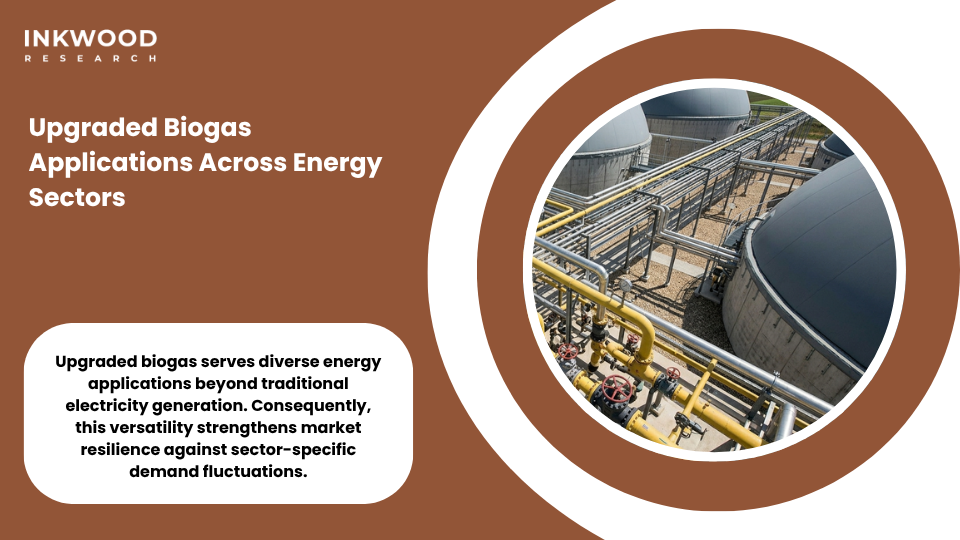
Upgraded biogas serves diverse energy applications beyond traditional electricity generation.
- Cooking gas markets receive consistent biomethane supplies meeting residential and commercial demands.
- Vehicle fuel applications expand rapidly as transportation fleets transition toward renewable alternatives.
- Electricity generation continues to provide baseload renewable capacity, complementing variable solar and wind resources.
- Heat applications utilize combined heat and power systems, maximizing overall energy efficiency.
Consequently, this versatility strengthens market resilience against sector-specific demand fluctuations.
Cooking Gas Market Penetration
Biomethane injection into natural gas networks enables seamless integration with existing cooking gas infrastructure. Households and restaurants receive renewable gas without equipment modifications or service interruptions.
Furthermore, green gas tariffs allow environmentally conscious consumers to select premium biogas supplies. This market segment demonstrates strong growth as climate awareness influences consumer choices. Suppliers marketing carbon-neutral cooking gas gain competitive positioning advantages.
Industrial Energy Demand
Manufacturing facilities increasingly adopt biogas, meeting corporate sustainability targets while ensuring reliable energy supplies. Process heat applications particularly suit biogas characteristics, providing consistent thermal output.
Additionally, industrial combined heat and power installations achieve exceptional overall efficiency ratings. These configurations reduce operating costs while enhancing environmental credentials. Therefore, industrial biogas demand creates stable long-term offtake agreements supporting production expansion.
Cross-Border Trade Opportunities
European gas network interconnections facilitate biomethane exports from the Germany biogas market to neighboring countries. Harmonized renewable gas certification schemes enable cross-border trading.
Meanwhile, pipeline capacity expansions improve access to additional markets. These developments create price optimization opportunities for producers serving premium markets. Conversely, import capabilities ensure domestic supply security during production fluctuations.
Competitive Landscape and Major Market Players
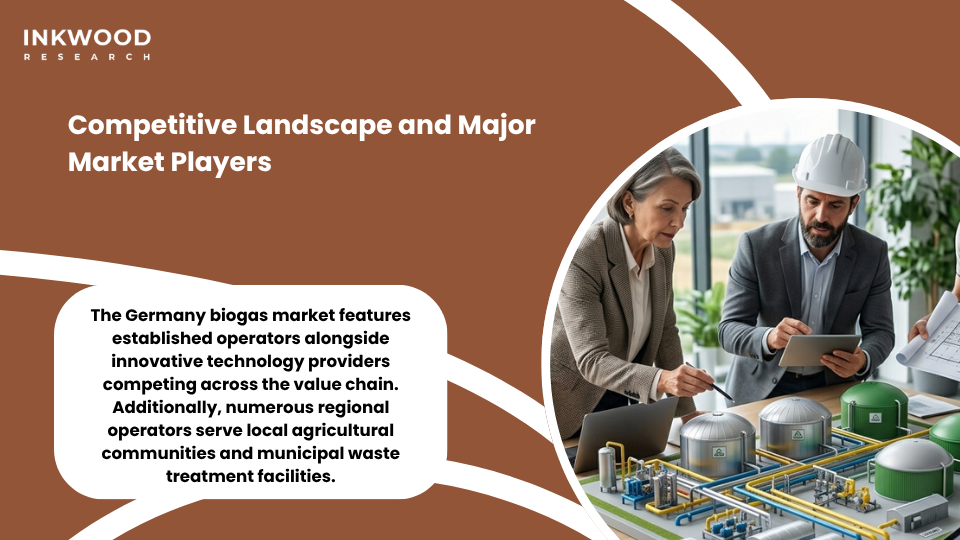
The Germany biogas market features established operators alongside innovative technology providers competing across the value chain.
- Air Liquide maintains leadership in gas upgrading solutions and biomethane distribution infrastructure.
- EnviTec Biogas specializes in comprehensive plant construction and operational services.
- Scandinavian Biogas expands aggressively in vehicle fuel applications and biomethane trading.
Additionally, numerous regional operators serve local agricultural communities and municipal waste treatment facilities.
1. Air Liquide’s Strategic Positioning
Air Liquide leverages industrial gas expertise, delivering advanced biogas upgrading technologies, achieving exceptional purity standards. The company’s membrane separation systems process biomethane for pipeline injection and vehicle fuel applications.
Furthermore, extensive distribution networks connect producers with end-users across Germany and neighboring markets. Recent investments expand liquefaction capacity, producing Bio-LNG for heavy transport sectors. These strategic moves position Air Liquide to capture growth across multiple biogas applications.
2. EnviTec Biogas’s Integrated Solutions
EnviTec Biogas provides turnkey plant construction services spanning project development through commissioning and ongoing operations. This integrated approach simplifies market entry for agricultural and industrial biogas producers.
Moreover, the company offers financing solutions addressing capital requirements for new installations. Technical service capabilities ensure optimal plant performance throughout operating lifecycles. Consequently, EnviTec maintains a strong market share in the agricultural biogas segment.
3. Scandinavian Biogas’s Market Expansion
Scandinavian Biogas focuses on vehicle fuel applications, driving biomethane adoption in transportation sectors. The company operates refueling infrastructure supporting commercial fleet conversions to renewable gas. Additionally, biomethane trading operations optimize supply chains connecting producers with mobility customers.
Strategic partnerships with logistics companies accelerate market penetration. These focused strategies differentiate Scandinavian Biogas within the competitive German biogas market landscape.
4. Emerging Technology Providers
Innovation drives continuous improvement in biogas production efficiency and upgrading economics. Startup companies develop advanced digestion technologies that extract higher methane yields from organic feedstocks. Meanwhile, digital monitoring systems optimize operational parameters, reducing downtime and maintenance costs. These technological advances lower barriers to entry for new market participants. Consequently, competition intensifies across equipment supply, engineering services, and operational optimization segments.
Business Opportunities and Investment Considerations

Strategic opportunities within the Germany biogas market attract diverse investor profiles and business models. Agricultural producers leverage existing waste streams, creating additional revenue sources through biogas production.
Industrial companies reduce energy costs while enhancing sustainability credentials. Meanwhile, financial investors recognize stable cash flows from renewable energy projects backed by government support mechanisms. However, success requires understanding regulatory complexities, technology selection, and market positioning strategies.
· Agricultural Biogas Development
Farming operations benefit from biogas plants converting manure and crop residues into renewable energy and valuable digestate fertilizers. This circular approach reduces waste management costs while generating electricity and heat income.
Furthermore, cooperative models enable smaller farms to share biogas infrastructure investments. Regional agricultural associations provide technical support and financing guidance. Therefore, agricultural biogas represents an accessible entry point for rural businesses.
· Industrial Waste-to-Energy Projects
Food processing facilities, breweries, and wastewater treatment plants generate substantial organic waste suitable for biogas production. On-site installations eliminate waste disposal costs while producing valuable energy for operations.
Additionally, environmental compliance improvements enhance corporate reputation and regulatory standing. Investment payback periods typically range from five to eight years under current policy frameworks. These economics attract industrial biogas development across manufacturing sectors.
· Technology Provider Opportunities
Equipment manufacturers and engineering firms benefit from ongoing biogas infrastructure expansion. Upgrading technology providers capture growing biomethane demand for cooking gas and vehicle fuel applications.
Meanwhile, digital solution developers address operational optimization needs. These service segments demonstrate strong growth potential as the Germany biogas market matures. Consequently, technology innovation remains a critical competitive differentiator.
· Risk Factors and Mitigation Strategies
Policy changes represent primary risks for biogas investments, dependent on subsidy structures. However, long-term feed-in tariff guarantees mitigate exposure during contract periods. Feedstock availability and pricing fluctuations impact operational margins.
Therefore, securing supply agreements reduces procurement risks. Technical performance risks decrease through proven technology selection and professional operations. Comprehensive due diligence and expert consultation minimize investment risks.
Key Takeaways
- The Germany biogas market presents compelling opportunities within Europe’s renewable energy transition. Market value reaches US$8,128.50 million in 2026, expanding to US$9,567.61 million by 2034 with a steady 2.06% CAGR.
- Upgraded biogas serves cooking gas, vehicle fuel, electricity, and heat applications, supporting national decarbonization goals. Renewable energy policies provide stable revenue frameworks through feed-in tariffs and sustainability incentives.
- Major players, including Air Liquide, EnviTec Biogas, and Scandinavian Biogas, demonstrate successful strategies across technology provision, plant operations, and market expansion. Agricultural producers, industrial facilities, and financial investors each find viable entry points matching their capabilities and objectives.
- Technology innovation continues to improve biogas production efficiency and upgrading economics. Cross-border trading opportunities emerge through European gas network integration.
- Transportation sector transformation accelerates biomethane demand as vehicle fuel applications expand. Meanwhile, building sector heating transitions create stable long-term cooking gas markets. These diverse applications provide resilience against sector-specific demand variations.
- Success requires understanding policy frameworks, technology selection, feedstock logistics, and market positioning strategies. Due diligence processes should evaluate regulatory compliance requirements, technology proven performance, and financial viability.
- Strategic partnerships with established operators can accelerate market entry and reduce execution risks. Therefore, businesses must develop comprehensive strategies addressing technical, regulatory, and commercial dimensions.
Conclusion:
Germany’s biogas sector occupies a central position within European renewable energy infrastructure, supporting ambitious decarbonization targets. The market demonstrates sustained growth driven by supportive policies, technological advancement, and expanding applications across energy sectors. Businesses navigating this landscape benefit from stable regulatory frameworks while managing the complexity inherent in evolving sustainability standards.
Strategic opportunities span the entire value chain from agricultural production through technology provision and end-use applications. Upgraded biogas increasingly substitutes fossil fuels in cooking, transportation, electricity, and heating applications. Consequently, market participants capture value through multiple revenue streams, enhancing project economics and risk profiles.
Looking forward, the Germany biogas market will continue evolving as renewable energy penetration increases and decarbonization pressures intensify. Innovation in upgrading technologies, digitalization, and business models will drive competitive dynamics. Meanwhile, European market integration creates opportunities for cross-border optimization and scale advantages.
For organizations seeking deeper insights into the Germany biogas market or renewable energy strategies, Inkwood Research offers comprehensive market intelligence and consulting services. Contact our team to explore how these emerging opportunities align with your strategic objectives and support your decarbonization commitments.
Frequently Asked Questions
What drives growth in the Germany biogas market?
Germany biogas market growth is driven by renewable energy incentives, feed in tariff stability, biomethane grid injection targets, agricultural waste utilization, and rising demand for low carbon heating and transport fuels
How does upgraded biogas compete with natural gas in Germany?
Upgraded biomethane in Germany meets natural gas grid standards, enabling seamless pipeline injection, while carbon pricing, renewable gas subsidies, and corporate net zero commitments improve competitiveness against fossil natural gas
What are the primary investment risks in Germany biogas projects?
Key risks in Germany biogas investment include subsidy policy changes, feedstock supply volatility, biomethane price fluctuations, grid access limitations, and technology performance reliability affecting long term project returns
What are the key applications of biomethane in Germany?
Biomethane in Germany is used for combined heat and power generation, renewable transport fuel for CNG vehicles, industrial process heat, and grid injected green gas for residential heating
How do government policies support biomethane production in Germany?
Germany supports biomethane production through feed in tariffs, renewable energy auctions, carbon reduction mandates, and incentives for advanced biogas upgrading technologies and sustainable agricultural waste management
What opportunities exist for investors in the Germany biomethane market?
Investors can explore opportunities in large scale anaerobic digestion plants, biogas upgrading systems, renewable gas trading, grid injection infrastructure, and long term corporate renewable gas supply agreements