Table of Contents
This comprehensive report comes from Inkwood Research, a globally recognized market intelligence firm specializing in the energy, power, and utilities sectors. Our European research division maintains deep connections with automotive manufacturers, battery suppliers, and government agencies across Germany. Through rigorous analysis and proprietary methodologies, we deliver strategic insights that empower executives to navigate the complex intersection of transportation electrification, renewable energy integration, and advanced manufacturing in Europe’s largest economy.
TLDR
The Germany battery market has reached $7.67 billion in 2025, projecting remarkable growth to $22.50 billion by 2032 at 16.61% CAGR. Consequently, automotive powerhouses Volkswagen, BMW, and Mercedes-Benz accelerate electrification through massive gigafactory investments and strategic partnerships. Moreover, the EU Green Deal mandates and ambitious climate targets drive electric vehicle adoption toward 15 million units by 2030. Meanwhile, lithium-ion batteries dominate mainstream applications while flow batteries gain traction for grid-scale energy storage. Furthermore, domestic manufacturing development reduces Asian import dependence as battery technology innovation positions Germany as Europe’s premier hub for advanced automotive batteries and sustainable transportation solutions.
This strategic analysis serves automotive executives, technology investors, and supply chain managers navigating Europe’s electrification transition. Additionally, renewable energy developers, policymakers, and manufacturing strategists seeking insights into battery manufacturing ecosystems, gigafactory economics, and EV battery integration strategies gain comprehensive perspectives. Moreover, business leaders evaluating partnerships with German automakers or analyzing competitive dynamics in energy storage systems discover actionable intelligence for informed decision-making throughout the European battery market landscape.
Germany Battery Market Overview: Strategic Commitment Drives Transformation
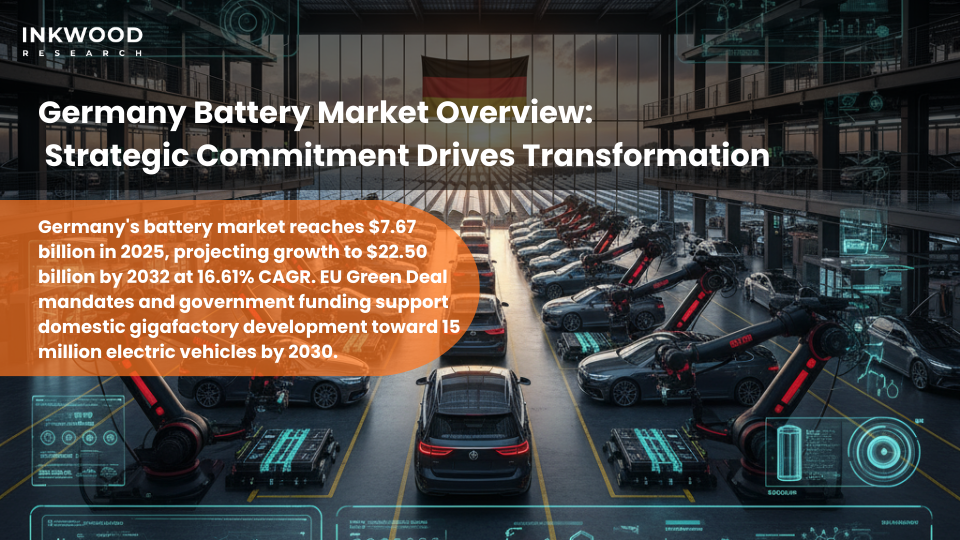
The Germany battery market undergoes transformative growth driven by a strategic commitment to automotive electrification and renewable energy transition. According to Inkwood Research, market valuation reached $7.67 billion in 2025, projecting expansion to $22.50 billion by 2032. This impressive 16.61% CAGR reflects Germany’s determination to lead European clean energy initiatives.
EU Green Deal Mandates Accelerate Adoption
The EU Green Deal and ambitious national climate targets fundamentally reshape transportation and energy sectors. According to Germany’s Federal Ministry for Economic Affairs and Climate Action, the country aims to have 15 million electric vehicles on the roads by 2030. Consequently, a massive demand for battery production capacity emerges across automotive supply chains.
Government funding programs provide substantial support for domestic gigafactory development nationwide. Billions of euros flow into establishing localized cell manufacturing, reducing dependence on Asian imports significantly. Moreover, rising electric vehicle sales from powerhouse automakers like Volkswagen, BMW, and Mercedes-Benz generate tremendous market momentum.
Renewable Energy Integration Demands Storage Solutions
High investment in renewable energy integration promotes storage deployment as Germany transitions away from fossil fuels. According to Germany’s Federal Network Agency, renewable energy sources provided over 56% of electricity generation in 2024. Therefore, sophisticated storage solutions become essential for grid stability management.
Collaborations between automotive manufacturers and battery producers drive localized production effectively. These partnerships reduce supply chain risks while supporting European industrial policy objectives. Furthermore, Germany’s robust R&D infrastructure supports innovations in solid-state and lithium-sulfur battery technologies, positioning the nation as Europe’s premier hub.
Flow Batteries: Long-Duration Storage for Renewable Integration
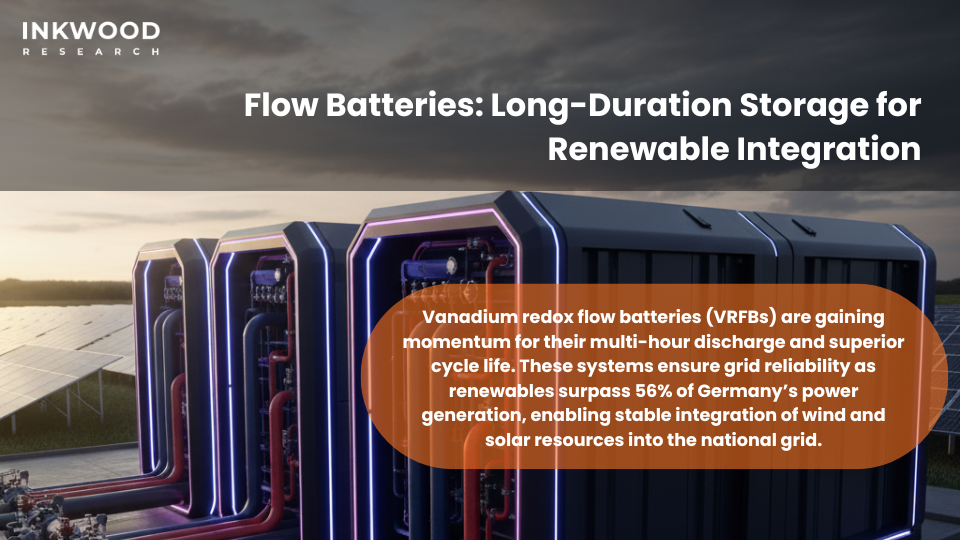
Flow batteries gain significant traction in Germany’s energy storage landscape, particularly for long-duration applications requiring sustained discharge capabilities. Unlike lithium-ion systems that degrade with cycling, flow batteries maintain consistent performance over tens of thousands of charge-discharge cycles.
Vanadium Redox Technology Leads Adoption
Vanadium redox flow batteries dominate this segment, offering scalability from residential installations to utility-scale projects effectively. German engineering companies develop innovative designs with improved energy density and reduced electrolyte costs. Consequently, these systems address critical grid stability challenges associated with aggressive renewable energy deployment.
Solar and wind generation create significant intermittency issues, requiring storage systems capable of multi-hour discharge durations. Based on our research, renewable energy sources’ 56% generation share necessitates sophisticated storage solutions. Therefore, flow batteries complement shorter-duration lithium-ion installations for comprehensive grid support.
Industrial Applications Drive Market Growth
Industrial and commercial applications represent key growth opportunities for flow battery technology development. Manufacturing facilities seek backup power and demand charge management solutions continuously. Additionally, telecommunications infrastructure requires reliable backup power, making flow batteries attractive alternatives to traditional lead-acid systems.
Moreover, Germany’s push toward carbon-neutral production facilities aligns perfectly with flow battery advantages. Non-toxic electrolytes and complete recyclability support sustainability objectives effectively. Research institutions like the Fraunhofer Institute for Chemical Technology advance performance through novel electrode materials and membrane technologies.
Cost Challenges Limit Residential Penetration
However, higher upfront costs compared to lithium-ion alternatives currently limit residential adoption significantly. Consequently, flow batteries remain primarily in commercial and utility applications presently. Nevertheless, falling component costs and increasing emphasis on long-duration storage position these systems favorably.
As Germany pursues ambitious decarbonization targets, multi-hour storage becomes increasingly valuable. Therefore, flow batteries complement faster-response lithium-ion systems in comprehensive energy storage portfolios. Furthermore, technological improvements continue to enhance economic competitiveness across diverse applications systematically.
E-Cars Segment: Redefining European Mobility Standards
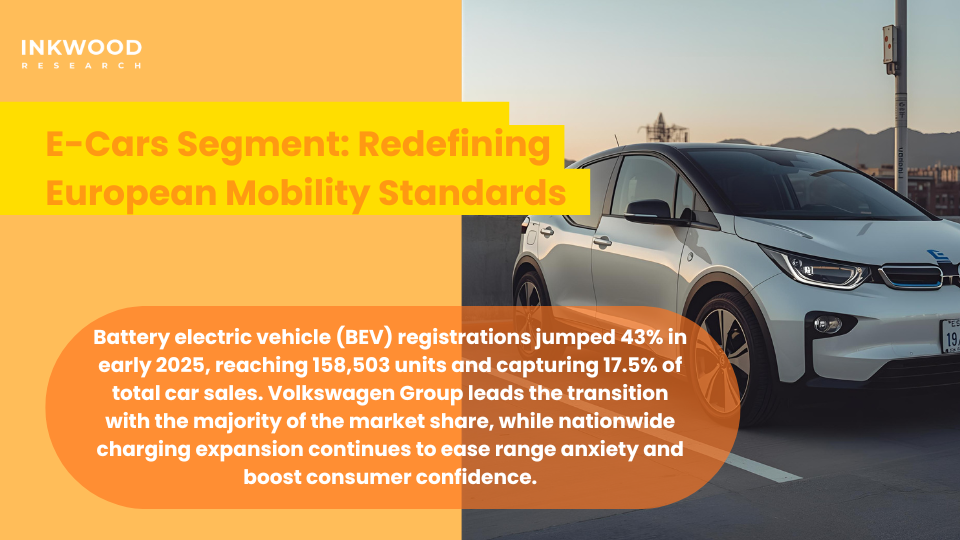
E-cars represent one of the fastest-growing segments within Germany’s battery market, driven by stringent emissions regulations and comprehensive charging infrastructure development. European Union CO2 emission standards mandate dramatic reductions, effectively requiring automakers to transition portfolios toward battery-electric vehicles.
Automotive Giants Commit Massive Investments
Germany’s automotive giants invest hundreds of billions in comprehensive electrification strategies. Volkswagen Group alone commits over €180 billion through 2030 for electric vehicle development and production. According to the German Federal Motor Transport Authority, EV registrations exceeded 850,000 units in 2024, representing approximately 28% of total passenger vehicle sales.
Moreover, in early 2025, BEV registrations jumped 43% to 158,503 units in the first four months alone. This momentum already exceeds 60% of full-year 2024 totals. Furthermore, battery electric vehicles now capture 17.5% of the total car market share nationally.
Charging Infrastructure Expansion Addresses Range Anxiety
Model offerings exploded across price segments, eliminating premium-only positioning that previously limited adoption. Germany’s extensive Autobahn network gains high-power charging stations continuously, addressing range anxiety concerns effectively. Consequently, consumer confidence grows as practical EV ownership becomes increasingly convenient.
Battery technology preferences evolve rapidly within the e-car segment currently. Premium brands like BMW and Mercedes-Benz favor high-nickel NMC chemistries for maximum energy density. These formulations deliver a driving range exceeding 500 kilometers consistently. Conversely, volume manufacturers increasingly adopt LFP batteries for entry-level and mid-range models.
Volkswagen Group Dominates Market Share
Volkswagen Group registered 75,195 BEVs during the January-April 2025 period, capturing nearly half of Germany’s entire electric vehicle market. The core Volkswagen brand accounted for 35,118 units, while sub-brands showed remarkable growth patterns. SEAT/Cupra soared 261% to 6,505 units, Škoda increased 150% to 10,258 units, and Porsche grew 221% to 5,978 cars.
BMW Group Executes Dual-Brand Strategy
BMW Group performed solidly with 17,896 BEV sales, representing 20.8% of its total volume impressively. BMW delivered 13,884 electric vehicles (+26%), while Mini added 4,012 units, soaring 233% year-over-year. The dual-brand strategy proves effective in both premium and urban segments systematically.
Additionally, BMW announced plans to purchase new large cylindrical batteries from EVE Energy for its New Class EVs. The strategy targets supplying the first new 3-series Neue Klasse with Hungarian-made batteries from 2025 models. However, demand fluctuations might postpone the introduction of six other planned models.
Mercedes-Benz Faces Competitive Pressure
Mercedes-Benz remains under pressure despite registering 9,716 BEVs during early 2025. Its share of electric models fell to 11.7%, making it the only major German carmaker reporting an overall decline. This performance signals that its electric portfolio lacks competitive positioning currently.
Competitive Landscape: Automakers and Suppliers Forge New Partnerships
The Germany battery market features complex partnerships between domestic automakers and international battery suppliers. These collaborations shape competitive dynamics while building localized manufacturing ecosystems throughout Europe.
CATL Establishes European Manufacturing Presence
Contemporary Amperex Technology Co. Limited operates its first factory outside Asia in Erfurt, Thuringia. Initially producing 14 GWh capacity, the facility will expand to eventually accommodate 24 GWh. This investment creates approximately 2,000 jobs by 2024 while serving German automotive customers directly.
“The automotive industry in Germany holds considerable sway and is home to several of CATL’s key customers,” states Matthias Zentgraf, Co-President Europe of CATL. Consequently, partnerships with BMW, Volkswagen, Daimler, Bosch, and Volvo ensure steady demand for production output.
BYD Company Expands European Footprint
BYD Company Ltd increases its presence in Germany through direct vehicle sales and battery supply agreements. The company’s vertical integration strategy enables competitive pricing while maintaining quality control throughout production. Moreover, BYD’s growth in Europe demonstrates a 263% increase during early 2025.
Chinese EV brands like BYD and MG triple sales during 2025, challenging incumbents across pricing and technology dimensions. This aggressive expansion significantly reshapes competitive dynamics throughout European markets. Furthermore, BYD’s own vehicle registrations contribute directly to domestic battery demand growth.
Duracell Dominates Consumer Battery Segment
Duracell operates under Berkshire Hathaway ownership, maintaining significant European operations with manufacturing facilities serving German markets. Headquartered in Chicago, the company specializes in alkaline, lithium, and specialty batteries for consumer electronics applications.
Brand recognition drives retail dominance, with Duracell commanding premium shelf space across German supermarkets and electronics retailers. Moreover, sustainability initiatives include rechargeable battery systems and recycling programs aligned with European environmental regulations. The Optimum line represents the latest innovation, claiming 50% longer-lasting performance.
Exide Technologies Serves Automotive Aftermarket
Exide Technologies provides lead-acid batteries for traditional automotive applications and emerging start-stop vehicle systems. The company maintains extensive distribution networks serving German workshops and retail channels effectively. Furthermore, Exide develops lithium-ion solutions for hybrid vehicle applications through strategic partnerships.
GS Yuasa International Focuses Premium Segment
GS Yuasa International Ltd specializes in high-performance batteries for premium vehicles and industrial applications. Japanese engineering expertise positions the company favorably in quality-focused segments. Additionally, GS Yuasa supplies batteries for luxury German automakers requiring superior performance characteristics.
Saft Groupe Targets Industrial Applications
Saft Groupe SA, a subsidiary of TotalEnergies, focuses on specialized battery solutions for industrial, aerospace, and defense sectors. The company develops advanced lithium-ion technologies for demanding applications requiring exceptional reliability. Moreover, Saft participates in an ACC joint venture with Stellantis and Mercedes-Benz.
Johnson Controls Leverages Global Scale
Johnson Controls Inc brings decades of automotive battery experience through established brands including VARTA, LTH, and Optima. The company produces starting, lighting, and ignition batteries for conventional vehicles extensively. Furthermore, Johnson Controls invests heavily in battery recycling infrastructure, operating closed-loop systems that recover materials sustainably.
Germany Battery Market: Latest Product Developments
The Germany battery market experiences continuous innovation through automotive manufacturer initiatives and supplier technology breakthroughs. These developments accelerate electrification while improving performance, cost, and sustainability metrics.
Volkswagen PowerCo Gigafactory Initiative
In July 2022, Volkswagen announced construction of a 40 GWh gigafactory in Salzgitter under a new PowerCo subsidiary. The facility opened in 2025, producing battery cells for electric vehicles initially. Total investment reaches €20 billion ($20.3 billion) for comprehensive battery business development.
Moreover, PowerCo plans to produce products for the grid-scale energy storage sector in future applications. The company targets annual sales exceeding €20 billion while employing up to 20,000 people across Europe. Furthermore, Salzgitter represents the first of several gigafactories Volkswagen plans throughout Europe.
Umicore-Volkswagen Cathode Material Joint Venture
In 2025, Umicore and Volkswagen AG launched a joint venture producing cathode materials for electric vehicles. The partnership targets an annual capacity of 20 GWh at Volkswagen’s Salzgitter plant specifically. This vertical integration strengthens supply chain control while reducing dependence on Asian suppliers.
Valmet Automotive Battery Test Center Expansion
In August 2024, Valmet Automotive completed a significant expansion of its Battery Test Center in Bad Friedrichshall. The facility asserts leadership in battery testing for both automotive and commercial sectors. Furthermore, specific focus on electric vehicles ensures comprehensive validation capabilities throughout development cycles.
Northvolt Partnership Challenges
Volkswagen and BMW invested heavily in Swedish battery manufacturer Northvolt for European cell production. However, the company faced bankruptcy in late 2024, creating uncertainty for European gigafactory development. Nevertheless, Northvolt’s Skellefteå facility offers turnkey manufacturing capabilities if rescued strategically.
Based on our analysis, dependency on imported Chinese batteries places European car companies under significant cost pressure. Consequently, securing domestic production capacity remains critical for competitiveness. However, collapsing profits in China make German automaker acquisitions challenging financially.
ACC Technology Pivot to LFP Chemistry
Automotive Cell Company (ACC), owned by Stellantis, Mercedes-Benz, and TotalEnergies, operates its first gigafactory in Nersac. The second 40 GWh unit in Douvrin ramps production toward the end of 2024. However, market conditions prompted a technology shift from advanced NMC to cheaper lithium-iron-phosphate chemistry.
This strategic pivot reflects cost pressures facing European manufacturers competing against Chinese producers. Nevertheless, ACC’s facilities support multiple automaker brands while developing next-generation technologies. Furthermore, government support ensures continued investment despite market headwinds.
CATL-Stellantis Joint Venture Expansion
Projects such as the joint venture between Stellantis and CATL accelerate European footprint expansion for Chinese manufacturers. These partnerships transfer technology while building local manufacturing capacity systematically. Consequently, European automakers access advanced battery technology while meeting regional content requirements
Gigafactory Development: Building Domestic Manufacturing Capacity
Germany positions itself as a central hub for European battery manufacturing through strategic gigafactory development initiatives. Multiple projects across the country strengthen domestic supply chains while reducing import dependence systematically.
Salzgitter Battery Complex
Volkswagen’s Salzgitter facility represents Germany’s most ambitious domestic battery production initiative. The site produces cells for prototype cars since September 2021, with full production of 16 GWh following in 2024. Furthermore, Volkswagen plans to establish three production lines, creating a comprehensive manufacturing ecosystem.
Additionally, the Umicore joint venture for cathode materials strengthens vertical integration significantly. This co-location strategy reduces logistics costs while accelerating development cycles. Moreover, PowerCo headquarters in Salzgitter coordinates global battery operations strategically.
CATL Arnstadt Facility Operations
CATL’s 14 GWh factory in Arnstadt, Germany, operates as the first lithium-ion battery plant in the country. Chinese investment brings advanced manufacturing expertise to European locations effectively. The facility supplies multiple German automakers with cells for electric vehicle production currently.
According to industry analysis, CATL’s presence demonstrates confidence in the European market growth potential. Furthermore, local production addresses supply chain concerns while meeting regional sourcing requirements. Nevertheless, geopolitical tensions create uncertainty about the long-term Chinese manufacturing presence.
Tesla Berlin Gigafactory Battery Plans
Tesla pushes forward with the German 100 GWh battery project despite some delays encountered. The Brandenburg facility produces Model Y vehicles currently, with battery cell production planned for future expansion. Moreover, Tesla’s vertical integration strategy mirrors Chinese competitors’ approaches effectively.
Abandoned and Delayed Projects
Chinese-owned Svolt and Farasis cancelled their 40 GWh projects in Germany due to market conditions. Additionally, PowerCo abandoned plans for a battery factory in eastern Europe while focusing resources on Salzgitter development. These setbacks reflect economic pressures facing European battery manufacturing initiatives.
Nevertheless, strategic projects continue advancing despite challenges encountered. Government support and automaker commitments ensure critical capacity developments proceed. Furthermore, technological improvements and scale economies gradually improve project economics over time.
Hungarian Manufacturing Hub Emergence
Hungary emerges as a battery manufacturing hot-spot in Europe thanks to moderate workforce costs. The country hosts SK Innovation and Samsung gigafactories with 47.5 GWh total capacity. Furthermore, Chinese EVE Energy and CATL invest in facilities producing 28 GWh and 100 GWh, respectively.
Proximity to leading car manufacturers provides strategic advantages for Hungarian locations. Volkswagen operates in Slovakia, while domestic capacity reaches 800,000 cars annually. Consequently, the central European manufacturing cluster supports multiple automakers efficiently.
Key Takeaways
- The Germany battery market reaches $7.67 billion in 2025, projecting growth to $22.50 billion by 2032 at 16.61% CAGR driven by EU Green Deal mandates and automotive electrification commitments.
- EV registrations surged 43% in early 2025 to 158,503 units, with battery electric vehicles capturing 17.5% of the total car market as charging infrastructure expands nationwide.
- Volkswagen Group dominates with 75,195 BEV sales, representing nearly 50% of market share, while sub-brands SEAT/Cupra (+261%), Škoda (+150%), and Porsche (+221%) show remarkable growth.
- Flow batteries gain traction for long-duration grid-scale energy storage, addressing intermittency challenges as renewable energy sources provided 56% of electricity generation in 2024.
- Volkswagen’s €20 billion PowerCo initiative establishes a 40 GWh gigafactory in Salzgitter, while Umicore’s joint venture produces cathode materials, strengthening vertical integration.
- CATL operates a 14 GWh facility in Arnstadt as Germany’s first lithium-ion plant, supplying multiple automakers while establishing a European manufacturing presence strategically.
- Premium brands favor high-nickel NMC chemistries for 500+ kilometer range, while volume manufacturers adopt LFP batteries for entry-level models, prioritizing affordability and supply diversification.
- Chinese brands BYD and MG triple sales, challenging incumbents, while Tesla experienced a 60% sales decline, reflecting intensifying competition in the German electric vehicle market.
Conclusion: Partnership Strategies Shape European Battery Future
The Germany battery market transformation represents Europe’s most significant industrial shift since post-war reconstruction. Automotive giants Volkswagen, BMW, and Mercedes-Benz commit hundreds of billions toward electrification while building domestic manufacturing capacity. Consequently, Germany positions itself as the continent’s premier hub for battery technology innovation and production.
EU Green Deal mandates and stringent emissions regulations create unstoppable momentum toward electric mobility adoption. With 15 million electric vehicles targeted by 2030, sustained demand supports massive infrastructure investments. Furthermore, renewable energy integration requires sophisticated grid-scale storage solutions, expanding battery applications beyond transportation sectors.
Strategic partnerships between German automakers and international battery suppliers reshape competitive dynamics significantly. CATL, BYD, and Korean manufacturers establish European presence while technology transfer accelerates local capability development. However, dependence on Asian suppliers creates vulnerabilities requiring domestic gigafactory expansion.
Recent developments demonstrate both opportunities and challenges facing European battery manufacturing. Northvolt’s bankruptcy highlights economic pressures while Chinese capacity expansion intensifies competition. Nevertheless, government support and technological innovation ensure continued progress toward electrification objectives.
For automotive executives, technology investors, and policymakers, understanding Germany’s battery market evolution remains essential for strategic planning. The convergence of regulatory mandates, consumer adoption, and manufacturing investments creates unprecedented opportunities. Consequently, stakeholders must navigate complex partnerships, technology choices, and supply chain strategies effectively.
Seeking deeper insights into Germany’s battery market dynamics?
Inkwood Research delivers comprehensive market intelligence, competitive analysis, and strategic consulting tailored to your organization’s specific needs. Connect with our European research specialists today to explore how our proprietary methodologies inform investment decisions, partnership strategies, and technology roadmaps.
Let our expertise guide your navigation through Europe’s most critical automotive transformation with confidence and clarity.
Frequently Asked Questions
What drives Germany's battery market growth through 2032?
Germany’s battery market grows at 16.61% CAGR driven by EU Green Deal mandates requiring dramatic emissions reductions and national targets for 15 million electric vehicles by 2030. Furthermore, automotive giants Volkswagen, BMW, and Mercedes-Benz invest hundreds of billions in electrification strategies while government funding supports domestic gigafactory development, reducing dependence on Asian battery suppliers.
How do flow batteries complement lithium-ion technology?
Flow batteries provide long-duration energy storage capabilities exceeding multiple hours, unlike lithium-ion systems optimized for shorter discharge periods. Vanadium redox flow batteries maintain consistent performance over tens of thousands of cycles without degradation. Therefore, these systems address critical grid stability challenges supporting renewable energy integration, while lithium-ion batteries serve electric vehicle and short-duration applications effectively.
Which companies lead Germany's electric vehicle battery market?
Volkswagen Group dominates with 75,195 BEV sales in early 2025, representing nearly 50% market share through brands including VW, SEAT/Cupra, Škoda, and Porsche. BMW Group follows with 17,896 BEV sales (20.8% of total volume), while Mercedes-Benz faces pressure with declining electric model share at 11.7%. Chinese manufacturers CATL and BYD establish European presence through gigafactories and direct vehicle sales, respectively.