Table of Contents

This analysis is brought to you by Inkwood Research, a leading market intelligence firm specializing in Asia-Pacific enterprise learning technology, corporate gamification ecosystems, and workforce development strategies across Japan, India, and Australia. Our research team combines deep expertise in Japanese interactive simulation adoption, India’s EdTech innovation landscape, and Australian hybrid workforce training patterns. Through strategic partnerships with Asia-Pacific HR technology providers, corporate learning leaders, and regional digital skills analysts, we deliver actionable insights for enterprises navigating the rapidly evolving Asia-Pacific gamified corporate training platforms market.
TLDR
Across the Asia-Pacific gamified corporate training platforms market, three distinct markets are emerging as standout growth stories. Japan is growing from US$112.18 million in 2026 to US$677.52 million by 2034, India from US$115.85 million to US$549.09 million, and Australia from US$71.20 million to US$395.78 million over the same period. Each market brings a unique adoption story shaped by local workforce culture, industry structure, and the specific pressures that are making gamified learning platforms for businesses an increasingly strategic enterprise priority.
This blog is directly relevant for HR technology directors, L&D strategists, and enterprise training buyers operating across Japan, India, and Australia. Additionally, EdTech investors tracking the Asia-Pacific gamified corporate training platforms market, regional HR technology distributors, and product teams developing gamified corporate training platforms market solutions for APAC enterprise clients will find grounded, strategically useful intelligence here.
What Is Shaping the Asia-Pacific Gamified Corporate Training Platforms Market?

The Asia-Pacific gamified corporate training platforms market is the most dynamic and diverse segment within the global gamified corporate training landscape. Three distinct forces are converging across the region to create strong, structural demand for gamified learning platforms for businesses that shows every sign of accelerating through the decade.
- First, rapid digital transformation across APAC economies is reshaping how enterprises approach workforce capability building. Governments and businesses alike are prioritizing digital upskilling at scale, creating institutional momentum for technology-enabled training formats.
- Second, the region’s demographic advantages, with large young workforces in markets like India and a generation of digitally fluent employees entering organizations across Japan and Australia, are naturally aligning workforce expectations with gamified learning formats.
- Third, the proven limitations of traditional classroom training in dispersed, multilingual, and geographically vast markets are making gamified e-learning market solutions operationally necessary rather than merely desirable.
Regional Policy Momentum Behind Gamified Learning
Government investment in digital workforce development is also providing meaningful institutional backing across the region. The Asia-Pacific Economic Cooperation (APEC) Workforce Development Forum has identified technology-enabled lifelong learning as a regional economic priority, encouraging member economies to invest in modern training infrastructure. This policy environment is strengthening enterprise confidence in committing to enterprise gamification market platforms as long-term workforce development investments, particularly in markets where government procurement and enterprise spending tend to move in alignment.
How Is Japan Using Interactive Simulations to Transform Employee Training?
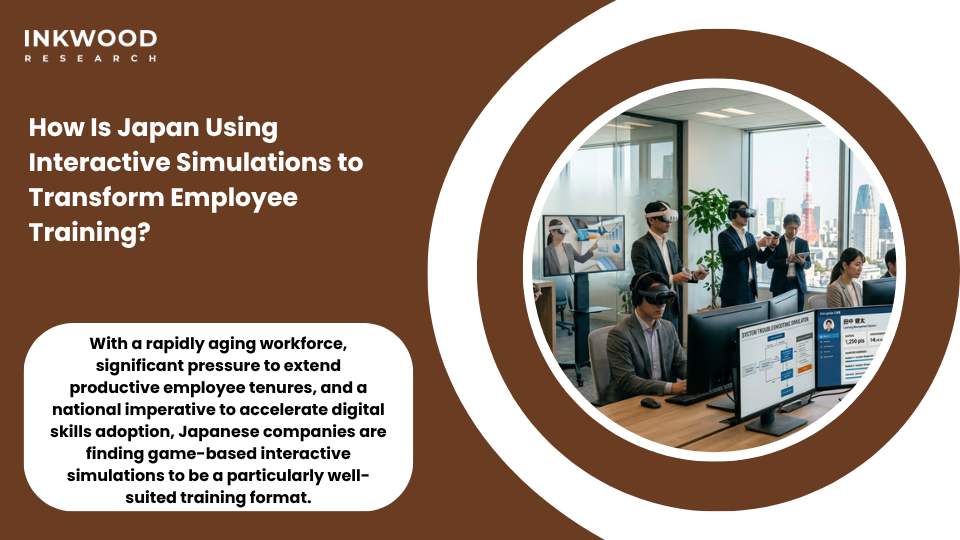
Japan’s approach to the Asia-Pacific gamified corporate training platforms market is deeply shaped by its corporate culture and the specific workforce challenges Japanese enterprises face. With a rapidly aging workforce, significant pressure to extend productive employee tenures, and a national imperative to accelerate digital skills adoption, Japanese companies are finding game-based interactive simulations to be a particularly well-suited training format.
Interactive simulations, which place employees inside realistic scenario environments that mirror actual job contexts, are resonating strongly in Japan’s enterprise training culture for several reasons:
- They preserve the structured, mastery-focused learning approach that Japanese corporate training has traditionally emphasized, while making that structure more engaging.
- They are available in Japanese-language versions that respect local communication norms and business context, addressing a significant barrier that many generic digital learning platforms fail to clear.
- They generate detailed performance data that Japanese enterprises can use for precise competency gap analysis, aligning with the country’s data-driven management culture.
- They work effectively in both onsite and remote delivery contexts, supporting Japan’s gradual but growing hybrid work transition.
Japan’s Gamified Training Growth Story
Japan’s gamified corporate training platforms market growth from US$112.18 million in 2026 to US$677.52 million by 2034 reflects both the depth of unmet demand and the scale of the opportunity that interactive, gamified formats represent in a market where traditional training approaches have been slow to evolve.
Furthermore, Japan’s Ministry of Economy, Trade and Industry (METI) has actively promoted digital human resource development as a national competitiveness priority, creating institutional support that is accelerating enterprise investment in modern gamification tools for employee training. Consequently, Japanese enterprises are increasingly viewing gamified simulation platforms not as an experiment but as a strategic capability infrastructure investment.
What Makes India One of Asia-Pacific’s Most Exciting Gamified Training Markets?
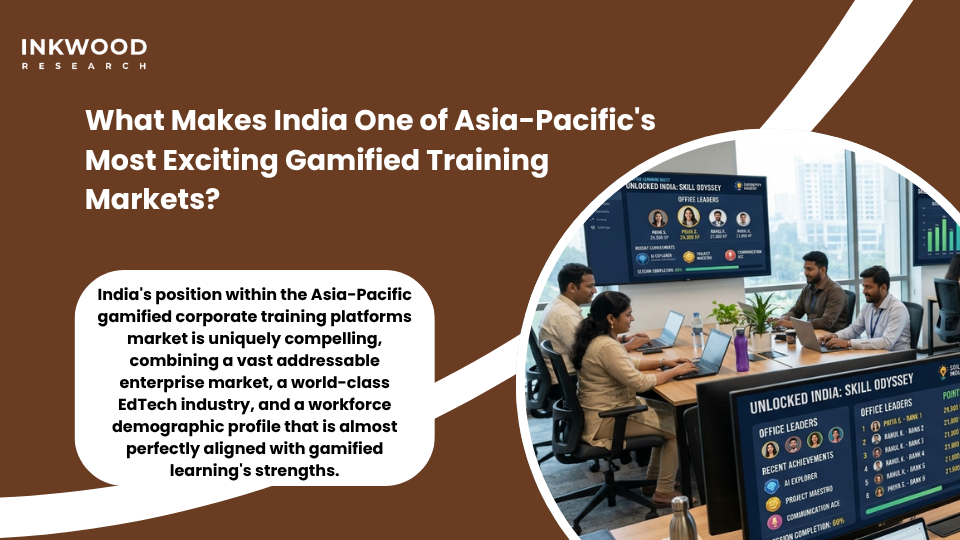
India’s position within the Asia-Pacific gamified corporate training platforms market is uniquely compelling, combining a vast addressable enterprise market, a world-class EdTech industry, and a workforce demographic profile that is almost perfectly aligned with gamified learning’s strengths. Growing from US$115.85 million in 2026 to US$549.09 million by 2034, the Indian gamified corporate training market is one of the most consequential growth stories in the global landscape.
What makes India particularly distinctive is the role of domestic EdTech innovation. Indian platforms are not simply adopting Western gamification approaches; they are developing genuinely novel solutions that address India-specific enterprise training challenges, including multilingual content delivery across over twenty official languages, low-bandwidth mobile optimization for employees in Tier 2 and Tier 3 cities, and culturally relevant scenario design that resonates with India’s diverse workforce.
Top Indian Platforms Transforming Corporate Gamified Training
- Skillsoft India: Extending its global gamified content library with India-specific compliance and leadership training modules, widely adopted across India’s IT and BFSI sectors.
- TalentLMS by Epignosis: Deployed extensively across Indian mid-market enterprises for its intuitive gamified LMS architecture and strong mobile delivery capabilities.
- Edcast (now part of Cornerstone): An AI-driven learning experience platform with strong adoption among India’s technology enterprises, known for its personalized gamified content curation.
- Crediyo and emerging Indian startups: A wave of homegrown gamified learning management systems purpose-built for India’s enterprise market, integrating regional language support with game-mechanics-driven engagement.
Together, these platforms reflect the depth of gamification in the corporate training industry outlook innovation that India is contributing to the broader Asia-Pacific market, and that innovation is increasingly influencing platform development globally.
How Is Australia's Corporate Sector Embracing Gamified Workforce Development?

Australia’s trajectory within the Asia-Pacific gamified corporate training platforms market tells a story of a mature, high-value enterprise market that is adopting gamified training with increasing speed and strategic intent. Growing from US$71.20 million in 2026 to US$395.78 million by 2034, the Australian market is smaller in absolute terms than Japan or India but shows an impressively strong growth rate driven by distinct local dynamics.
Australia’s enterprise training culture has historically been strong but heavily dependent on face-to-face and instructor-led formats. The permanent shift toward hybrid and remote work has disrupted this model substantially, creating genuine demand for corporate learning gamification solutions that deliver consistent training quality across geographically dispersed teams. Australia’s vast geography makes in-person training coordination particularly challenging, and gamified digital platforms directly address this structural barrier.
Australian Industry Sectors Driving Gamified Training Adoption
Several Australian industries are proving especially active in the gamified corporate training market:
- Mining and resources: Safety training gamification is reducing incident rates while improving completion consistency across remote site workforces.
- Financial services: Compliance and regulatory training delivered through gamified platforms is achieving higher engagement than traditional formats while satisfying ASIC and APRA requirements.
- Healthcare: Gamified clinical scenario simulations are supporting continuous professional development for healthcare workers across dispersed regional and rural facilities.
- Retail and hospitality: Microlearning gamification platforms are training large, high-turnover frontline workforces at scale across national chains.
Furthermore, Australia’s National Skills Commission has highlighted the urgency of workforce capability investment across the economy, creating a policy environment that encourages enterprises to adopt modern training technologies. This institutional support is meaningfully reinforcing enterprise investment in gamified training platforms industry analysis solutions across the Australian market.
Which Technologies Are Driving Gamified E-Learning Across Asia-Pacific?
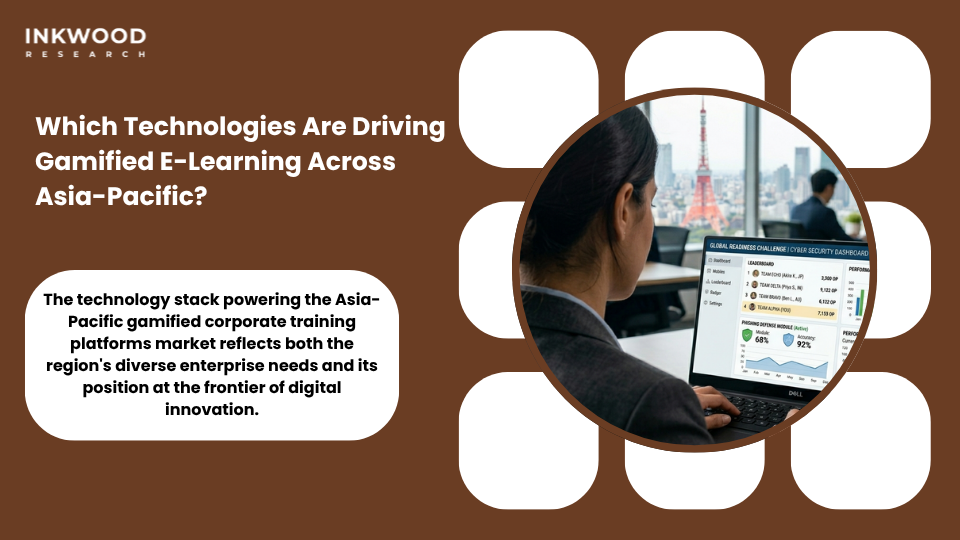
The technology stack powering the Asia-Pacific gamified corporate training platforms market reflects both the region’s diverse enterprise needs and its position at the frontier of digital innovation. Several technologies are proving particularly consequential across Japan, India, and Australia.
- AI-personalization engines: AI-driven training platforms that adapt gamified learning pathways in real time are especially valuable in Asia-Pacific, where workforce diversity in terms of language, skill level, and role context demands highly individualized experiences.
- Mobile-first architecture: With smartphone penetration exceeding PC access in many APAC markets, skill development platforms built for mobile-first delivery are essential for reaching frontline and field-based employees across the region.
- Multilingual content support: Leading gamified LMS platforms for enterprises operating in Asia-Pacific are investing heavily in multilingual content engines that preserve gamification mechanics across language variants without losing engagement quality.
- Immersive simulation technology: Immersive learning tools, including VR safety simulations and AR technical training, are gaining traction in Japan’s manufacturing sector and Australia’s mining industry, where high-risk environments make realistic practice scenarios particularly valuable.
Analytics and behavioral data: Advanced enterprise employee training platforms are surfacing granular learner behavior data that APAC enterprises use to continuously refine gamified program design and demonstrate ROI to senior stakeholders.
Who Are the Key Players Competing in the Asia-Pacific Gamified Training Market?
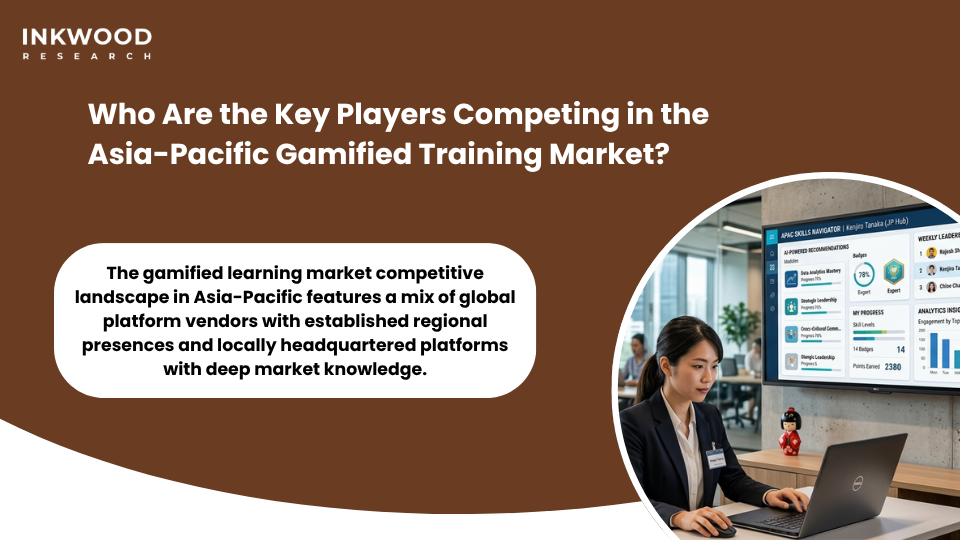
The gamified learning market competitive landscape in Asia-Pacific features a mix of global platform vendors with established regional presences and locally headquartered platforms with deep market knowledge. Understanding this competitive dynamic is important for enterprises evaluating the best gamified corporate training solutions for APAC deployment.
Cornerstone OnDemand
Cornerstone OnDemand has established strong enterprise penetration across Japan and Australia through its comprehensive gamified LMS capabilities and deep integration with enterprise HR systems. Its skills ontology updates have made its gamified learning pathways more precisely targeted to specific capability frameworks, a feature that resonates particularly well with Japanese enterprises’ structured development culture.
SAP SuccessFactors
SAP SuccessFactors leverages its dominant position in enterprise HR software across the APAC region to deliver gamified training as an integrated component of broader talent management workflows. Its AI-powered skill inference capabilities, which automatically recommend personalized gamified learning pathways based on role and performance data, have strengthened its value proposition for large enterprises managing complex workforce development programs.
Docebo
Docebo has built growing traction across Australia and India’s mid-market and enterprise segments through its intuitive gamified interface and powerful AI content curation. Its strong mobile delivery capabilities and flexible content import options make it particularly well-suited to the varied technology environments found across Asia-Pacific enterprises.
Regional and Emerging Players
Alongside global vendors, a growing ecosystem of regionally headquartered platforms is competing effectively in the Asia-Pacific gamified corporate training platforms market. Indian EdTech platforms purpose-built for enterprise gamification, Japanese simulation specialists, and Australian compliance-focused gamified training providers are all finding enterprise clients who value local market knowledge alongside platform capability. This regional competitive layer is enriching the gamified corporate training market forecast significantly and raising overall innovation standards.
Key Takeaways
- Japan’s gamified corporate training platforms market is projected to grow from US$112.18 million to US$677.52 million by 2034, driven by interactive simulation adoption, METI’s digital workforce agenda, and the pressures of an aging workforce.
- India’s market, growing from US$115.85 million to US$549.09 million, is uniquely shaped by domestic EdTech innovation, with platforms developing genuinely novel solutions for multilingual, mobile-first enterprise training.
- Australia’s growth from US$71.20 million to US$395.78 million reflects the disruption of traditional face-to-face training models by hybrid work and the geographic scale advantages of gamified digital platforms.
- AI personalization, mobile-first architecture, multilingual content support, and social gamification mechanics are the most impactful technology trends across the Asia-Pacific gamified corporate training platforms market.
- APEC’s workforce development priorities and Japan’s METI digital skills agenda are providing institutional policy backing that is reinforcing enterprise investment in gamified training infrastructure across the region.
- Generative AI content creation and team-based gamification mechanics are the two most consequential recent innovations reshaping enterprise gamified training across Japan, India, and Australia.
Conclusion:
The Asia-Pacific gamified corporate training platforms market is not a single story; it is three distinct and deeply compelling ones unfolding simultaneously across Japan, India, and Australia. Together, these markets are reshaping what enterprise workforce development looks like across the region, and the pace of innovation is accelerating. For organizations seeking to build workforce capability at scale, gamified learning platforms for businesses are transitioning from promising experiments into essential infrastructure.
Inkwood Research delivers the market intelligence and strategic analysis needed to navigate the gamification in corporate training market across Asia-Pacific with confidence.
Connect with our team to explore how our insights can support your strategy in this dynamic and rapidly evolving market.
Frequently Asked Questions
How large is the Asia-Pacific gamified corporate training platforms market?
Japan reaches US$677.52 million by 2034, India US$549.09 million, and Australia US$395.78 million, reflecting strong regional growth across all three markets.
Why is Japan's gamified training market growing so rapidly?
Interactive simulations suit Japan’s mastery-focused training culture, while METI’s digital skills agenda and workforce aging pressures are together accelerating enterprise adoption significantly.
What distinguishes India's gamified corporate training market from other APAC markets?
India’s domestic EdTech innovation, multilingual platform capabilities, and mobile-first delivery for Tier 2 and Tier 3 city workforces make it uniquely dynamic within Asia-Pacific.
Which industries in Australia are most actively adopting gamified training?
Mining, financial services, healthcare, and retail are Australia’s most active adopters, driven by safety compliance needs, regulatory requirements, and dispersed workforce training challenges.
How does social gamification differ from individual gamification in corporate training?
Social gamification uses team challenges and peer learning rewards rather than individual leaderboards, showing stronger engagement in collective work cultures like Japan and India.
What role does AI play in the Asia-Pacific gamified corporate training platforms market?
AI enables personalized learning pathways, multilingual content generation, and rapid training deployment, making gamified platforms scalable and cost-effective across Asia-Pacific’s diverse enterprise environments.