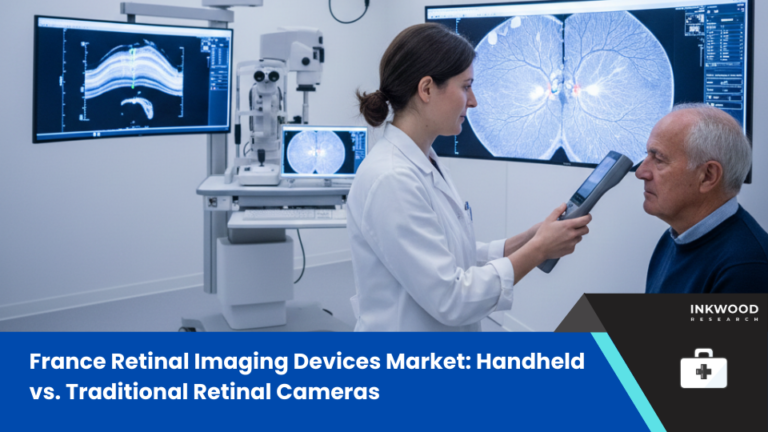
This analysis is brought to you by Inkwood Research, a leading market intelligence firm specializing in European medical technology, ophthalmology equipment markets, and clinical adoption patterns across Western Europe. Our research team combines extensive experience analyzing the France retinal imaging devices market, comparative device performance studies, and healthcare provider preferences throughout France, Germany, the UK, and broader European Union markets. Based on our proprietary research methodologies and strategic partnerships with medical device manufacturers, hospital networks, ophthalmology professional organizations, and European regulatory bodies, we deliver actionable insights that empower strategic decision-making for global enterprises navigating France’s sophisticated healthcare system and retinal imaging technology adoption dynamics.
TLDR
French ophthalmologists navigate complex decisions between handheld retinal imaging devices and traditional tabletop retinal imaging systems based on clinical context, patient populations, and diagnostic requirements. Comparative studies reveal that advanced portable devices achieve equivalent image quality to conventional systems in many applications. Nevertheless, workflow efficiency, operator training, and specific diagnostic needs influence equipment choices. The France retinal imaging devices market demonstrates sophisticated adoption patterns where clinicians strategically deploy both technologies rather than replacing one with the other completely.
Ophthalmology practice administrators evaluating equipment purchases, hospital procurement specialists comparing diagnostic imaging options, retinal specialists seeking portable screening solutions, and emergency department directors implementing point-of-care diagnostics will find this essential. Additionally, telehealth program coordinators expanding retinal screening access, medical device distributors serving European markets, and clinical decision-makers balancing cost with diagnostic capability benefit from understanding French clinicians’ evidence-based preferences and practical implementation experiences.
The French Healthcare Context
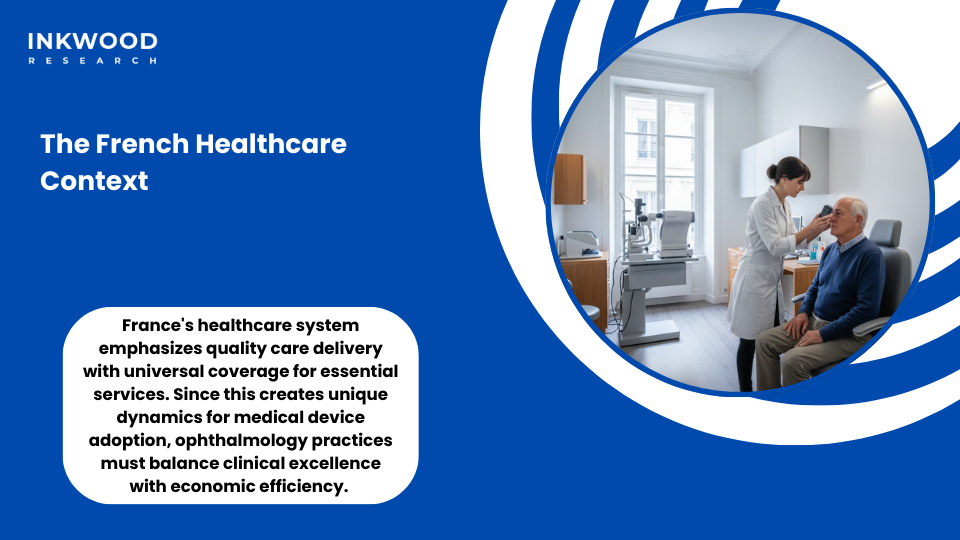
France’s healthcare system emphasizes quality care delivery with universal coverage for essential services. Since this creates unique dynamics for medical device adoption, ophthalmology practices must balance clinical excellence with economic efficiency. Consequently, equipment purchasing decisions reflect careful consideration of performance, workflow, and cost-effectiveness.
Healthcare Infrastructure Realities
French hospitals and clinics face space constraints in urban centers where real estate costs remain high. In this regard, traditional tabletop retinal imaging systems require dedicated rooms with specific environmental controls. These spatial requirements become problematic for practices operating in historic buildings or shared medical facilities. Moreover, aging infrastructure complicates retrofitting for modern diagnostic equipment.
Conversely, handheld retinal imaging devices offer flexibility that addresses spatial limitations. These portable systems operate in standard examination rooms without extensive modifications. Moreover, clinicians can move devices between locations as patient volumes fluctuate. This adaptability proves valuable in French healthcare contexts where efficiency drives operational decisions.
Patient populations in France increasingly include elderly individuals with mobility limitations. In this regard, traditional fundus photography requires patients to position themselves at stationary cameras, which can be challenging for those with arthritis, Parkinson’s disease, or frailty. Plus, portable devices accommodate patients who cannot comfortably maintain positions required by table-mounted systems.
Comparative Performance Studies
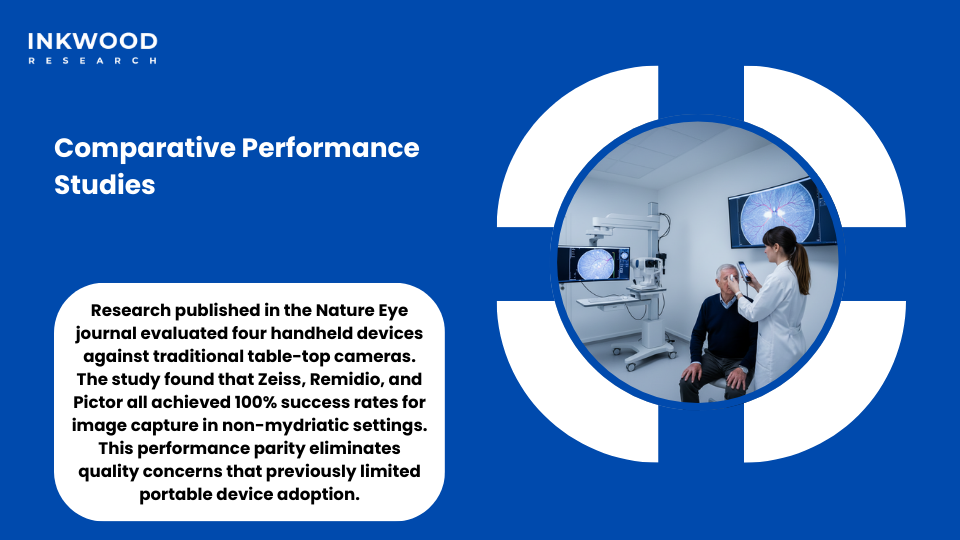
Image Quality Assessment
Rigorous comparative studies provide evidence informing French clinicians’ preferences. Research published in the Nature Eye journal evaluated four handheld devices against traditional table-top cameras. Two handheld devices, Remidio and Pictor, demonstrated equivalent image acquisition success and quality compared to Zeiss table-top systems.
The study found that Zeiss, Remidio, and Pictor all achieved 100% success rates for image capture in non-mydriatic settings. This performance parity eliminates quality concerns that previously limited portable device adoption. As a result, clinicians no longer sacrifice diagnostic capability when choosing handheld options for specific applications.
Image gradeability assessments revealed interesting findings. Ophthalmologists masked to device types successfully graded optic disc morphology and vascular abnormalities from both handheld and traditional systems. Moreover, agreement between clinician estimates of cup-to-disc ratios remained consistent across device categories. These results validate portable systems for critical diagnostic assessments.
Patient Experience Factors
Patient preference data from comparative studies shows compelling patterns. Participants rated Remidio and Pictor as having similar or higher acceptability compared to table-top devices. Additionally, comfort scores remained high across all three top-performing systems. However, brightness levels varied significantly between devices.
Some handheld cameras using constant white light sources proved significantly brighter and consequently less comfortable than alternatives. Accordingly, devices employing infrared or near-infrared guidance systems with optimized flash timing minimized pupil constriction. This technical distinction separates high-performing portable systems from less sophisticated alternatives.
Examination length perceptions influenced patient satisfaction. Faster image acquisition with handheld devices improved overall experience, particularly for anxious patients or children. Further, the ability to complete screenings quickly without prolonged positioning enhances patient cooperation and reduces examination stress.
Clinical Applications and Use Cases

Emergency Department Implementation
French emergency departments increasingly deploy portable fundus photography systems for rapid assessment of vision-threatening conditions. According to research findings, fundus photography in emergency settings not only augments optic disc edema diagnosis but also changes final diagnoses and subsequent management plans.
Emergency physicians require imaging solutions that operate without dedicated spaces or specialist technicians. In this regard, handheld fundus cameras meet these requirements while providing diagnostic-quality images for ophthalmology consultation. Speed becomes critical in emergency contexts where delayed diagnosis risks permanent vision loss.
The advent of tele-ophthalmology expands emergency department capabilities. Aligning with this, portable devices capture images that ophthalmologists review remotely, enabling expert consultation regardless of time or location. This model proves particularly valuable for hospitals in regions with limited on-site specialist coverage.
Pediatric and Geriatric Applications
Children and elderly patients present unique imaging challenges that favor handheld approaches. Pediatric patients often cannot cooperate with traditional fundus camera positioning requirements. Plus, bright lights frighten young children, reducing examination success rates. Conversely, low-intensity handheld devices with rapid capture capabilities improve pediatric imaging feasibility.
Geriatric populations with mobility limitations benefit similarly from portable approaches. Plus, bedridden patients in nursing facilities or those receiving home healthcare can undergo screenings without hospital transport. This accessibility prevents delayed diagnoses caused by logistical barriers to traditional office visits.
Retinopathy of prematurity (ROP) screening represents another specialized application. In this regard, portable devices enable bedside imaging in neonatal intensive care units where transporting fragile infants poses risks. French hospitals adopt handheld systems specifically for ROP programs, complementing rather than replacing traditional equipment.
Primary Care Integration
Primary care physicians increasingly participate in diabetic retinopathy screening programs throughout France. Traditional table-mounted systems prove impractical for most general practice offices. However, portable devices enable screening during routine diabetes management visits without specialist referrals.
This integrated approach improves screening compliance rates significantly. Plus, patients complete examinations during existing appointments rather than scheduling separate ophthalmology visits. Consequently, early detection rates improve while reducing system-wide healthcare costs associated with late-stage complications.
Market Dynamics in France
Market Size and Growth
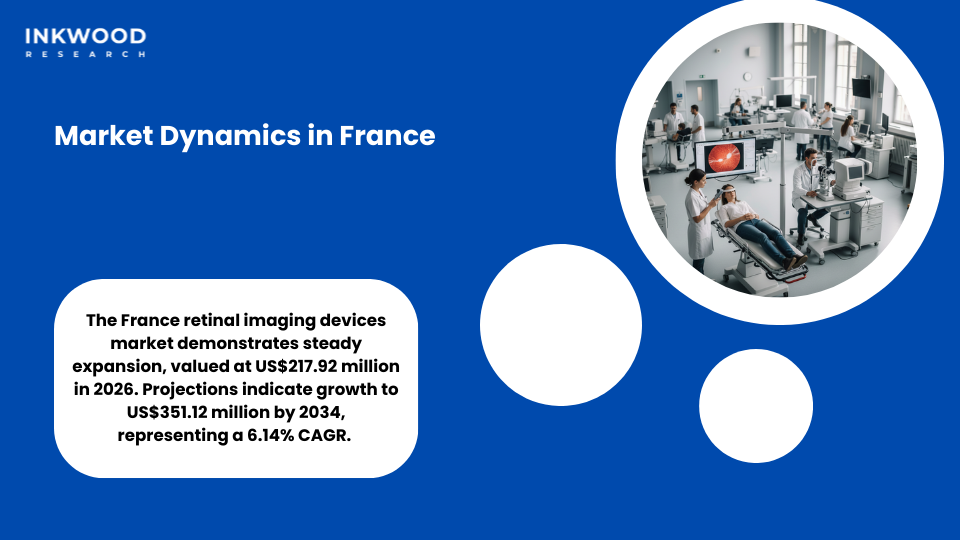
The France retinal imaging devices market demonstrates steady expansion, valued at US$217.92 million in 2026. Projections indicate growth to US$351.12 million by 2034, representing a 6.14% CAGR. This growth reflects aging demographics, rising diabetes prevalence, and expanding screening programs.
Market maturity in France differs from emerging markets. French healthcare providers already possess an established diagnostic infrastructure. Therefore, growth stems primarily from equipment replacement cycles and technology upgrades rather than first-time installations. Moreover, this dynamic favors manufacturers offering superior performance or workflow advantages.
Reimbursement Considerations
France’s national healthcare system provides universal coverage for medically necessary services. Reimbursement policies significantly influence device adoption patterns. As a result, equipment that enables more efficient care delivery attracts attention from cost-conscious healthcare administrators.
Portable devices potentially reduce per-examination costs through improved technician efficiency. Single operators can conduct screenings in various locations without extensive setup requirements. Subsequently, these workflow improvements justify investments even when upfront device costs exceed traditional alternatives.
Competitive Landscape
Established European manufacturers dominate the French market. For instance, Zeiss, Topcon, and Nidek maintain strong positions through legacy relationships with major hospital networks. Their tabletop retinal imaging systems set quality standards that new entrants must match or exceed.
Nevertheless, specialized portable device manufacturers gain market share in specific segments. Volk Optical’s Pictor Plus achieves recognition for emergency department and mobile screening applications. Also, Optomed’s handheld cameras penetrate primary care practices seeking affordable screening capabilities.
Technology Preferences and Trends
Hybrid Deployment Strategies
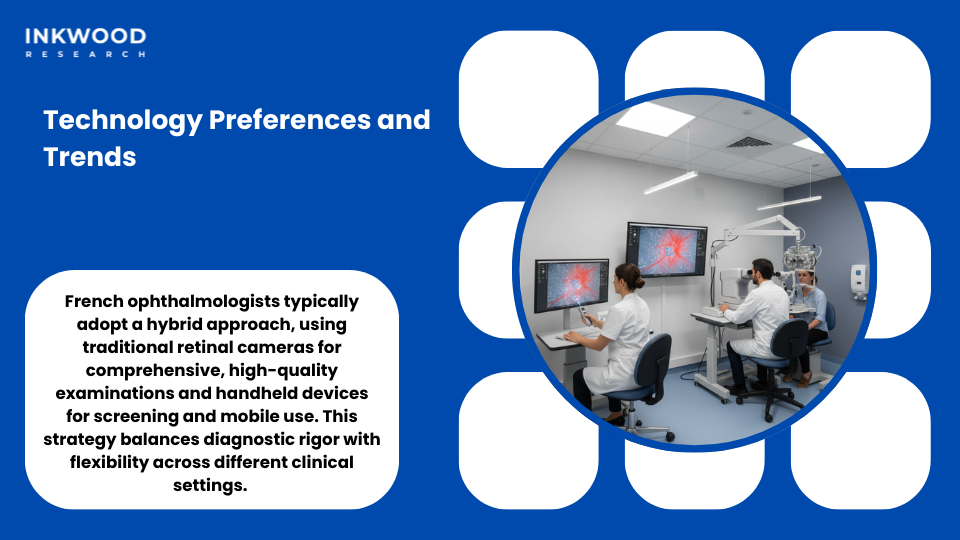
French ophthalmologists rarely view handheld versus traditional cameras as either/or decisions. Instead, sophisticated practices deploy both technologies strategically. Traditional systems remain preferred for comprehensive examinations requiring maximum image quality and extensive documentation.
Portable devices complement traditional equipment for screening applications, home visits, and emergency assessments. This hybrid approach optimizes workflow while maintaining diagnostic standards. Investment in both technologies reflects recognition that different clinical contexts demand different tools.
Non-Mydriatic Capabilities
Non-mydriatic imaging—capturing retinal images without pupil dilation—represents critical functionality for French clinicians. Dilation requires time, causes temporary vision impairment, and complicates patient schedules. Therefore, devices offering high-quality non-mydriatic imaging command premium prices.
Advanced portable systems achieve non-mydriatic imaging through infrared guidance and optimized illumination. Plus, studies confirm that devices with infrared or near-infrared capabilities demonstrate superior success rates. This technical specification heavily influences French purchasing decisions.
Integration with Digital Workflows
French healthcare increasingly emphasizes electronic health records and integrated clinical systems. In this regard, retinal imaging devices must seamlessly transmit images to picture archiving and communication systems (PACS). Cloud connectivity enables remote consultations and longitudinal patient monitoring.
On the other hand, both traditional and portable systems offer digital integration capabilities. However, wireless transmission from handheld devices provides workflow advantages. Technicians capture images that instantly appear in patient records without manual uploading. This efficiency resonates with French clinicians managing high patient volumes.
Leading Manufacturers and Products

Zeiss: Quality Standard-Setter
- Carl Zeiss Meditec maintains market leadership through comprehensive product portfolios spanning traditional and portable categories. Their Visucam series establishes quality benchmarks that competitors reference. The VisuScout 100 handheld camera features a 5-megapixel sensor with a 40-degree field of view, meeting ISO 10940 fundus camera standards.
- Zeiss products command premium pricing justified by superior optics, robust construction, and extensive service networks. Additionally, French hospitals preferring established relationships with proven vendors often default to Zeiss despite higher acquisition costs. Brand reputation and reliability outweigh price considerations for many institutional buyers.
Volk Optical: Portable Specialist
- Volk Optical concentrates on handheld imaging solutions, developing specialized expertise in portable applications. Their Pictor Plus achieves recognition for image quality comparable to traditional systems. Aligning with this, comparative studies demonstrate that Pictor and Remidio achieve similar feasibility, image quality, gradeability, and diagnostic sensitivity to Zeiss table-top cameras.
- The Pictor Prestige adds anterior segment imaging capabilities, addressing broader diagnostic needs. This versatility appeals to practices seeking multifunction devices. Image quality assessment features provide instant feedback on brightness, focus, and reflections, improving capture success rates for less experienced operators.
Topcon: Comprehensive Solutions
- Topcon’s Signal handheld camera enables non-mydriatic retinal examinations with a 50 x 40-degree field of view. Moreover, the device features nine fixation targets for central and peripheral imaging, improving examination completeness. Autofocus functions speed image acquisition, which is a critical advantage in busy clinical environments.
- Approximately five hours of continuous operation between charges supports mobile screening programs, and subsequently, images are uploaded to cloud storage or saved in device memory, providing flexibility for varied connectivity environments. Low brightness and intensity levels prove beneficial when examining children who fear bright examination lights.
Optomed: Innovation Leader
- Optomed’s Lumo flagship product brings enhanced usability and adaptability to retinal imaging. The Finnish manufacturer pioneered AI-powered handheld cameras that transform routine eye screenings into comprehensive health insights. Their devices detect diabetic retinopathy, neurological conditions, and various eye diseases anywhere, anytime.
- Optomed positions portable devices as tools for comprehensive health assessment beyond traditional ophthalmology. This broader value proposition attracts primary care and internal medicine practices. Early detection capabilities fitting in one’s hand appeal to the French healthcare system’s preventive medicine emphasis.
Key Takeaways
- French ophthalmologists’ preferences reflect a sophisticated understanding of each technology’s strengths and limitations. Moreover, traditional tabletop retinal imaging systems remain preferred for comprehensive examinations requiring maximum image quality, extensive documentation, and specialized diagnostic procedures. These systems continue dominating hospital ophthalmology departments and specialized retinal clinics.
- Handheld retinal imaging devices earn acceptance for screening applications, emergency assessments, pediatric/geriatric populations, and mobile services. Plus, advanced portable systems achieve image quality and diagnostic accuracy comparable to traditional equipment for many applications. This performance parity eliminates quality-based objections to portable adoption.
- Hybrid deployment strategies optimize the French practices’ diagnostic capabilities. Rather than replacing traditional systems, portable devices expand service locations and patient populations served. Consequently, this complementary approach maximizes return on both technology investments.
- Operator training significantly influences handheld device performance. Devices with intuitive interfaces, real-time quality feedback, and optimized illumination reduce operator dependency. Nevertheless, proper training remains essential for consistent high-quality image capture with any system.
- The global retinal imaging devices market benefits from comparative research establishing portable device capabilities. Aligning with this, French clinicians’ evidence-based adoption patterns demonstrate that context-appropriate technology selection, rather than universal preferences, optimizes patient care while managing costs effectively.
Conclusion:
French ophthalmologists’ balanced approach to handheld retinal imaging devices versus traditional systems provides valuable lessons for healthcare systems worldwide. Additionally, clinical evidence demonstrates that advanced portable devices achieve comparable performance to table-mounted systems in many applications. However, specific diagnostic requirements, patient populations, and clinical workflows influence optimal technology choices.
The France retinal imaging devices market continues evolving as manufacturers improve portable device capabilities while traditional systems incorporate digital workflow enhancements. Moreover, market growth at 6.14% CAGR through 2034 reflects equipment modernization rather than dramatic technology shifts. This measured pace enables French healthcare providers to thoughtfully integrate new capabilities.
Neither technology completely supplants the other. Instead, sophisticated practices deploy both strategically, matching tools to tasks. This pragmatic approach maximizes diagnostic capabilities while optimizing resource utilization—hallmarks of France’s healthcare system philosophy.
Considering equipment investments for your ophthalmology practice or healthcare facility?
Our team at Inkwood Research provides detailed competitive analysis, technology comparisons, and strategic recommendations tailored to your specific clinical and economic requirements. Contact us today to discover how French adoption patterns can inform your technology selection process and optimize your ophthalmic imaging devices portfolio for both quality and efficiency.
Frequently Asked Questions
Do handheld retinal cameras require more operator training than traditional systems?
Studies indicate that handheld devices with infrared guidance, real-time quality feedback, and optimized flash timing reduce operator dependency compared to basic portable systems. However, achieving consistent high-quality images with any handheld device requires proper training. Devices lacking these features demonstrate higher failure rates, particularly with inexperienced operators. Organizations implementing portable systems should invest in comprehensive training programs.
Can portable fundus cameras perform all diagnostic functions of traditional table-mounted systems?
Advanced portable devices achieve diagnostic parity with traditional systems for many screening and assessment applications, including diabetic retinopathy detection, optic disc evaluation, and vascular morphology analysis. However, specialized procedures requiring extremely wide fields of view, ultra-high resolution, or specific imaging modalities may still necessitate traditional equipment. Practice-specific needs should guide technology selection.
How do French ophthalmologists balance cost and quality when selecting retinal imaging equipment?
French clinicians prioritize diagnostic capability while considering the total cost of ownership, including purchase price, maintenance, workflow efficiency, and reimbursement rates. Devices enabling more efficient screening or expanding service locations justify higher upfront costs through improved patient access and throughput. Quality-focused healthcare culture prevents pure price-based decisions, but economic efficiency remains important for sustainable operations.