Table of Contents
This analysis is brought to you by Inkwood Research, a distinguished market intelligence firm specializing in European energy transition and renewable integration sectors. Our research team combines decades of experience analyzing flow battery technologies, European Green Deal implementations, and cross-border grid infrastructure developments. Based on our proprietary research methodologies and extensive partnerships with EU regulatory bodies, national energy agencies, and pioneering technology developers, we deliver actionable insights that empower strategic decision-making for global enterprises navigating Europe’s decarbonization pathways and advanced energy storage markets.
TLDR
Europe’s flow battery market reached $109.20 million in 2025 and projects explosive growth to $402.92 million by 2032 at a vigorous CAGR of 20.50%. This analysis examines how flow battery technology enables the EU’s ambitious net-zero targets while addressing unprecedented grid challenges. Learn why European utilities and policymakers consider vanadium redox flow batteries essential infrastructure for achieving 2030 decarbonization goals. Discover strategic insights on renewable energy storage deployment, regulatory frameworks, and competitive dynamics shaping Europe’s sustainable energy storage landscape.
European energy policymakers, grid operators, renewable project developers, and infrastructure financiers will discover critical intelligence throughout this comprehensive analysis. Battery technology companies, cleantech investors, and sustainability officers seeking to understand long-duration energy storage solutions in Europe’s regulatory environment will find actionable market intelligence. Climate strategists, utility planners, and government officials focused on achieving net-zero commitments through grid-scale batteries and industrial energy storage systems will gain valuable perspectives on market evolution and technology deployment strategies.
Europe’s Decarbonization Imperative: The Flow Battery Solution
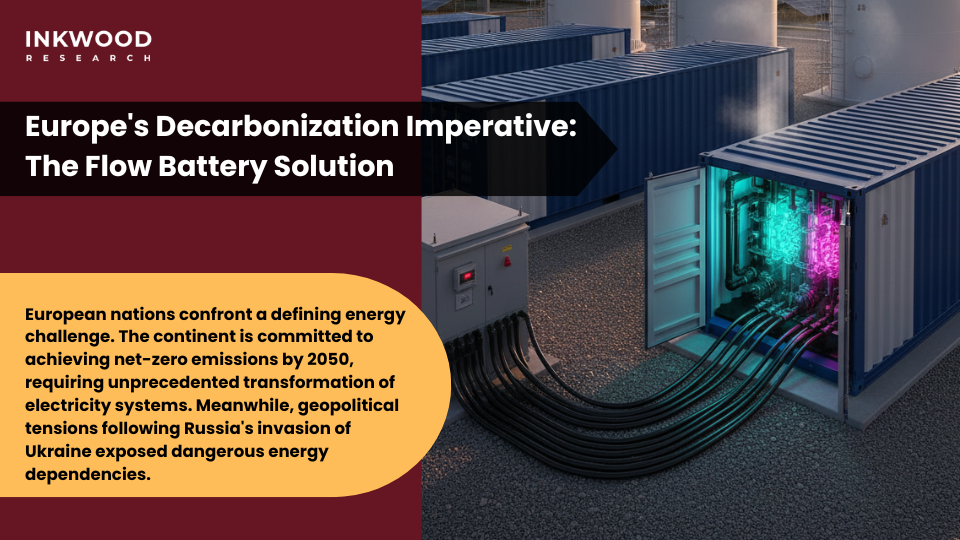
European nations confront a defining energy challenge. The continent is committed to achieving net-zero emissions by 2050, requiring unprecedented transformation of electricity systems. Meanwhile, geopolitical tensions following Russia’s invasion of Ukraine exposed dangerous energy dependencies. Simultaneously, aging nuclear facilities close while coal plants shut down ahead of schedule. Against this backdrop, wind and solar capacity surges, yet intermittency threatens grid stability.
The Europe flow battery market achieved $109.20 million valuation in 2025, based on our comprehensive analysis. Remarkably, forecasts project this sector will expand to $402.92 million by 2032, demonstrating an impressive CAGR of 20.50% throughout the forecast years. This substantial flow battery market trends acceleration reflects strategic imperatives around energy security, climate commitments, and infrastructure modernization across the European Union and associated states.
European grid operators face unique complexities compared to other global regions. Cross-border electricity flows require coordination among dozens of transmission system operators. Dense population centers sit near major renewable installations, demanding sophisticated energy storage solutions for load balancing. Furthermore, stringent safety regulations and sustainability standards drive preference for technologies with superior environmental credentials. These factors collectively favor flow battery technology adoption over alternatives with shorter lifespans or higher environmental impacts.
EU Policy Architecture Enabling Storage Deployment
Green Deal Industrial Plan Foundations
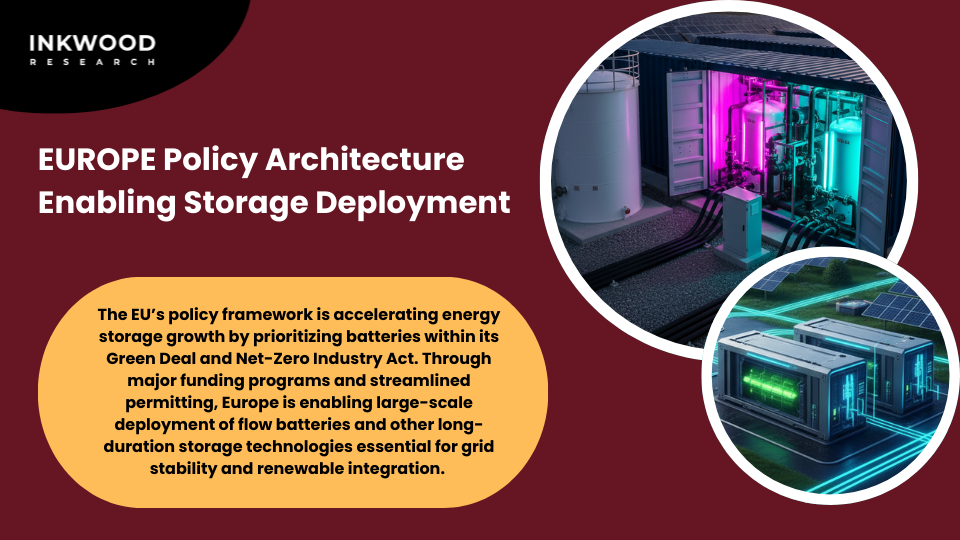
The European Green Deal established comprehensive frameworks for accelerating sustainable energy storage deployment across member states. Launched in 2020, this policy suite targets net-zero greenhouse gas emissions by 2050 while creating competitive advantages in clean technologies. Subsequently, the Green Deal Industrial Plan of 2023 presented roadmaps for boosting EU net-zero industry capacity. Battery technologies received priority status within these frameworks, recognizing their critical role in enabling renewable integration and grid stability.
Funding mechanisms support flow battery manufacturers through multiple channels. The Innovation Fund allocated €4.6 billion for net-zero technologies and electric vehicle battery manufacturing during 2024-2025. These resources target projects demonstrating innovation, emission reduction potential, and commercial scalability. Additionally, the European Investment Bank committed €1.8 billion specifically toward battery value chain investments. Such substantial financial support transforms project economics for grid-scale batteries, making deployments viable even before technologies reach full cost competitiveness.
Net-Zero Industry Act Implementation
The Net-Zero Industry Act, formally adopted in June 2024, establishes ambitious targets requiring the EU to produce at least 40% of its clean technology needs domestically by 2030. This legislation specifically designates battery and storage technologies as strategic priorities, receiving accelerated permitting and streamlined regulatory processes. Consequently, flow battery deployment projects benefit from shortened approval timelines that previously extended for years in some jurisdictions.
The Act creates regulatory sandboxes allowing innovative energy storage solutions to operate under flexible conditions for testing and validation. These frameworks reduce barriers facing novel technologies like organic and iron redox flow batteries that lack extensive operational histories. Moreover, the Net-Zero Europe Platform coordinates implementation across member states while gathering stakeholder input. This coordination mechanism ensures consistent approaches toward long-duration energy storage solutions while respecting national differences in energy systems and regulatory traditions.
Battery Regulations and Circular Economy Requirements
Europe’s comprehensive Battery Regulation, replacing the outdated 2006 Batteries Directive, recognizes batteries as strategic imperatives in clean energy transitions. This framework addresses sustainability across entire lifecycles, from raw material sourcing through end-of-life management. Starting August 2025, battery suppliers must adopt due diligence policies covering social and environmental risks throughout supply chains. This requirement favors vanadium flow batteries due to their high recyclability rates approaching 99% when materials are properly separated.
Battery passports will become mandatory in 2026, requiring detailed documentation of performance, composition, and recycling content. These digital credentials enhance transparency while supporting circular economy objectives. Additionally, the regulation establishes ambitious collection targets, requiring 63% portable battery collection by 2027 and 73% by 2030. While primarily targeting consumer batteries, these frameworks create infrastructure benefiting industrial energy storage solutions. Recycling efficiency targets mandate 80% recovery for nickel-cadmium and 75% for lead-acid by 2025, with stricter standards following in 2030. Such a comprehensive regulatory architecture positions Europe as the global leader in sustainable energy storage standards.
Technology Leadership and Manufacturing Initiatives
European Battery Alliance Achievements
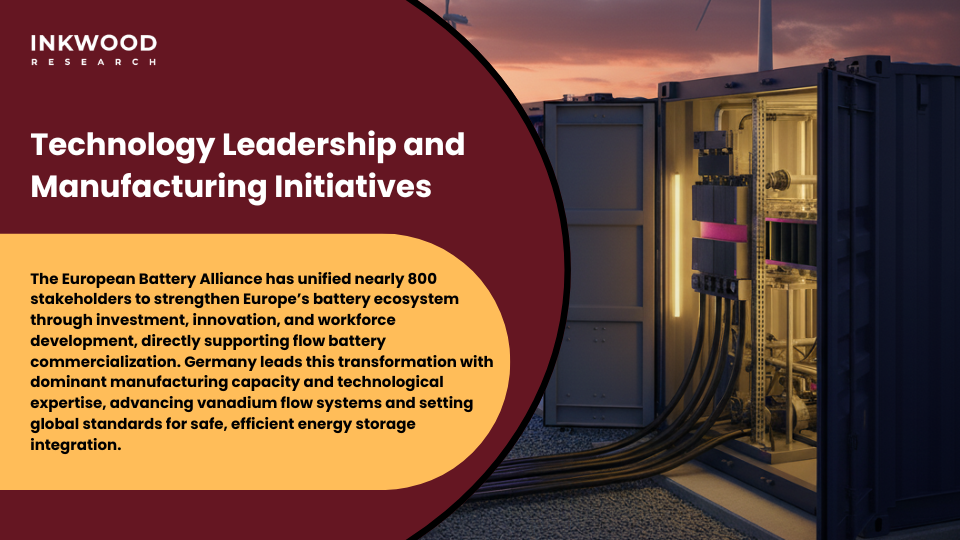
The European Battery Alliance, launched in 2017, has grown from 120 initial stakeholders to nearly 800 participants spanning the complete battery value chain. This industrial development program aims to capture €250 billion annual market opportunities projected for 2025. The Alliance coordinates activities from raw material extraction through recycling, creating pan-European capabilities that reduce dependencies on Asian suppliers. Since 2022 alone, participants have developed 111 major battery projects across the EU, representing over €127 billion in total investment.
These coordinated efforts advance flow battery technology innovations through shared research initiatives and standardization efforts. The EBA Academy addresses critical skills shortages by training thousands of workers in battery-specific competencies. This workforce development parallels similar academies established under the Net-Zero Industry Act for solar, hydrogen, and wind technologies. Furthermore, the Alliance facilitates partnerships between research institutions, equipment manufacturers, and end users. Such collaborations accelerate the translation of laboratory breakthroughs into commercial flow battery market applications.
German Leadership in Battery Manufacturing
Germany leads European flow battery manufacturers with a projected production capacity of 353.5 GWh by 2030, substantially ahead of Hungary’s 215.3 GWh and France’s 174.5 GWh. This manufacturing concentration reflects Germany’s automotive industry expertise and substantial government support for battery technology development. One in four electric vehicles produced in Europe during the coming years will incorporate German-made batteries, demonstrating the country’s commitment to battery supply chain leadership.
German companies and research institutions drive breakthroughs in vanadium redox flow battery market technologies. Engineering firms develop advanced stack designs, improving power density while reducing material costs. Additionally, German safety standards influence global best practices, particularly for stationary industrial energy storage systems deployed near residential areas. The country’s renewable energy transition experience, known as Energiewende, provides real-world testing grounds for long-duration energy storage solutions integrated with high renewable penetration grids.
Cross-Border Grid Challenges and Storage Solutions
Managing Continental Electricity Flows
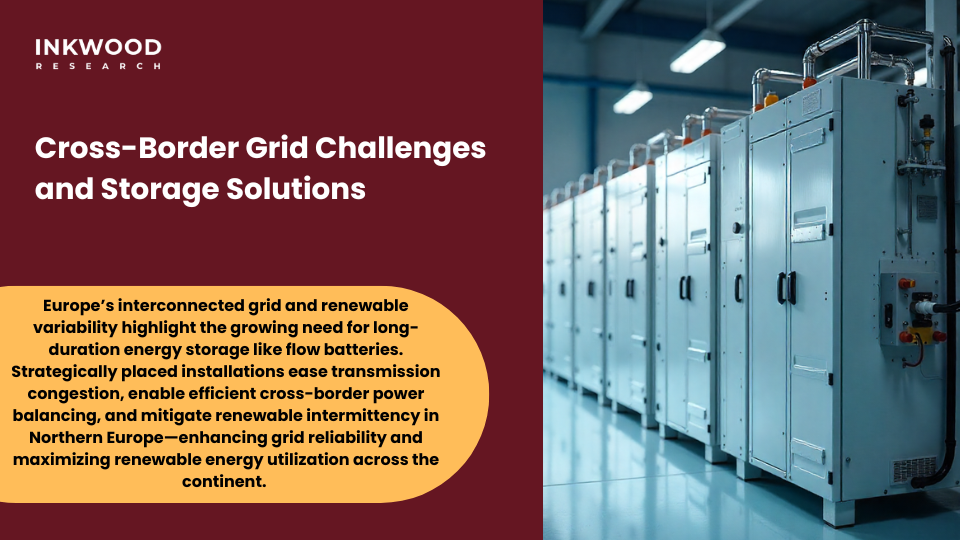
Europe’s interconnected transmission system creates unique requirements for grid energy storage solutions. Power flows continuously across borders as weather patterns shift renewable generation. German wind farms export electricity southward when production exceeds local demand. Spanish solar installations supply northern neighbors during peak generation periods. However, transmission constraints frequently cause curtailment of renewable generation, wasting clean energy capacity. Strategically deployed flow batteries for grid applications can alleviate these bottlenecks by storing surplus generation near sources and discharging when transmission capacity becomes available.
Cross-border coordination requires sophisticated forecasting and real-time management systems. Transmission system operators across Europe collaborate through ENTSO-E, coordinating operations and planning infrastructure investments. Nevertheless, national interests sometimes conflict with continental optimization. Large-scale energy storage located at strategic grid interconnection points can smooth these tensions by providing flexibility that accommodates both local and system-wide needs. Flow battery installations at border crossings enable more efficient utilization of existing transmission infrastructure without requiring expensive line upgrades.
Addressing Renewable Intermittency in Northern Europe
Northern European nations face distinctive challenges from renewable intermittency patterns. Scandinavian hydropower provides flexible generation, yet seasonal variations create extended low-production periods. Offshore wind farms in the North Sea generate enormous output during storms but produce little during calm weather. These variability patterns demand renewable energy storage systems capable of multi-day discharge durations. Traditional batteries discharge within hours, proving inadequate for weather-driven intermittency spanning days or weeks.
Flow battery technology addresses these requirements through scalable tank designs that economically extend discharge duration. Norwegian utilities evaluate flow batteries for island communities transitioning away from diesel generation. Danish grid operators test systems managing offshore wind variability while providing ancillary services. Swedish industrial facilities deploy storage, reducing demand charges while maintaining operations during grid disturbances. These diverse applications demonstrate flow battery efficiency across varied use cases and climatic conditions throughout Northern Europe.
Leading European Companies and Strategic Partnerships
Invinity Energy Systems’ European Projects
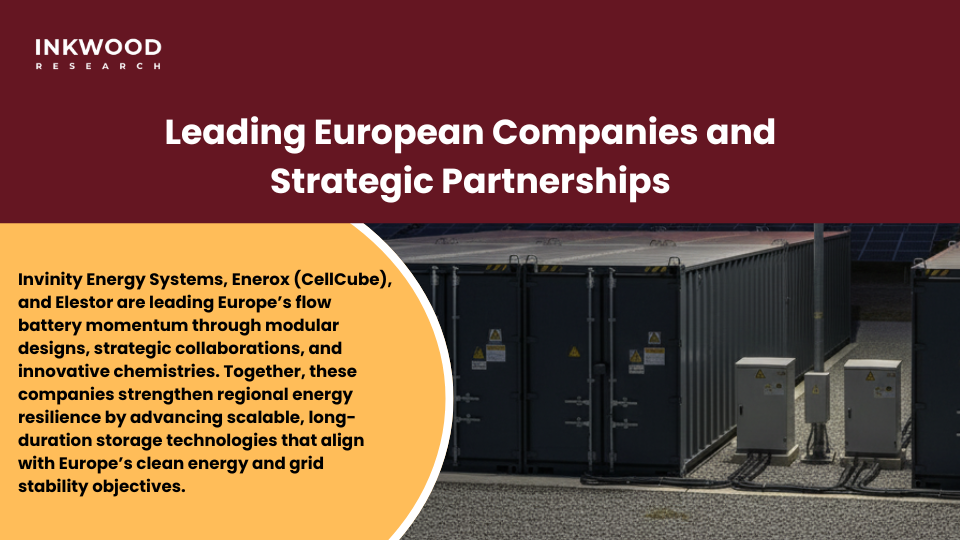
Invinity Energy Systems, headquartered in the United Kingdom, maintains a strong presence across European flow battery market segments. The company announced multiple project deployments during 2024-2025, including installations supporting electric vehicle charging infrastructure. Their VS3 next-generation system incorporates improvements in energy density and operational efficiency compared to previous product lines. Invinity’s modular design philosophy allows rapid scaling from tens of kilowatt-hours to multi-megawatt-hour configurations, addressing both commercial and utility-scale requirements.
Strategic partnerships enhance Invinity’s European market penetration considerably. Collaborations with engineering firms and energy developers create project pipelines while building industry confidence in vanadium flow batteries. The company actively participates in European battery industry associations and regulatory working groups, influencing standards development. Furthermore, Invinity’s “Energy Storage as a Service” business model reduces customer capital requirements while providing predictable operational expenses. This approach proves particularly attractive to risk-averse European utilities and commercial customers seeking proven long-duration energy storage solutions.
Enerox and CellCube Technology
Austria’s Enerox GmbH, operating under the CellCube brand, represents another significant player in the European flow battery manufacturers ecosystem. The company’s VRFB technology emphasizes safety and longevity for stationary applications. CellCube systems have demonstrated reliable operation in diverse European climates, from Mediterranean heat to Alpine cold. Their track record includes installations supporting renewable integration, microgrid operations, and industrial backup power across multiple countries.
Enerox formed strategic R&D partnerships, expanding technology capabilities and market reach. In September 2022, CellCube announced a collaboration with Australian partners establishing a presence in that country’s expanding sustainable energy storage market. This international expansion strategy leverages European technology leadership while accessing high-growth regions. Additionally, the company maintains manufacturing facilities capable of serving European demand while exploring localized production in emerging markets. Such strategic positioning enables CellCube to capture opportunities across geographies while maintaining the quality standards demanded by European customers.
Elestor and Next-Generation Chemistry
The Netherlands-based Elestor develops innovative hydrogen-bromine flow battery technology offering distinct advantages over vanadium systems. This alternative chemistry provides higher energy density while utilizing more abundant materials. Elestor’s approach addresses supply chain concerns associated with vanadium sourcing, particularly relevant given European emphasis on strategic autonomy. The company’s systems target applications ranging from residential energy storage to utility-scale installations.
Elestor received support through various European innovation programs, recognizing potential for breakthrough technologies. Development partnerships with Dutch utilities and industrial customers provide testing environments, validating performance claims. Moreover, the company’s focus on modular, containerized systems aligns with European preferences for standardized products, reducing installation complexity. As flow battery commercialization accelerates, alternative chemistries like hydrogen-bromine complement vanadium dominance by addressing different use cases and customer requirements across European markets.
Regional Market Dynamics and Deployment Patterns
Mediterranean Solar Integration
Southern European nations confront distinctive renewable energy storage requirements driven by high solar penetration. Spain, Italy, and Greece have deployed massive photovoltaic capacity responding to abundant sunshine and favorable policies. However, solar generation ceases entirely after sunset, creating sharp demand-supply mismatches during evening hours. This diurnal pattern requires storage capable of bridging six to eight-hour gaps between peak generation and peak demand. Grid-scale batteries with shorter durations prove insufficient for this application.
Spain demonstrates leadership in utility-scale flow battery deployment through multiple commercial projects. Enel Green Power España commissioned a 5.5 MWh vanadium system in partnership with Largo Clean Energy during 2024, representing one of Europe’s largest utility installations. This project validates vanadium redox flow batteries for solar firming applications requiring daily cycling over decades. Italian utilities similarly evaluate flow technologies for integrating Sicily’s expanding solar capacity with mainland grid operations. Such deployments establish operational track records that accelerate broader European adoption.
Central European Industrial Applications
Germany, Poland, and the Czech Republic exhibit strong demand for industrial energy storage systems supporting manufacturing operations. These nations maintain substantial industrial bases requiring uninterrupted power supplies for critical processes. European electricity markets with variable pricing create opportunities for large consumers to reduce costs through strategic storage deployment. Additionally, industrial customers increasingly face pressure from stakeholders and regulators to decarbonize operations, driving interest in renewable-powered backup systems.
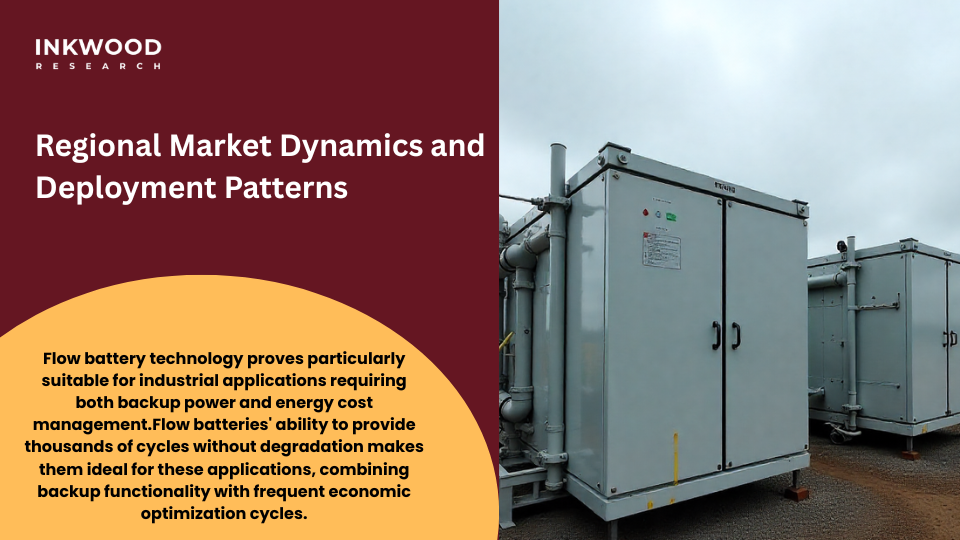
Flow battery technology proves particularly suitable for industrial applications requiring both backup power and energy cost management. Chemical plants, automotive manufacturers, and data centers represent key customer segments across Central Europe. These facilities typically operate continuously, making long-duration backup capability essential. Furthermore, industrial electricity consumers can participate in grid services markets, generating revenue streams that improve project economics. Flow batteries’ ability to provide thousands of cycles without degradation makes them ideal for these applications, combining backup functionality with frequent economic optimization cycles.
Eastern European Grid Modernization
Poland, Romania, and the Baltic states face extensive grid modernization requirements as they transition from coal-dependent systems toward renewable-dominated futures. These nations must simultaneously decommission aging fossil infrastructure while building clean generation and supporting storage. Limited interconnection capacity with Western Europe creates challenges managing renewable variability without adequate domestic flexibility resources. Therefore, large-scale energy storage becomes essential for maintaining grid stability during this transition period.
European Union funding specifically targets infrastructure improvements in Eastern European member states, creating opportunities for flow battery market participants. The Just Transition Fund provides resources supporting communities affected by coal closures, including investments in clean energy technologies. Poland’s renewable auctions increasingly require storage components, mandating energy storage solutions alongside solar and wind projects. Romanian grid operators evaluate storage for managing Danube hydropower variability and integrating new wind capacity along Black Sea coasts. These developments collectively drive Eastern European demand for proven renewable energy storage systems capable of multi-hour discharge.
Key Takeaways
- The Europe flow battery market demonstrates exceptional growth potential, expanding from $109.20 million in 2025 to $402.92 million by 2032 at a 20.50% CAGR. This trajectory reflects comprehensive policy support through the Green Deal Industrial Plan, Net-Zero Industry Act, and Battery Regulation, creating favorable regulatory and financial environments. The European Union’s commitment to producing 40% of clean technology needs domestically by 2030 drives manufacturing investments and supply chain development across member states.
- Technology leadership from companies including Invinity Energy Systems, Enerox/CellCube, and Elestor establishes Europe as a global innovation center for flow battery technology. The European Battery Alliance coordinates activities across nearly 800 stakeholders, facilitating €127 billion in investments since 2022. Germany leads manufacturing capacity development, while countries like Spain demonstrate utility-scale deployment, validating vanadium redox flow batteries for solar firming and grid services applications.
- Cross-border grid complexity and diverse renewable patterns create distinctive requirements favoring long-duration energy storage solutions with superior cycling capability. Mediterranean solar integration, Central European industrial applications, and Eastern European grid modernization represent distinct market segments driving adoption. Stringent sustainability standards and circular economy requirements favor flow technologies with high recyclability and long operational lifespans.
- Investment trends confirm strong market confidence as Innovation Fund resources and EIB commitments channel billions toward battery projects. The combination of policy support, technology advancement, and demonstrated project success positions Europe for sustained leadership in sustainable energy storage deployment throughout the forecast period. Stakeholders across utilities, manufacturing, and policy domains must align strategies with evolving European frameworks to capture emerging opportunities.
Conclusion: Europe’s Storage-Enabled Energy Transition
Europe stands poised to demonstrate how advanced energy storage solutions enable ambitious decarbonization targets while maintaining energy security and grid reliability. The flow battery market expansion from $109.20 million to $402.92 million by 2032 represents more than a financial opportunity.
Rather, it reflects fundamental infrastructure transformation supporting the continent’s net-zero vision. Utilities must integrate grid-scale batteries strategically within broader system planning, recognizing that long-duration storage complements rather than competes with short-duration alternatives.
Policymakers face critical implementation challenges in translating ambitious frameworks into operational realities. The Net-Zero Industry Act and Battery Regulation create foundations, yet sustained success requires continued refinement responding to technological advances and market evolution.
Streamlined permitting processes must balance speed with thoroughness, ensuring safety and environmental protection while eliminating unnecessary bureaucratic delays. Additionally, cross-border coordination mechanisms require strengthening to optimize continental-scale renewable integration, leveraging strategically located renewable energy storage systems.
For technology companies and investors, European markets offer exceptional opportunities grounded in supportive policies, sophisticated customers, and stringent quality standards that drive continuous improvement. Companies successfully navigating regulatory complexity while delivering proven performance will establish market positions difficult for competitors to challenge.
The Europe flow battery market evolution ultimately determines whether the continent achieves energy transition leadership or struggles with intermittency challenges undermining climate commitments. Evidence suggests that with continued focus on flow battery technology advancement and deployment, Europe will demonstrate pathways others can follow toward sustainable, reliable, decarbonized energy systems.
Frequently Asked Questions
How do European regulations affect flow battery deployment compared to other regions?
European regulations establish comprehensive sustainability requirements throughout battery lifecycles, favoring flow battery technology with superior environmental credentials. The Battery Regulation mandates due diligence for supply chains starting August 2025, requiring transparency on social and environmental impacts. Additionally, battery passports will become mandatory in 2026, documenting performance and recycling content. These frameworks favor vanadium redox flow batteries, achieving 99% recyclability rates.
What role do flow batteries play in achieving EU net-zero targets by 2050?
Flow batteries provide essential infrastructure enabling the high renewable penetration required for net-zero emissions. The EU targets at least 40% domestic clean technology production by 2030, requiring massive renewable energy storage capacity, addressing solar and wind intermittency. Long-duration energy storage solutions like flow batteries bridge multi-hour gaps between generation and demand that shorter-duration systems cannot economically address.
Which European countries lead in flow battery adoption and why?
Germany dominates with 353.5 GWh projected battery manufacturing capacity by 2030, driven by automotive industry expertise and substantial government support. Spain leads utility-scale deployment through projects like the 5.5 MWh Enel installation, validating vanadium flow batteries for solar firming. The United Kingdom maintains a strong presence through Invinity Energy Systems headquarters and multiple commercial deployments. Austria’s Enerox/CellCube demonstrates technology leadership with proven systems across European climates. Additionally, Eastern European countries increasingly deploy storage addressing grid modernization requirements and coal transition challenges.