Table of Contents
• The European Dermatology Devices Landscape
• 3D Bioprinting Technology Fundamentals
• Competitive Dynamics in European Markets
• Regulatory Frameworks and Market Entry
• Latest Innovations in Bioprinting
• Market Integration Challenges
• Future Trajectory and Investment Opportunities
• Key Takeaways
• Conclusion
TLDR
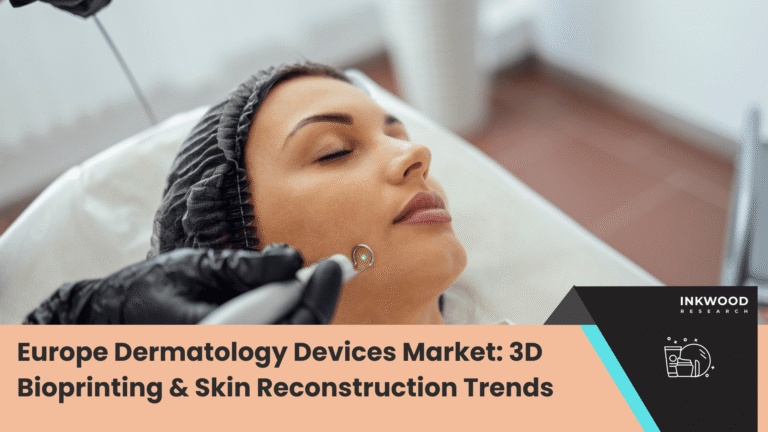
Europe’s dermatology devices market stands at a transformative crossroads where 3D bioprinting technology merges with traditional laser systems and energy-based devices. Valued at US$3,820.58 million in 2025, the Europe dermatology devices market accelerates toward US$8,264.06 million by 2032, propelled by an 11.65% CAGR. Meanwhile, 3D bioprinting emerges as a revolutionary force in skin reconstruction, promising personalized tissue engineering that could redefine treatment protocols for burn victims, chronic wound patients, and those seeking advanced aesthetic solutions.
Dermatology equipment manufacturers, cosmetic dermatology laser developers, healthcare investors exploring the global dermatology devices market, regulatory specialists navigating CE Mark requirements, and medical practitioners seeking insights into laser devices and bioprinting applications will discover actionable intelligence. Additionally, dermatology sales companies, equipment suppliers, and professionals researching Germany dermatology devices, UK dermatology devices, and France dermatology devices markets will benefit from this analysis.
The European Dermatology Devices Landscape: Where Innovation Meets Infrastructure
Market Dynamics Driving Growth
Europe’s mature healthcare ecosystem creates fertile ground for advanced dermatology devices. According to our analysis, the region benefits from comprehensive insurance coverage, substantial per-capita healthcare expenditure, and robust medical device manufacturing capabilities. Germany dermatology devices manufacturers lead production innovation, particularly in laser technologies and diagnostic equipment.
The Europe dermatology devices market size expansion reflects multiple converging factors. Aging demographics across Western Europe intensify demand for skin rejuvenation treatments. Simultaneously, rising skin cancer incidence drives the adoption of diagnostic imaging and therapeutic devices. Furthermore, growing consumer acceptance of aesthetic procedures fuels market momentum for cosmetic laser devices and light therapy devices.
Product Type Segmentation Analysis
Laser devices dominate the market landscape, accounting for significant revenue generation. These sophisticated systems utilize focused light energy for hair removal, skin resurfacing, and pigmentation treatment. Manufacturers continuously enhance wavelength precision, pulse duration control, and safety protocols to meet stringent European Medical Device Regulation (MDR) standards.
Light therapy devices represent another critical segment. Phototherapy systems employ LED technology and intense pulsed light (IPL) for acne treatment, psoriasis management, and skin rejuvenation. Additionally, energy-based devices in dermatology incorporate radiofrequency and ultrasound technologies, expanding treatment versatility beyond traditional laser applications.
Regional Performance Indicators
- Germany dermatology devices market demonstrates remarkable strength through advanced manufacturing infrastructure. Moreover, the country’s Federal Institute for Drugs and Medical Devices (BfArM) provides efficient regulatory pathways supporting innovation while maintaining patient safety standards.
- Meanwhile, the UK dermatology devices sector maintains competitive advantages through National Health Service coverage and thriving private aesthetic services. The British Association of Dermatologists reports escalating skin cancer rates, consequently driving demand across public and private healthcare facilities.
- France dermatology devices market benefits from universal healthcare coverage and expanding private aesthetic procedures. The French National Agency for Medicines and Health Products Safety enforces rigorous standards, thereby building consumer confidence in advanced technologies.
3D Bioprinting Technology Fundamentals: Engineering Living Skin
Understanding Bioprinting Architecture
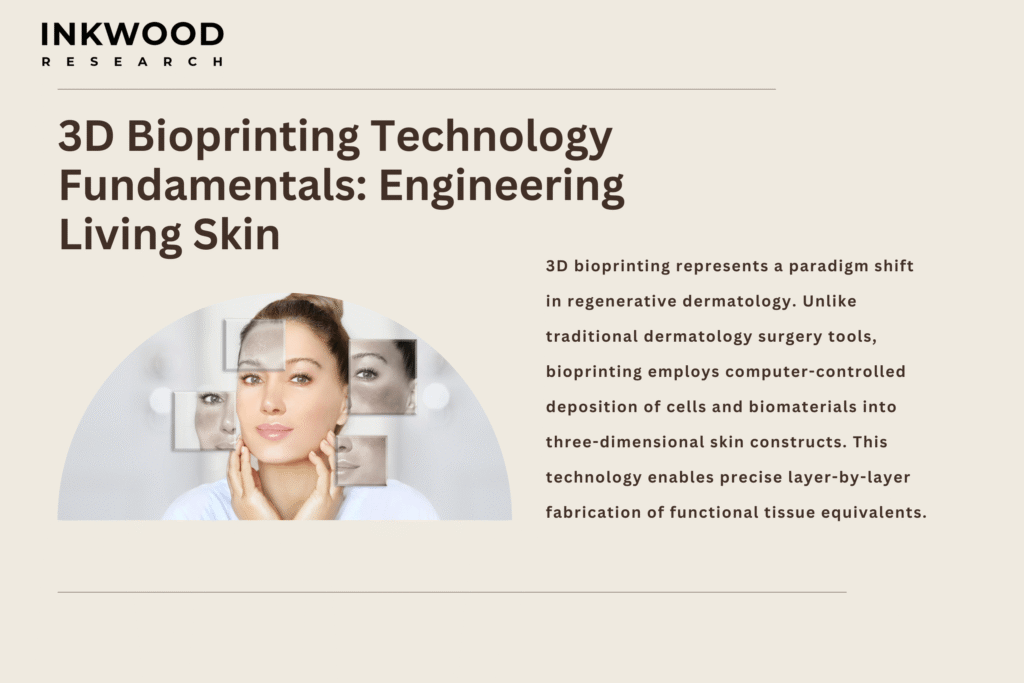
3D bioprinting represents a paradigm shift in regenerative dermatology. Unlike traditional dermatology surgery tools, bioprinting employs computer-controlled deposition of cells and biomaterials into three-dimensional skin constructs. This technology enables precise layer-by-layer fabrication of functional tissue equivalents.
The process involves three critical phases. Initially, pre-bioprinting encompasses imaging, digital modeling, and bioink formulation. Subsequently, actual bioprinting deposits cellular materials according to programmed specifications. Finally, post-bioprinting maturation allows printed constructs to develop functional characteristics.
Bioink Innovation and Cell Selection
Bioink composition determines construct viability and functionality. Researchers utilize extracellular matrix components, including collagen, fibrinogen, and gelatin, combined with living cells such as keratinocytes and fibroblasts. These formulations must balance printability with biocompatibility, ensuring cells survive the printing process while maintaining structural integrity.
Cell sourcing presents both opportunities and challenges. Autologous cells derived from patients offer personalized solutions without rejection risks. However, limited availability in extensive burn cases necessitates alternative approaches. Consequently, stem cell technologies, including adipose-derived stem cells and mesenchymal stem cells, provide scalable cell sources for commercial applications.
Competitive Dynamics in European Markets: Players Shaping the Future
Established Device Manufacturers
- Carl Zeiss Meditec AG maintains a strong positioning through optical expertise translated into dermatology imaging solutions. The company’s CLARUS 500 system, adapted for skin imaging, and OCT platforms deliver detailed analysis capabilities. Headquartered in Germany, Zeiss leverages its century-long optical innovation for medical applications.
- Heine Optotechnik GmbH & Co KG specializes in non-invasive digital dermatoscopes. Their 2023 product launches achieved a strong reception in Australia and Japan, demonstrating global market penetration capabilities. Meanwhile, FotoFinder Systems GmbH advances AI-powered diagnostic imaging, addressing early skin cancer detection needs across European healthcare systems.
Laser and Energy Device Leaders
- Alma Lasers Ltd continuously innovates energy-based treatment platforms. In March 2024, the company unveiled the Soprano Titanium Special Edition, featuring cloud-based analytics enabling practitioners to access real-time performance data. This innovation exemplifies the industry’s shift toward connected, data-driven treatment platforms.
- Lumenis Ltd maintains market leadership through a diverse laser portfolio spanning aesthetic and surgical applications. The company’s April 2025 SPLENDOR X+ launch couples Nd:YAG and Alexandrite wavelengths for comprehensive hair removal across all Fitzpatrick skin types. Such technological sophistication addresses Europe’s ethnically diverse patient populations.
- Candela Medical focuses on precision laser systems for vascular, pigmented lesion, and hair removal applications. The company’s strategic collaborations, including a partnership with The Vascular Birthmarks Foundation, demonstrate a commitment to expanding treatment accessibility across underserved patient segments.
Regulatory Frameworks and Market Entry: Navigating European Complexity
Medical Device Regulation 2017/745
The European MDR establishes comprehensive requirements for the dermatology devices market access. Classification ranges from Class I (low risk) to Class III (high risk), with surgical devices and laser devices typically requiring Class IIa or higher designation. Consequently, manufacturers must engage Notified Bodies for conformity assessment and CE marking authorization.
Clinical evaluation represents a cornerstone requirement. Manufacturers must compile Clinical Evaluation Reports demonstrating device safety and performance through literature reviews, clinical investigations, or post-market surveillance data. Additionally, Technical Documentation must encompass risk management, usability engineering, and design verification.
Bioprinting Regulatory Challenges
3D bioprinted skin constructs face classification ambiguity. Current frameworks struggle to categorize products combining cells, biomaterials, and manufacturing processes. Should regulators classify them as medical devices, advanced therapy medicinal products, or hybrid constructions? This uncertainty creates market entry barriers.
Post-market surveillance requirements intensify for bioprinted products. Mandatory vigilance systems and Periodic Safety Update Reports demand ongoing monitoring. Furthermore, traceability through Unique Device Identification ensures patient safety while imposing administrative burdens on emerging bioprinting companies.
Comparative Regulatory Analysis
European pathways contrast sharply with other regions. While MDR mandates extensive clinical data, the United States FDA 510(k) processes may rely on predicate device equivalence. Meanwhile, Japan’s PMDA requires re-evaluation cycles, and China’s NMPA enforces local testing requirements. These variations complicate global commercialization strategies.
Latest Innovations in Bioprinting: From Laboratory to Clinical Reality
In Situ Bioprinting Breakthroughs
In situ bioprinting transforms wound treatment by directly depositing cells onto injury sites. This approach eliminates expensive in vitro maturation periods and multiple surgical interventions. Research demonstrates that inkjet bioprinting of keratinocytes and fibroblasts onto full-thickness wounds achieves complete re-epithelialization within eight weeks, significantly faster than conventional healing timelines.
Handheld bioprinters represent the next evolution. These portable devices enable point-of-care treatment, particularly valuable for emergency departments and military field hospitals. However, manual operation introduces consistency challenges, necessitating automated guidance systems and precision controls for widespread adoption.
Vascularization and Sweat Gland Integration
Functional skin requires more than layered cells. Vascularization ensures oxygen and nutrient delivery, while sweat glands enable thermoregulation. Recent advances demonstrate that bioprinted ECM containing tissue homogenates can create inductive niches for sweat gland differentiation, with successful in vivo transplantation restoring functional perspiration in animal models.
Hair follicle regeneration presents additional complexity. Researchers have achieved symbiotic reconstruction of sweat glands and hair follicles within 3D-bioprinted porous constructs. This interdependent regeneration, revealing mutual inhibitory effects, guides sequential genesis timing for optimal appendage development.
Commercial Translation Progress
Clinical trial activity accelerates globally. Between 2016 and 2023, registration dates span multiple continents, with China conducting substantial trials. Four interventional studies aimed to implant bioprinted tissues, including blood vessels, trachea, external ear, and wound dressings, all utilizing autologous cells to minimize rejection risks.
European bioprinting companies navigate unique challenges. While traditional dermatology equipment lists items that face established approval pathways, bioprinted constructs require novel regulatory approaches. Consequently, early-stage companies collaborate with academic institutions and larger medical device manufacturers to access expertise and capital.
Market Integration Challenges: Bridging Laboratory Innovation and Clinical Adoption
Cost and Accessibility Barriers
High development costs constrain bioprinting commercialization. Unlike established dermatology machine price points for laser systems, bioprinted constructs require specialized facilities, trained personnel, and extensive validation. These expenses translate to premium pricing, potentially limiting adoption to specialized burn centers and academic medical institutions.
Scalability represents another significant hurdle. Manual bioprinting processes suit research applications but lack throughput for commercial viability. Automation technologies must advance substantially before bioprinted skin matches the production capacity of traditional dermatology creams list or conventional skin grafts.
Clinical Training and Expertise Gap
Dermatology equipment manufacturers face unique training challenges with bioprinting technology. Unlike conventional products dermatologists use, bioprinted constructs require an understanding of cell biology, tissue engineering principles, and sterile handling protocols. Consequently, comprehensive educational programs must accompany product launches.
The shortage of trained operators extends beyond physicians. Bioprinting demands interdisciplinary teams including bioengineers, cell culture specialists, and quality assurance professionals. This workforce development requirement slows market penetration, particularly in regions with limited regenerative medicine infrastructure.
Integration with Existing Treatment Protocols
Healthcare systems designed around traditional dermatology surgical equipment must adapt to bioprinting adoption. Operating room configurations, sterile processing workflows, and reimbursement structures require modification. Moreover, clinical outcome measurement for bioprinted treatments lacks standardization, complicating comparative effectiveness research.
Insurance coverage ambiguity further impedes adoption. While European healthcare systems reimburse many dermatological treatments, bioprinted skin constructs fall into regulatory gray zones. Payers require robust cost-effectiveness data before establishing coverage policies, creating a chicken-and-egg dilemma for manufacturers seeking market validation.
Future Trajectory and Investment Opportunities: Strategic Imperatives for 2026-2032
Market Convergence Scenarios
The dermatology devices market evolution suggests convergence between traditional energy-based therapies and bioprinting technologies. Forward-thinking dermatology sales companies recognize that future treatment paradigms may combine laser-based lesion removal with bioprinted tissue reconstruction, creating comprehensive care pathways.
Investment flows reflect this convergence. Private equity firms increasingly target companies bridging diagnostic imaging, therapeutic devices, and regenerative technologies. The 2022 $60 million Cynosure investment from Clayton, Dubilier & Rice exemplifies capital allocation toward comprehensive aesthetic and medical dermatology solutions.
Emerging Business Models
Subscription analytics and cloud-based platforms create recurring revenue streams. Laser devices manufacturers now offer connected systems providing treatment outcome tracking, predictive maintenance alerts, and AI-powered parameter optimization. This servitization trend may extend to bioprinting, where tissue construct performance data informs iterative bioink improvements.
Medical spa expansion transforms end-user dynamics. While hospitals and the largest dermatology companies clinics traditionally dominated device procurement, spa facilities now represent the fastest-growing channel. This shift influences product development toward user-friendly interfaces, compact footprints, and financing flexibility.
Strategic Recommendations for Market Entrants
Dermatology equipment suppliers considering bioprinting investments should prioritize regulatory expertise. Early engagement with Notified Bodies and competent authorities accelerates approval timelines. Additionally, partnerships with established medical device companies provide distribution networks and clinical validation capabilities.
Geographic expansion strategies must account for regulatory heterogeneity. Germany dermatology devices market entry requires BfArM navigation, while the UK dermatology devices access necessitates MHRA compliance. Furthermore, post-Brexit regulatory divergence creates additional complexity for companies targeting multiple European markets simultaneously.
Technology transfer models offer viable market entry alternatives. Rather than developing proprietary bioprinting platforms, established dermatology equipment manufacturers might license university-developed technologies, acquiring intellectual property while leveraging existing manufacturing and distribution infrastructure.
Key Takeaways
- Europe dermatology devices market grows from US$3,820.58 million (2025) to US$8,264.06 million (2032) at 11.65% CAGR, driven by aging demographics and aesthetic procedure acceptance
- 3D bioprinting technology enables personalized skin reconstruction with precise cellular placement, offering solutions for burns, chronic wounds, and aesthetic applications beyond traditional laser devices capabilities
- Germany dermatology devices, UK dermatology devices, and France dermatology devices markets lead European innovation through robust manufacturing, comprehensive healthcare coverage, and efficient regulatory pathways
- In situ bioprinting represents a breakthrough innovation, allowing direct wound-site cell deposition that accelerates healing and eliminates expensive in vitro maturation periods
- Regulatory complexity under MDR 2017/745 creates market entry barriers, particularly for bioprinted constructs facing classification ambiguity between medical devices and advanced therapy medicinal products
- Established players, including Carl Zeiss Meditec, Heine Optotechnik, Alma Lasers, Lumenis, and Candela Medical, shape competitive dynamics through continuous innovation in cosmetic laser devices and diagnostic imaging
- Market convergence between traditional energy-based devices in dermatology and bioprinting technologies creates strategic opportunities for forward-thinking dermatology equipment manufacturers and investors
- Cost barriers, scalability challenges, and clinical training gaps currently constrain commercial bioprinting adoption, necessitating automation advances and workforce development before mainstream market penetration
Conclusion: Embracing the Bioprinting Revolution
The intersection of established dermatology devices market expertise and emerging bioprinting innovation creates unprecedented opportunities. Europe’s sophisticated healthcare infrastructure, rigorous regulatory frameworks, and strong manufacturing capabilities position the region as a bioprinting leader.
However, translating laboratory breakthroughs into clinical reality demands strategic collaboration between biotech startups, established medical device companies, regulatory authorities, and healthcare providers.
For organizations navigating this transformative landscape, success requires balancing innovation ambition with regulatory pragmatism. Whether you’re developing next-generation laser hair removal systems, exploring bioprinting applications, or seeking market intelligence for strategic planning, understanding the complex interplay between technology, regulation, and market dynamics proves essential.
Ready to explore how 3D bioprinting and advanced dermatology devices can transform your clinical practice or investment portfolio?
Connect with Inkwood Research for comprehensive market intelligence, regulatory guidance, and strategic consulting services tailored to your specific needs.