Table of Contents
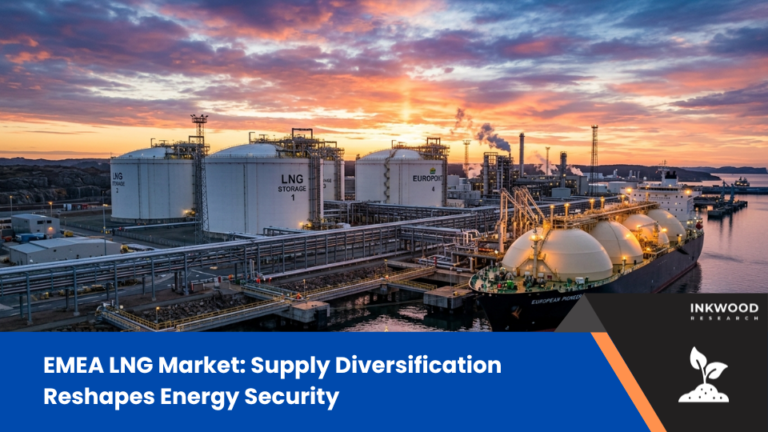
This analysis is brought to you by Inkwood Research, a leading market intelligence firm specializing in Europe and the Middle East energy transitions, liquefied natural gas infrastructure developments, and regional supply security frameworks. Our research team combines extensive experience analyzing Middle Eastern gas production, European import dynamics, and geopolitical energy security strategies. Based on our proprietary research methodologies and strategic partnerships with regional energy authorities, LNG producers, and terminal operators, we deliver actionable insights that empower strategic decision-making for global enterprises navigating EMEA’s transforming energy landscape.
TLDR
Europe and the Middle East LNG markets undergo dramatic restructuring driven by geopolitical upheaval and energy security imperatives. Qatar’s massive expansion projects position the Gulf state as a dominant global supplier serving Asian and European markets. Meanwhile, the UAE develops export ambitions through new capacity investments. European nations accelerate import infrastructure following Russian supply disruptions, with Italy and the UK leading diversification strategies. These developments fundamentally alter global gas trade flows. Regional dynamics continue evolving rapidly, responding to shifting geopolitical realities.
Energy security strategists, LNG traders, infrastructure investors, European utility executives, Middle Eastern gas producers, shipping operators, policy analysts, geopolitical risk analysts, terminal developers, and international energy companies will gain valuable insights into EMEA LNG market transformation, supply diversification imperatives, capacity expansion plans, regulatory developments, and strategic implications for regional energy security and global gas trade evolution.
Europe & Middle East LNG Market Outlook
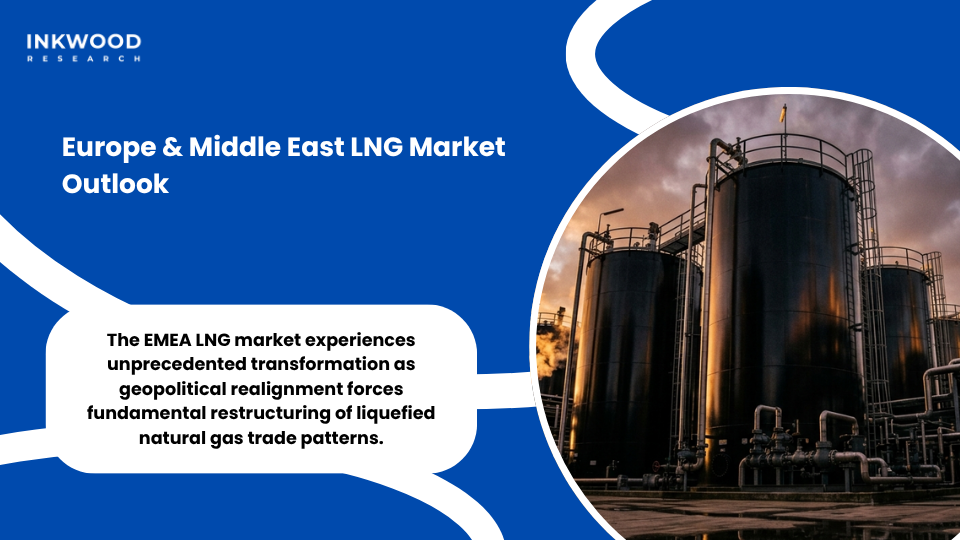
The EMEA LNG market experiences unprecedented transformation as geopolitical realignment forces fundamental restructuring of liquefied natural gas trade patterns. Energy security considerations now dominate procurement decisions as European nations seek supply diversification away from concentrated dependencies.
Meanwhile, Qatar LNG expansion projects position the Gulf state as an increasingly dominant global supplier, challenging established market leaders. European regasification terminals multiply rapidly as countries accelerate LNG infrastructure development, replacing disrupted pipeline imports.
Additionally, the UAE pursues export ambitions through strategic capacity investments. These shifting dynamics reshape geopolitical energy trade as natural gas supply becomes a strategic commodity beyond purely commercial considerations. Understanding regional developments proves essential for stakeholders navigating these turbulent markets. Our analysis examines how European gas import restructuring and Middle Eastern expansion strategies create both challenges and opportunities.
Qatar’s Massive LNG Expansion Reshapes Global Markets
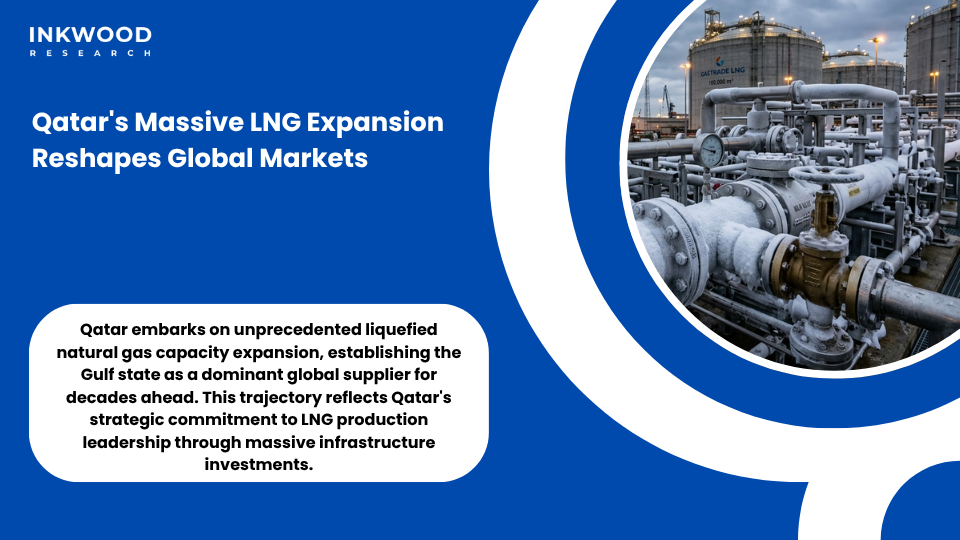
Qatar embarks on unprecedented liquefied natural gas capacity expansion, establishing the Gulf state as a dominant global supplier for decades ahead. Our projections indicate the Qatar LNG market growth from US$4.23 billion in 2026 to US$7.50 billion by 2034, achieving 7.41% annual expansion. This trajectory reflects Qatar’s strategic commitment to LNG production leadership through massive infrastructure investments.
QatarEnergy’s North Field development projects fundamentally alter global supply-demand balances. Moreover, these expansions position Qatar competitively against emerging suppliers, including American exporters. QatarEnergy announced plans to increase LNG production capacity from the current 77 million tons per annum to 142 million tons per annum by the 2030’s end.
This dramatic expansion encompasses North Field East, North Field South, and North Field West projects, adding substantial new capacity sequentially. According to QatarEnergy official statements, these developments represent the world’s largest LNG expansion program, establishing Qatar’s supply dominance. Additionally, the North Field East project alone adds 32 million tons of annual capacity through four mega-trains beginning production in 2026-2027.
Strategic Partnerships and Market Positioning
Meanwhile, Qatar strategically partners with international energy companies and major consumers, securing long-term market positions. Chinese companies, including Sinopec, secured stakes in North Field East development alongside long-term offtake agreements spanning 27 years. These arrangements reflect Qatar’s approach of involving both consumers and competitors in expansion projects, ensuring market access.
QatarEnergy builds a comprehensive value chain control from production through marketing. Moreover, Japanese, Korean, and European buyers commit to substantial long-term purchases supporting project financing. However, Qatar’s massive capacity additions raise concerns about global market oversupply, potentially pressuring prices downward. Some analysts question whether demand growth accommodates planned capacity increases from Qatar and other suppliers.
QatarEnergy proceeds confidently, nevertheless, citing long-term Asian demand growth and European supply security requirements. Our research suggests Qatar’s strategic planning extends beyond immediate market conditions, targeting a dominant position through inevitable supply disruptions and demand evolution. Additionally, Qatar’s relatively low production costs enable competitive positioning even during periods of market softness.
UAE Pursues Export Growth Through Strategic Investments
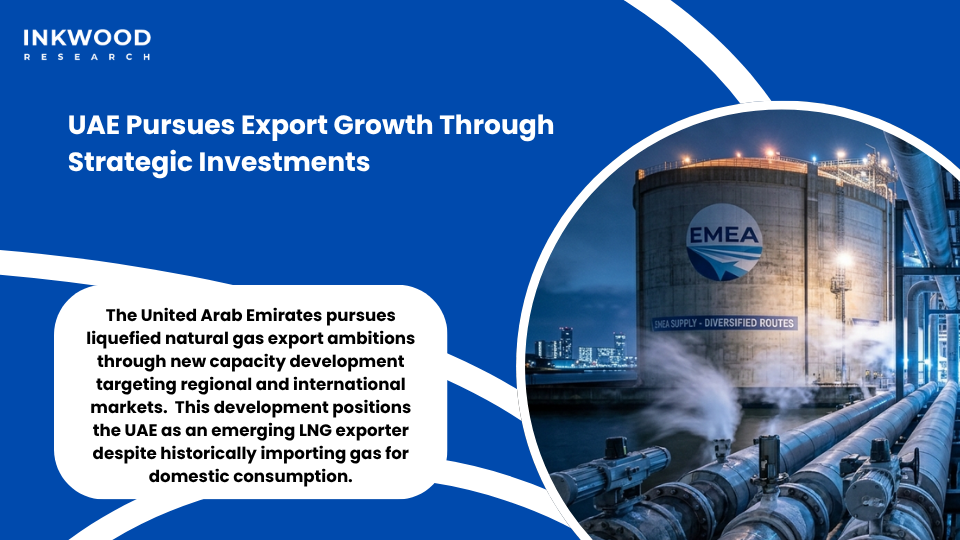
The United Arab Emirates pursues liquefied natural gas export ambitions through new capacity development targeting regional and international markets. The United Arab Emirates (UAE) LNG market expansion from US$375.52 million in 2026 to US$697.42 million by 2034 reflects 8.05% annual growth. This development positions the UAE as an emerging LNG exporter despite historically importing gas for domestic consumption.
UAE’s strategic shift demonstrates regional energy dynamics evolution as countries optimize natural gas resource utilization. Moreover, export capabilities enhance the UAE’s energy security through supply diversification. Furthermore, the UAE advances several LNG export projects, including expansions at existing facilities and new terminal developments. The country historically consumed domestic gas production plus imports from Qatar, serving growing electricity generation and industrial requirements.
However, recent offshore gas discoveries enable potential export capacity development, reversing traditional import dependency. Additionally, the UAE positions itself as a regional LNG trading hub, complementing export capabilities with re-export potential through strategic infrastructure investments.
Balancing Domestic Needs with Export Opportunities
Meanwhile, the UAE carefully balances export development against ensuring adequate domestic supply for power generation and industrial consumption. Summer electricity demand peaks stress gas supply systems, requiring substantial volumes for cooling-driven generation. These seasonal patterns create challenges in managing export commitments while meeting domestic requirements.
UAE develops substantial production capacity supporting both objectives through careful resource planning and infrastructure coordination. However, the UAE’s export ambitions face competition from established regional suppliers, including Qatar possessing cost advantages from massive scale. Additionally, developing new LNG infrastructure requires substantial capital investment, competing against other energy sector priorities.
Nevertheless, the UAE proceeds with strategic projects targeting niche markets and leveraging geographic advantages for specific buyers. Our analysis suggests the UAE establishes a meaningful but modest export presence rather than challenging Qatar’s regional dominance. Moreover, export capabilities strengthen the UAE’s energy diplomacy, enhancing regional influence through gas supplies.
Italy's LNG Strategy Anchors Energy Security Transformation
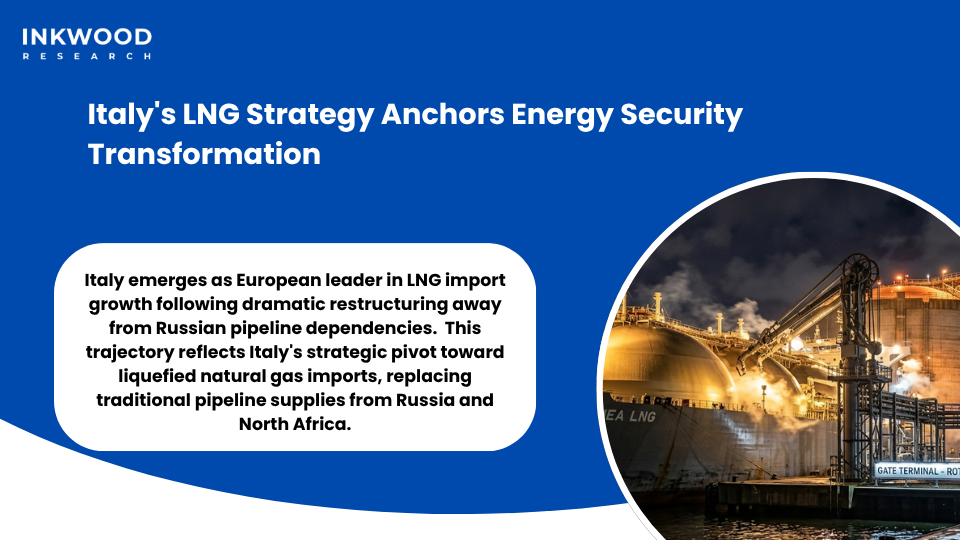
Italy emerges as European leader in LNG import growth following dramatic restructuring away from Russian pipeline dependencies. Italy LNG market’s expansion from US$2.35 billion in 2026 to US$4.76 billion by 2034 represents a remarkable 9.21% annual growth rate. This trajectory reflects Italy’s strategic pivot toward liquefied natural gas imports, replacing traditional pipeline supplies from Russia and North Africa.
Italian regasification capacity expansions and new terminal developments reshape Mediterranean gas trade patterns. Moreover, Italy positions itself as a potential Southern European gas hub serving regional markets. Furthermore, Italy accelerated LNG infrastructure development through emergency measures following Russian supply disruptions.
New floating storage and regasification units deployed rapidly at multiple ports increased import capacity substantially within months rather than years, typical for conventional terminals. Additionally, existing terminals at Livorno and Panigaglia enhanced throughput capacities, accommodating increased volumes. These swift actions demonstrate Italy’s responsive approach to energy security challenges, prioritizing rapid capacity additions.
Southern Europe Gateway Development
Meanwhile, Italy develops a Southern European gateway role, leveraging geographic position and expanded import capabilities. Pipeline connections to Slovenia, Austria, and potential future links to other neighbors enable gas redistribution serving broader regional needs. This hub ambition transforms Italy from an endpoint consumer into a transit corridor, enhancing regional energy security.
Italian infrastructure investments benefit multiple European nations, diversifying supply sources collectively. Moreover, Italy’s Mediterranean position enables efficient LNG imports from diverse suppliers, including Middle Eastern, African, and American sources. However, Italy’s long-term gas demand faces uncertainty given aggressive renewable energy targets and energy efficiency improvements. These policies aim to reduce overall natural gas consumption, potentially limiting LNG import growth beyond 2030.
Nevertheless, near-term import requirements remain substantial as Italy phases out Russian pipeline volumes, requiring alternative supplies. Our research suggests Italian LNG imports peak in the late 2020s before potentially moderating as renewables displace gas-fired generation. Additionally, seasonal demand variations create ongoing LNG storage and flexibility requirements supporting continued import infrastructure utilization.
UK Accelerates Gas Import Diversification Post-Russian Crisis
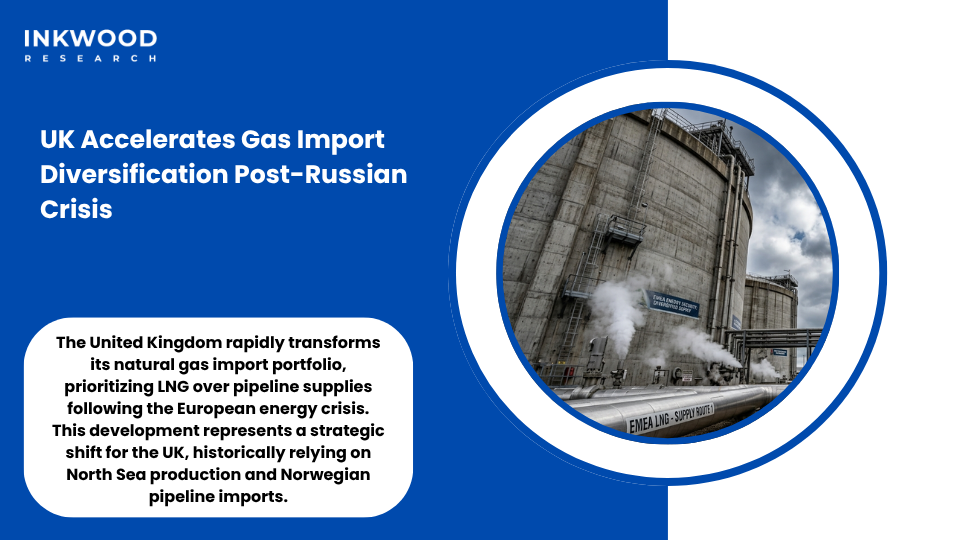
The United Kingdom rapidly transforms its natural gas import portfolio, prioritizing LNG over pipeline supplies following the European energy crisis. The United Kingdom LNG market growth from US$1.91 billion in 2026 to US$3.80 billion by 2034 reflects 8.99% annual expansion. This development represents a strategic shift for the UK, historically relying on North Sea production and Norwegian pipeline imports.
British LNG terminals operate at high utilization rates, accommodating increased import volumes serving both domestic consumption and European re-exports. Moreover, the UK’s established regasification infrastructure positions the country as an important European LNG import gateway. Furthermore, the United Kingdom possesses three operational LNG import terminals with combined capacity exceeding domestic consumption requirements.
This overcapacity traditionally served Continental European markets through pipeline interconnectors with Belgium and the Netherlands. However, European LNG import infrastructure expansion reduces the UK’s transit role while domestic consumption importance increases. Additionally, UK terminals provide supply flexibility during high-demand periods, supporting grid reliability and energy security. These facilities process American, Qatari, and other international supplies, diversifying the UK’s gas sourcing.
North Sea Production Decline Compensation
Meanwhile, declining North Sea natural gas production necessitates increasing import dependencies for British energy security. Mature offshore fields experience natural production depletion, while new development faces challenges from costs and the regulatory environment. This production trajectory transforms the UK from a net exporter to a substantial importer requiring secure supply sources.
LNG imports complement Norwegian pipeline supplies, preventing excessive dependency on a single source. Moreover, diverse LNG suppliers provide additional security against supply disruptions from any individual source. However, the UK’s long-term natural gas demand faces uncertainty amid aggressive net-zero commitments targeting substantial emissions reductions by 2050.
Renewable electricity generation expansion and heating electrification policies aim to reduce gas consumption across residential and commercial sectors. Nevertheless, gas-fired power generation maintains importance in providing backup capacity supporting intermittent wind and solar generation. Our analysis suggests UK LNG imports remain significant through the 2030s despite overall gas demand moderation. Additionally, potential hydrogen production from natural gas could sustain import requirements under certain decarbonization pathways.
European Regasification Infrastructure Expansion
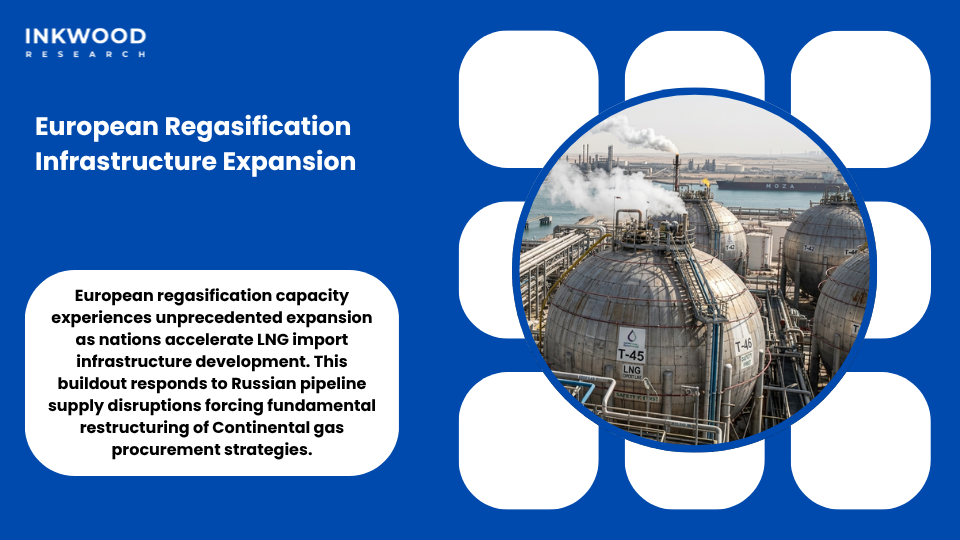
European regasification capacity experiences unprecedented expansion as nations accelerate LNG import infrastructure development. This buildout responds to Russian pipeline supply disruptions forcing fundamental restructuring of Continental gas procurement strategies. Plus, multiple countries deploy floating storage and regasification units, providing rapid capacity additions while permanent terminals advance through development.
Moreover, infrastructure investments span Northern, Western, and Southern Europe, creating comprehensive import capabilities. These developments fundamentally alter the European gas market structure, previously dominated by pipeline imports. Furthermore, Germany exemplifies this rapid infrastructure transformation, having possessed zero LNG import capacity prior to 2022.
Within eighteen months, Germany deployed multiple floating terminals at northern ports, processing substantial volumes, replacing Russian pipeline imports. Additionally, permanent terminal projects advance through planning and construction, targeting long-term capacity. These achievements demonstrate European determination, prioritizing energy security despite typically lengthy infrastructure development timelines. Moreover, streamlined regulatory approvals enabled unprecedented speed from concept to operation.
Overcapacity Concerns and Utilization Challenges
Meanwhile, rapid capacity expansion raises concerns about potential overcapacity as European gas demand declines in the long term. Renewable energy growth and efficiency improvements reduce overall consumption, potentially leaving excess regasification infrastructure underutilized. This dynamic creates financial challenges for terminal operators and raises questions around stranded asset risks.
Terminal developers consider flexible usage options, including hydrogen imports and other potential applications beyond traditional LNG processing. However, near-term European LNG import requirements remain substantial, justifying continued infrastructure investments despite long-term uncertainties. Energy security prioritization outweighs purely economic optimization given geopolitical supply risks.
Our research suggests selective capacity rationalization post-2030 as European gas demand stabilizes at lower levels. Nevertheless, substantial import capabilities persist, supporting seasonal demand variations and providing supply redundancy, enhancing overall system reliability. Additionally, infrastructure sharing arrangements and flexible terminal operations help optimize utilization across seasonal and cyclical demand patterns.
Middle East Supply Competition and Market Positioning
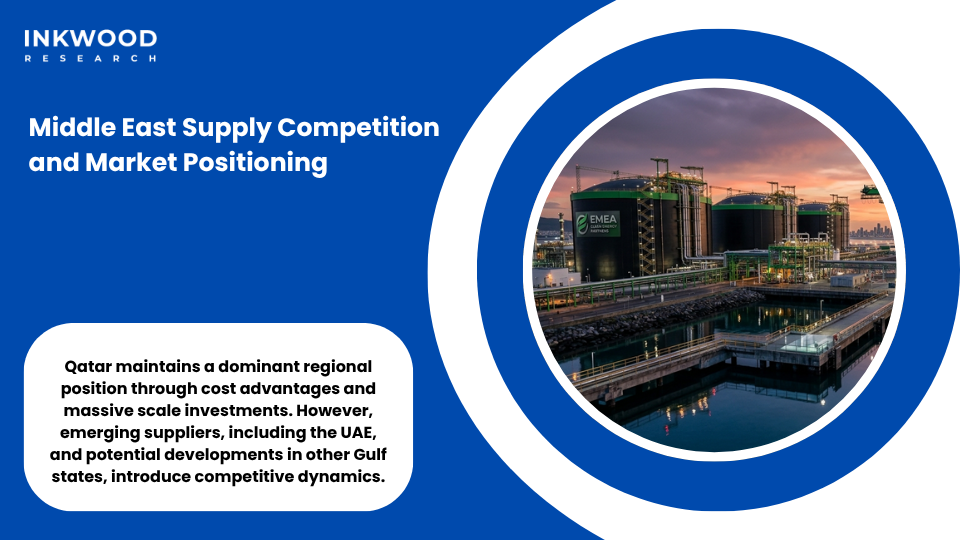
Middle Eastern LNG producers navigate intensifying competition as global capacity expansions create increasingly crowded markets. Qatar maintains a dominant regional position through cost advantages and massive scale investments. However, emerging suppliers, including the UAE, and potential developments in other Gulf states, introduce competitive dynamics.
Middle Eastern producers emphasize long-term relationships and supply reliability, differentiating against pure commodity competition. Moreover, strategic partnerships with major consumers secure market access amid growing supply availability. Furthermore, Middle Eastern LNG benefits from proximity advantages, serving both Asian and European markets efficiently. Shipping economics favor Gulf suppliers over more distant alternatives for many buyers despite competitive pressures.
Additionally, established infrastructure and operational experience provide reliability advantages, attracting buyers valuing supply security. These competitive strengths sustain Middle Eastern market positions despite global capacity growth. Moreover, relatively low production costs enable profitable operations even during periods of market softness, affecting higher-cost suppliers.
Asian Market Focus and European Opportunities
Middle Eastern suppliers traditionally prioritized Asian markets given proximity and demand growth trajectories. However, European supply restructuring creates substantial opportunities for Middle Eastern LNG previously unavailable due to Russian pipeline dominance. This market opening enables Middle Eastern producers to diversify customer bases, enhancing commercial flexibility.
Qatar and other regional suppliers secure long-term European contracts, complementing established Asian positions. Moreover, flexible destination provisions enable cargo optimization responding to price signals across markets. However, American LNG competition intensifies, particularly in European markets where US supplies provide a politically aligned alternative. This dynamic creates pricing pressures as buyers leverage competing suppliers, negotiating favorable commercial terms.
Middle Eastern suppliers maintain competitive positions through operational flexibility and established relationships. Our analysis suggests Middle Eastern LNG sustains significant global market shares despite American export growth. Additionally, Asian demand growth absorbs incremental Middle Eastern production, maintaining healthy utilization rates across regional facilities.
Future Market Evolution Through 2030
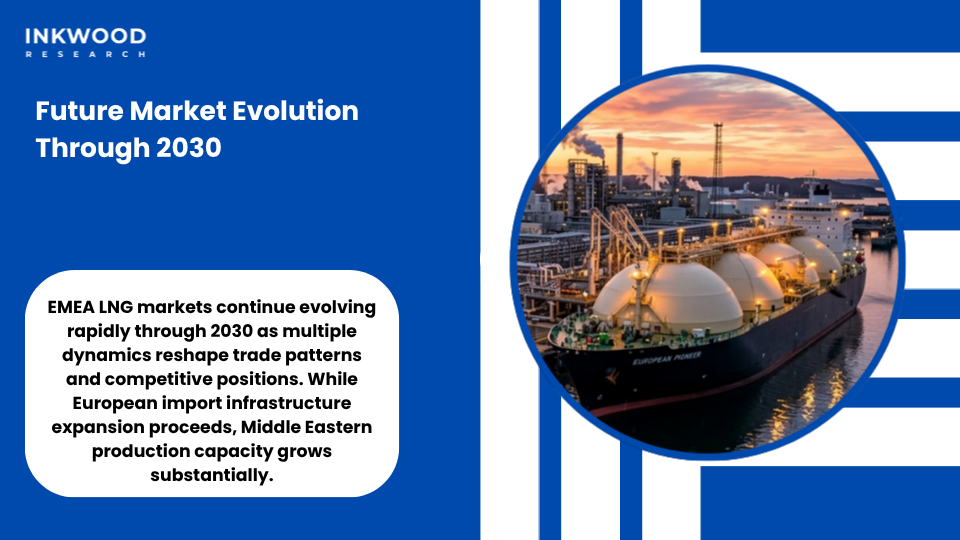
EMEA LNG markets continue evolving rapidly through 2030 as multiple dynamics reshape trade patterns and competitive positions. While European import infrastructure expansion proceeds, Middle Eastern production capacity grows substantially. These parallel developments fundamentally alter global gas trade flows, creating both opportunities and challenges.
Market participants navigate uncertain demand trajectories amid aggressive renewable energy deployments, potentially reducing long-term gas consumption. Moreover, geopolitical factors increasingly influence commercial decisions as energy security prioritization intensifies. Furthermore, Qatar’s massive capacity additions entering service sequentially through the late 2020s test market absorption capabilities. Some analysts project oversupply scenarios potentially pressuring prices downward, affecting producer economics.
Demand growth from Asian markets and European supply security requirements potentially accommodate substantial new volumes. Additionally, supply disruptions from mature fields and geopolitical events could tighten markets despite capacity additions. These competing factors create uncertainty around medium-term market balances, requiring adaptive strategies from market participants.
Technology and Sustainability Considerations
Meanwhile, carbon intensity concerns increasingly influence LNG procurement decisions as buyers implement emissions reduction strategies. European carbon pricing mechanisms and corporate sustainability commitments favor lower-carbon supplies, creating competitive advantages for efficient producers. Qatar’s investments in carbon capture and emissions reduction technologies strengthen competitive positioning.
Moreover, methane emissions monitoring and reduction initiatives become critical differentiators as environmental standards tighten globally. These sustainability considerations reshape traditional LNG trade focused purely on cost and reliability. However, balancing environmental objectives against immediate energy security needs creates policy tensions and commercial complexities. Natural gas maintains importance as a transition fuel despite long-term decarbonization goals requiring continued LNG trade.
Our research suggests that sustainable LNG production and procurement practices evolve substantially through 2030 as the industry responds to stakeholder pressures. Additionally, potential hydrogen economy development could transform LNG infrastructure, supporting new energy carriers beyond traditional natural gas applications. These technological possibilities create strategic optionality for forward-thinking market participants.
Key Takeaways
- Europe and the Middle East LNG markets undergo a dramatic transformation driven by geopolitical realignment and energy security imperatives. Qatar’s unprecedented capacity expansion establishes a dominant global supplier position, challenging established market structures.
- Meanwhile, European nations accelerate import infrastructure development, replacing Russian pipeline supplies through diverse LNG sources. Additionally, Italy and the UK lead European diversification strategies, positioning themselves as regional import gateways. These developments fundamentally alter global gas trade patterns.
- Furthermore, the UAE pursues export ambitions through strategic capacity investments despite historical import dependencies. This shift demonstrates regional energy dynamics evolution as countries optimize resource utilization strategies.
- Moreover, intense competition emerges among suppliers as global capacity expansions outpace near-term demand growth, potentially creating market challenges. Nevertheless, Asian demand growth and European supply security requirements provide substantial absorption capacity supporting continued infrastructure investments.
- Additionally, sustainability considerations increasingly influence LNG procurement and production strategies as carbon intensity concerns intensify. Efficient producers investing in emissions reduction technologies gain competitive advantages as environmental standards tighten.
- Subsequently, EMEA LNG markets balance immediate energy security needs against long-term decarbonization objectives, creating complex policy and commercial dynamics. Stakeholders successfully navigating these turbulent markets require a sophisticated understanding of technical, commercial, and geopolitical factors shaping regional developments.
Conclusion:
The Europe and Middle East LNG market transformation represents one of the most significant energy sector developments reshaping global trade patterns fundamentally. Geopolitical upheaval forces European supply diversification while Middle Eastern producers expand capacity, targeting growing opportunities.
These parallel trends create dynamic, rapidly evolving markets requiring adaptive strategies from all participants. Moreover, energy security prioritization increasingly dominates decisions alongside traditional commercial considerations, reflecting the broader strategic importance of natural gas supplies.
Based on our analysis, EMEA LNG markets will continue experiencing substantial volatility and structural change through the remainder of this decade. Qatar’s massive capacity additions test market absorption capabilities while European demand trajectories remain uncertain amid aggressive renewable deployments.
Successfully navigating these dynamics demands a sophisticated understanding of regional political developments, infrastructure constraints, and long-term sustainability trends. Organizations positioning themselves strategically can capitalize on opportunities emerging from market restructuring.
For organizations seeking deeper insights into EMEA LNG market developments or regional energy strategy formulation, Inkwood Research offers comprehensive market intelligence and consulting services.
Contact our team to explore how these transformative dynamics align with your strategic objectives and operational planning requirements across Europe and the Middle East energy markets.
Frequently Asked Questions
How will Qatar’s LNG expansion influence global LNG prices and supply dynamics?
Qatar’s large capacity expansions could soften global LNG prices if supply growth temporarily exceeds demand, though strong LNG consumption growth in Asia and Europe’s energy security requirements are expected to absorb a significant share of the additional volumes
Can Europe’s LNG import infrastructure support long-term energy security and power demand?
Europe’s expanded LNG regasification capacity provides short- to medium-term supply flexibility and energy security, while natural gas continues supporting grid stability during the renewable transition and LNG terminals may eventually be repurposed for hydrogen infrastructure
What competitive advantages do Middle Eastern LNG suppliers maintain in the global LNG market?
Middle Eastern LNG suppliers maintain strong global competitiveness due to low production costs, large-scale liquefaction capacity, strategic proximity to Asian and European markets, and long-term supply contracts that ensure reliable LNG trade flows
How is LNG demand growth in Asia shaping global LNG trade patterns?
Rapid industrialization, population growth, and rising electricity demand in countries such as China and India are increasing LNG imports, making Asia the primary driver of global LNG trade growth and long-term contract activity
Why are long-term LNG supply contracts still important in the evolving global gas market?
Long-term LNG contracts remain critical for ensuring supply security, supporting large infrastructure investments, and stabilizing price risks even as spot LNG trading and portfolio diversification continue to expand
How do geopolitical and energy security concerns influence LNG procurement strategies?
Geopolitical uncertainties and supply disruptions encourage countries to diversify LNG suppliers, expand import infrastructure, and secure long-term contracts to strengthen national energy security and reduce dependence on single supply sources