Table of Contents
Inkwood Research specializes in comprehensive market analysis across the United States dental imaging market, dental service organization business models, and healthcare technology procurement strategies. Our research team delivers data-driven insights empowering strategic decisions for dental equipment manufacturers, practice management organizations, and healthcare investors navigating America’s evolving dental diagnostics landscape.
TLDR
Dental Service Organizations (DSOs) transform America’s dental imaging market through strategic bulk purchasing agreements. These partnerships enable dental imaging equipment market consolidation, reducing costs by 14-22% while accelerating digital dental radiography devices adoption. Cone beam computed tomography (CBCT) devices and intraoral dental imaging systems dominate DSO procurement. The United States dental imaging market witnesses unprecedented transformation as DSOs negotiate favorable terms for 3D dental imaging systems and AI-enabled dental imaging solutions, fundamentally reshaping equipment accessibility.
Dental equipment manufacturers, DSO executives, independent practice owners, healthcare investors, practice management consultants, dental technology vendors, equipment financing specialists, clinical operations directors, and strategic planning professionals will discover actionable insights into how consolidated purchasing reshapes the dental imaging systems industry analysis, equipment accessibility, competitive dynamics, and long-term strategic positioning within America’s evolving dental care delivery ecosystem.
Understanding DSO-Driven Transformation in the United States Dental Imaging Market
America’s dental landscape experiences dramatic consolidation through Dental Service Organizations (DSOs). These entities manage non-clinical operations for dental practices nationwide. Consequently, purchasing dynamics shift fundamentally across the dental imaging equipment market. Furthermore, DSOs leverage economies of scale unavailable to individual practices.
Market Scale and DSO Penetration Dynamics
The United States dental imaging market reached approximately US$1242.41 million in 2026. Projections indicate growth to US$2200.24 million by 2034, representing a 7.41% CAGR from 2026-2034. Meanwhile, DSO-affiliated practices demonstrate accelerating equipment modernization rates. Indeed, bulk purchasing agreements enable faster technology deployment across networks.
According to our analysis, more than 8,000 dental clinics operate under DSO management. These organizations employ over 100,000 dentists, representing approximately 7% of American dental practices. However, this percentage understates their dental imaging systems industry analysis impact. DSOs disproportionately invest in advanced diagnostic equipment due to procurement advantages.
Procurement Transformation Through Consolidation
Traditional dental practices purchase equipment individually, negotiating with local suppliers. Conversely, DSOs aggregate demand across dozens or hundreds of locations. This fundamental shift creates powerful leverage. Manufacturers prioritize large contracts offering predictable revenue streams. Therefore, DSOs secure preferential pricing, extended payment terms, and comprehensive service agreements.
Moreover, standardization emerges naturally from bulk procurement strategies. When DSOs select specific cone beam computed tomography (CBCT) devices or intraoral dental imaging systems, they deploy identical models network-wide. This consistency simplifies staff training, reduces maintenance complexity, and enables centralized technical support. Additionally, IT integration becomes substantially more manageable.
How Consolidated Procurement Reshapes Equipment Economics
Bulk purchasing delivers quantifiable financial advantages beyond simple per-unit discounts. DSOs transform equipment acquisition into strategic investment programs. Subsequently, access barriers fall for advanced digital dental radiography devices and sophisticated imaging platforms.
Direct Cost Reduction Through Volume Agreements
Equipment costs decrease by 14-22% through DSO bulk purchasing arrangements. These savings accumulate rapidly across large practice networks. For instance, a 100-location DSO purchasing panoramic dental X-ray machines achieves six-figure savings compared to individual practice procurement. Furthermore, volume commitments often unlock manufacturer rebate programs unavailable to smaller buyers.
Installation and configuration expenses also decline under consolidated agreements. Vendors provide dedicated territory managers serving DSO accounts. These professionals coordinate deployments, reducing downtime and accelerating implementation. Additionally, standardized installation protocols minimize site-specific complications that inflate costs for independent practices.
Enhanced Financial Terms and Capital Access
DSOs negotiate payment structures reflecting their financial stability and growth trajectories. Equipment manufacturers offer extended financing terms, sometimes reaching 60-72 months for major capital investments. Moreover, interest rates typically fall below those available to individual practitioners. This capital efficiency enables accelerated technology refresh cycles.
According to healthcare equipment financing research, DSOs typically maintain stronger credit profiles than standalone practices. Consequently, they access institutional financing at favorable rates. Some organizations even self-finance equipment purchases, eliminating interest expenses entirely. As a result, this financial flexibility fundamentally alters equipment lifecycle planning across the dental diagnostic imaging market trends landscape.
Service Agreement Standardization and Optimization
Maintenance represents a significant ongoing expense for sophisticated 3D dental imaging systems. DSOs leverage purchasing volume to negotiate comprehensive service packages. These agreements typically include preventive maintenance, priority response times, and discounted parts replacement. Furthermore, centralized service coordination reduces administrative overhead across practice networks.
On the other hand, some DSOs establish direct relationships with manufacturers’ field service organizations. These partnerships bypass traditional dealer networks, reducing service costs by 10-15%. Additionally, predictable maintenance expenses simplify budgeting and eliminate surprise repair bills that burden independent practices. Therefore, the total cost of ownership decreases substantially under DSO management models.
Digital Adoption Through DSO Infrastructure Investment
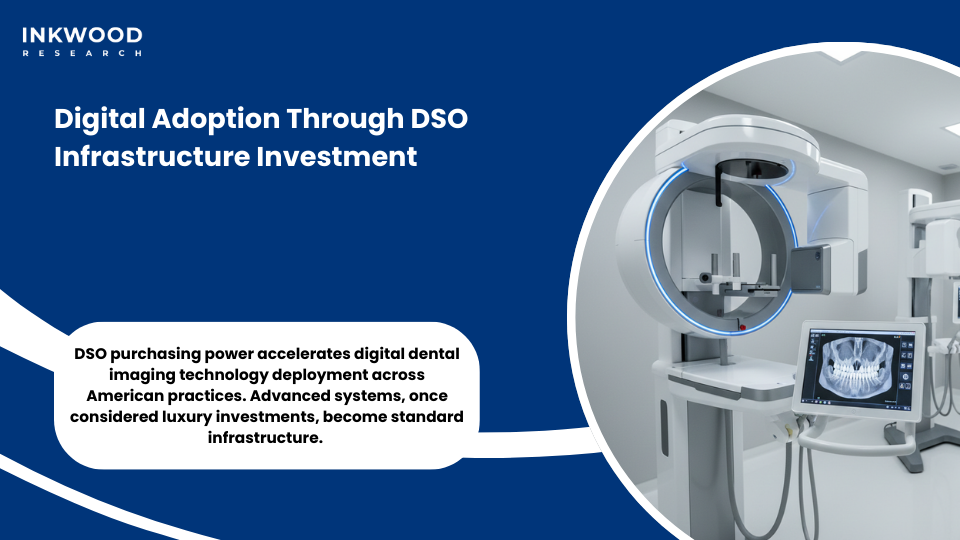
DSO purchasing power accelerates digital dental imaging technology deployment across American practices. Advanced systems, once considered luxury investments, become standard infrastructure. Consequently, patient care quality improves while diagnostic capabilities expand dramatically.
CBCT and 3D Imaging Proliferation
Cone beam computed tomography (CBCT) devices provide three-dimensional anatomical visualization impossible with traditional radiography. However, these systems traditionally cost $100,000-$400,000, creating substantial barriers for individual practices. DSO bulk purchasing reduces per-unit costs significantly while spreading acquisition expenses across organizational budgets.
Data from 2023 indicates DSO-affiliated clinics installed approximately 14,000 digital imaging systems, including CBCT units. This represents substantial market penetration compared to independent practice adoption rates. Moreover, standardized CBCT deployment enables network-wide training programs, maximizing clinical utilization. Specialists can interpret images remotely, expanding diagnostic capabilities for general practitioners.
Furthermore, 3D dental imaging systems integration with treatment planning software creates comprehensive digital workflows. DSOs invest in enterprise-level platforms connecting imaging data with electronic health records. This integration, prohibitively expensive for individual practices, becomes economically viable through consolidation. Therefore, diagnostic quality and treatment precision improve across DSO networks.
AI-Powered Diagnostic Enhancement
AI-enabled dental imaging solutions represent cutting-edge technology requiring substantial software licensing fees. DSOs negotiate enterprise agreements covering hundreds of practitioners simultaneously. According to industry reports, AI-supported dental imaging software experienced over 20% growth post-pandemic. DSOs drive significant portions of this expansion through coordinated deployment strategies.
In April 2025, Rodeo Dental & Orthodontics expanded partnerships with Overjet, an AI diagnostic platform. Dr. Yahya Mansour, Chief Dental Officer, emphasized AI integration importance: businesses either adopt AI or face obsolescence. This partnership demonstrates how DSOs leverage technology relationships unavailable to individual practices. AI systems detect caries, bone loss, and other pathologies missed by human observers, improving diagnostic consistency network-wide.
Moreover, AI platforms generate performance analytics impossible without centralized data aggregation. DSOs analyze diagnostic patterns across practitioners, identifying training needs and quality improvement opportunities. This data-driven approach, enabled by bulk technology purchasing, elevates clinical standards systematically.
Digital Workflow Integration and Cloud Infrastructure
Intraoral dental imaging systems and digital scanners require sophisticated data management infrastructure. DSOs deploy cloud-based platforms centralizing image storage, enabling real-time sharing between practitioners, specialists, and dental laboratories. This infrastructure investment exceeds most individual practices’ budgets.
Additionally, cloud solutions from companies like Carestream Dental and 3Shape facilitate efficient communication between dentists and laboratories. Real-time data exchange reduces turnaround times for prosthetic fabrication and treatment planning.
According to digital dentistry adoption statistics, over 22,000 DSO-supported clinics implemented cloud-based patient management solutions by 2023. This represents an infrastructure transformation fundamentally dependent on consolidated purchasing power.
Major Players Capitalizing on DSO Partnerships
Leading dental equipment manufacturers recognize DSOs as critical distribution channels. Strategic partnerships reshape competitive dynamics within the clinical dental imaging devices market. Aligning with this, companies investing in DSO-focused sales strategies capture disproportionate market share.
Established Equipment Manufacturers
Carestream Dental maintains strong DSO relationships through comprehensive imaging solutions. The company offers integrated platforms combining digital dental radiography devices, practice management software, and AI analytics. These innovations target DSO requirements for standardized, enterprise-level deployments.
A-dec, a prominent dental equipment provider, created dedicated DSO programs. The company appointed specialized Territory Managers serving DSO accounts exclusively. These professionals understand the unique requirements of multi-location organizations. A-dec offers configurable equipment packages designed for rapid deployment and operational consistency. Also, fleet packages featuring the A-dec 500 chair system specifically address DSO standardization needs.
KaVo Dental Systems provides advanced instruments and technology tailored to evolving DSO requirements. The company’s comprehensive product portfolio supports everything from basic diagnostic equipment to sophisticated surgical systems. Also, strategic focus on DSO partnerships positions KaVo advantageously as consolidation continues transforming American dentistry.
Software and AI Platform Developers
Overjet emerged as a leading AI-powered imaging analytics provider. The platform analyzes dental radiographs in real-time, identifying conditions that human observers might miss. Overjet’s expansion with Rodeo Dental illustrates how software companies target DSO partnerships for rapid scaling. Enterprise licensing models align perfectly with DSO bulk purchasing strategies.
Moreover, national DSOs implementing Overjet across networks report 15% case acceptance increases within months. This measurable ROI justification accelerates adoption. Furthermore, AI diagnostic standardization across multi-provider practices maintains quality consistency—a critical DSO operational priority. Software companies offering proven outcomes through enterprise deployments capture growing market share.
3Shape provides comprehensive CAD/CAM solutions integrating with imaging systems. The company’s partnerships facilitate complete digital workflow implementations. Additionally, DSOs value suppliers offering integrated ecosystems rather than standalone products. Therefore, 3Shape’s strategic positioning capitalizes on bulk purchasing trends favoring comprehensive technology partnerships.
Emerging Technology Providers
Smaller companies leverage DSO partnerships for market penetration otherwise be impossible. For example, Imagoworks, specializing in AI-driven digital dental solutions, entered distribution agreements expanding its reach. These partnerships enable technology validation at scale. Successful DSO deployments provide credibility, accelerating broader market acceptance.
On the other hand, DentiMax expanded practice management features in August 2023, aligning with digital dentistry shifts. Cloud-based platforms and AI integration represent strategic priorities. Companies offering specialized solutions that complement DSO infrastructure investments position themselves advantageously. Furthermore, demonstrated success with major DSOs creates compelling case studies attracting additional clients.
What Bulk Purchasing Means for Traditional Dental Practices
DSO bulk purchasing creates competitive pressures for independent practitioners. Aligning with this, equipment cost advantages and technology access gaps widen. However, strategic responses enable traditional practices to remain competitive within the dental imaging technology market forecast landscape.
Increasing Cost and Technology Gaps
Independent practices face 14-22% higher equipment costs compared to DSO-affiliated competitors. This differential compounds across multiple technology investments. A practice purchasing cone beam CT dental imaging systems, intraoral dental imaging systems, and associated software might spend $50,000-$100,000 more than an equivalent DSO procurement.
These cost disadvantages erode profit margins significantly. Furthermore, technology refresh cycles differ dramatically. DSOs leverage bulk purchasing to update equipment every 5-7 years systematically. Independent practices often extend equipment lifecycles to 10-15 years due to capital constraints. Consequently, technology gaps emerge. Patients increasingly notice differences between modern DSO facilities and traditional practices using older equipment.
According to CDC oral health statistics, approximately 21% of adults aged 20-64 have untreated dental caries. Competitive diagnostic capabilities influence where patients seek care. Advanced AI-enabled dental imaging solutions and 3D dental imaging systems provide marketing advantages, attracting quality-conscious patients to DSO-affiliated practices.
Strategic Response Options for Independent Practices
Group purchasing organizations (GPOs) offer independent practices collective bargaining power. These cooperatives aggregate demand across unaffiliated practices, negotiating improved pricing. While discounts typically fall short of DSO advantages, GPOs narrow cost gaps meaningfully. Additionally, industry associations sometimes facilitate equipment purchasing programs for members. Used and refurbished equipment represents another strategic option.
Reputable dealers like Renew Digital offer certified pre-owned dental imaging equipment market solutions at 40-50% discounts compared to new systems. Plus, quality refurbished panoramic dental X-ray machines and CBCT units provide advanced capabilities at accessible price points. This approach enables independent practices to deploy sophisticated technology despite capital constraints.
Additionally, leasing and alternative financing arrangements also mitigate upfront cost barriers. Equipment manufacturers increasingly offer subscription-based models. Practices pay monthly fees rather than large capital expenditures. While total costs may exceed outright purchases, cash flow management improves significantly. As a result, this financial flexibility enables technology investments previously impossible under traditional financing.
Differentiation Through Personalized Service
Independent practices cannot match DSO equipment advantages directly. However, personalized patient relationships represent competitive strengths DSOs struggle to replicate. Also, continuity of care, community engagement, and individualized attention create patient loyalty transcending technology advantages.
Strategic emphasis on these differentiators helps independent practices maintain competitive positions. Moreover, specialized services targeting specific patient populations enable niche positioning. Pediatric dentistry, cosmetic procedures, and complex restorative care often benefit from personalized approaches.
Equipment investments focused on specialization rather than comprehensive capabilities can maximize ROI. Therefore, strategic differentiation remains viable despite DSO bulk purchasing advantages.
Strategic Implications for America's Dental Technology Landscape
DSO consolidation continues to reshape the United States dental imaging market. Technology accessibility, competitive dynamics, and innovation trajectories all evolve. Understanding these trends enables stakeholders to position strategically for future success.
Accelerating Market Consolidation
DSO expansion shows no signs of slowing, with organizations opening 640 new clinics globally during 2023. American markets experience particularly rapid growth. As consolidation accelerates, bulk purchasing influence intensifies. Equipment manufacturers will increasingly orient product development toward DSO requirements rather than individual practice needs.
As a result, this shift favors standardized, scalable solutions over customized equipment. Software platforms emphasizing enterprise deployment, cloud integration, and centralized management gain importance. Consequently, the dental imaging solutions market growth trajectory increasingly reflects DSO priorities. Vendors succeeding in this environment build strategic partnerships with major DSOs early.
Furthermore, DSO purchasing concentration creates supplier dependency risks. Losing a major DSO account significantly impacts manufacturers. Therefore, companies cultivate multiple DSO relationships while maintaining independent practice sales channels. This balanced approach mitigates concentration risks while capitalizing on bulk purchasing trends.
Technology Innovation and Development Priorities
DSO feedback loops influence manufacturer R&D investments directly. Large organizations provide detailed requirements shaped by operating hundreds of practices. These insights guide product development more effectively than individual practitioner feedback. Consequently, equipment increasingly reflects standardization, integration, and operational efficiency priorities.
AI-powered dental CBCT devices and cloud-based dental imaging platforms represent technology directions driven partly by DSO requirements. Enterprise-level analytics, remote diagnostics capabilities, and centralized data management align with DSO operational models. Individual practices benefit indirectly as manufacturers incorporate these capabilities into consumer-grade products.
Additionally, DSOs drive demand for integrated digital dental workflow imaging systems connecting all practice functions. Equipment manufacturers increasingly offer comprehensive ecosystems rather than standalone products. This holistic approach, validated through DSO deployments, has gradually become the industry standard.
Regulatory and Market Access Considerations
DSO purchasing power influences regulatory discussions around healthcare consolidation. Policymakers monitor whether bulk purchasing benefits translate to improved patient care or merely cost savings.
Evidence from 2023 indicates patient satisfaction averaged 91% with minimally invasive techniques enabled by advanced equipment. This supports arguments that DSO investments improve clinical outcomes. However, concentration concerns emerge as DSOs dominate regional markets.
Competitive dynamics change when a few organizations control the majority market share. Additionally, regulatory scrutiny may increase if consolidation reaches levels threatening competition. Equipment manufacturers must navigate these dynamics carefully, ensuring DSO relationships don’t create antitrust concerns.
Key Takeaways
- Dental Service Organizations fundamentally transform the United States dental imaging market through consolidated bulk purchasing. Equipment costs decrease 14-22% under DSO procurement models. This advantage accelerates advanced technology adoption, including cone beam computed tomography (CBCT) devices and AI-enabled dental imaging solutions.
- Major manufacturers like Carestream Dental, A-dec, and KaVo Dental Systems cultivate strategic DSO partnerships. Independent practices face growing competitive pressures from DSO technology and cost advantages. However, group purchasing organizations, refurbished equipment, and strategic specialization enable competitive responses.
- The dental imaging equipment market will continue evolving toward standardization and enterprise-level solutions reflecting DSO priorities. Market consolidation accelerates, with DSOs opening hundreds of new clinics annually. This expansion intensifies the bulk purchasing influence on equipment manufacturers.
- Technology development increasingly reflects DSO requirements for scalability, integration, and operational efficiency. Stakeholders must adapt strategies, recognizing DSOs’ permanent influence on America’s dental technology landscape.
Conclusion:
DSO bulk purchasing represents more than simple cost reduction. This procurement model transforms how dental practices access advanced imaging technology. Moreover, the dental diagnostic imaging market trends demonstrate that consolidated purchasing accelerates digital transformation across American dentistry. Equipment once considered a luxury investment becomes standard infrastructure under DSO management. Independent practices must strategically respond to changing competitive dynamics.
While matching DSO equipment advantages directly proves impossible, alternative approaches enable continued viability. Group purchasing, refurbished equipment, and service differentiation provide pathways for traditional practices navigating this transformed landscape.
Based on our analysis, DSO’s influence on the dental imaging systems industry analysis will intensify over the coming years. Market consolidation continues, with organizations expanding practice networks steadily. Equipment manufacturers prioritizing DSO relationships position themselves advantageously. Technology innovation increasingly reflects enterprise-level requirements rather than individual practice needs.
Additionally, dental equipment vendors, DSO executives, independent practitioners, and healthcare investors understand that bulk purchasing implications prove essential. These procurement strategies reshape not only equipment economics but entire care delivery models. Hence, organizations adapting proactively to DSO-driven market transformation will thrive in America’s evolving dental landscape.
For organizations seeking deeper insights into dental technology procurement strategies or DSO market analysis, Inkwood Research offers comprehensive intelligence and consulting services.
Contact our team to explore how these transformative trends align with your strategic objectives.
Frequently Asked Questions
How do DSO bulk purchasing agreements benefit patient care quality?
DSO equipment investments enable advanced diagnostic capabilities like 3D dental imaging systems and AI-enabled dental imaging solutions across practice networks. These technologies improve early disease detection and treatment precision. Standardized equipment facilitates specialist consultations and remote diagnostic support. Consequently, patients receive higher-quality care regardless of which network location they visit.
Can independent dental practices compete effectively against DSO technology advantages?
Independent practices can remain competitive through strategic approaches, including group purchasing organizations, certified refurbished equipment, and service differentiation. While equipment costs remain higher than DSO procurement, GPOs narrow gaps meaningfully. Personalized patient relationships and specialized services create competitive advantages that DSOs struggle to replicate. Strategic technology investments focused on core competencies maximize independent practice ROI.
Which dental imaging technologies show the strongest growth in DSO bulk purchasing?
Cone beam computed tomography (CBCT) devices and AI-powered diagnostic platforms demonstrate the strongest DSO procurement growth. These technologies provide substantial clinical value while benefiting from economies of scale. Cloud-based imaging platforms and integrated digital workflow systems also show accelerating adoption. DSOs prioritize technologies offering network-wide standardization and centralized data management capabilities.