Table of Contents
This analysis is brought to you by Inkwood Research, a leading market intelligence firm specializing in North American and European automotive markets, autonomous vehicle technology ecosystems, and AI-driven transportation systems. Our research team combines in-depth expertise in US federal autonomous vehicle policy, Germany’s automotive manufacturing landscape, and the convergence of computer vision with smart mobility infrastructure. Through strategic partnerships with automotive OEMs, ADAS suppliers, and smart city developers, we deliver actionable intelligence for businesses navigating the United States computer vision applications in mobility market and the Germany computer vision applications in mobility market.
TLDR
The United States computer vision applications in mobility market is projected to grow from US$10.07 billion in 2026 to US$26.15 billion by 2034 at a 12.67% CAGR, while the Germany computer vision applications in mobility market expands from US$2.71 billion in 2026 to US$6.92 billion by 2034 at a 12.45% CAGR. Both markets are scaling rapidly, but through sharply different pathways. The US is commercializing autonomous fleets and robotaxi networks, while Germany is embedding computer vision deep into its precision automotive engineering tradition.
This blog is directly relevant for automotive executives, autonomous vehicle developers, and smart city planners operating in or entering the US and German markets. Furthermore, mobility investors, regulatory affairs specialists, ADAS suppliers, and transportation infrastructure stakeholders will find focused intelligence on competitive dynamics, policy environments, and technology trends shaping both the United States and Germany computer vision applications in mobility markets.
How Is the United States Computer Vision Applications in Mobility Market Scaling?
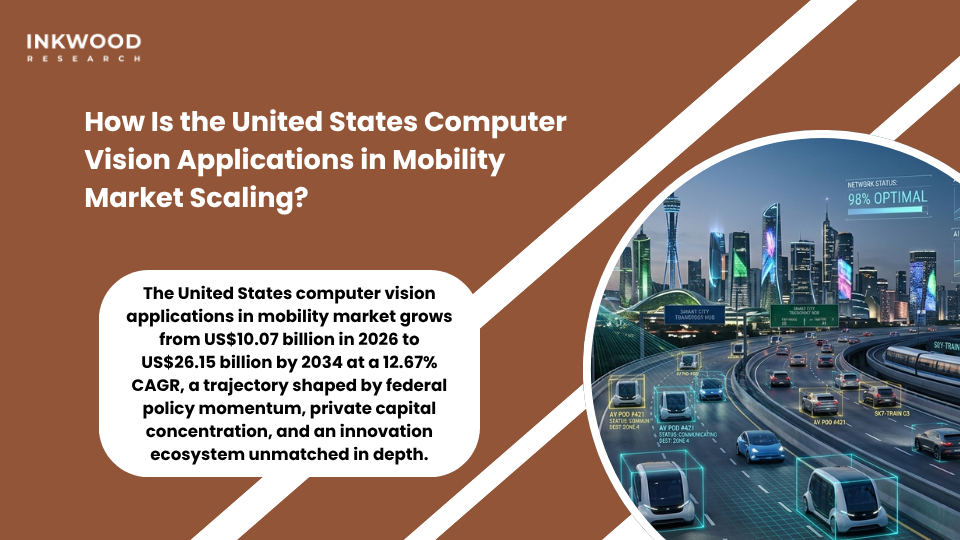
No market is scaling AI computer vision mobility with more commercial urgency than the United States. The United States computer vision applications in mobility market grows from US$10.07 billion in 2026 to US$26.15 billion by 2034 at a 12.67% CAGR, a trajectory shaped by federal policy momentum, private capital concentration, and an innovation ecosystem unmatched in depth.
The US Department of Transportation has progressively clarified the regulatory pathway for autonomous vehicles, publishing updated guidelines that reduce uncertainty for commercial fleet operators. Additionally, NHTSA’s standing general order requiring manufacturers to report crashes involving automated driving systems is creating a transparency infrastructure that builds public trust while generating actionable safety data for developers.
Federal Safety Standards as a Growth Catalyst
A key driver of the computer vision automotive market expansion in the US is the tightening of federal vehicle safety standards. NHTSA began requiring automatic emergency braking on all new passenger cars and light trucks, a mandate (to be standard by September 1, 2029) that directly increases demand for computer vision for ADAS systems at scale. Moreover, the 2024 update to the FMVSS framework extends electronic stability and braking requirements further, reinforcing the multi-year demand floor for automotive computer vision systems market participants.
What Makes Robotaxis the Flagship Application for US Computer Vision Mobility?
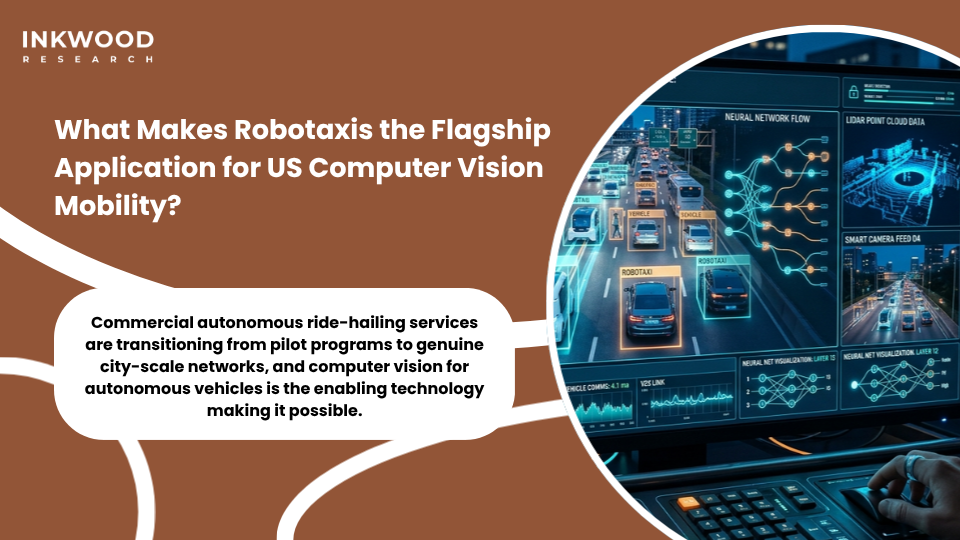
If one application defines the ambition of the United States computer vision applications in mobility market, it is the robotaxi. Commercial autonomous ride-hailing services are transitioning from pilot programs to genuine city-scale networks, and computer vision for autonomous vehicles is the enabling technology making it possible.
Waymo One’s commercial operations in San Francisco, Phoenix, and Los Angeles represent the most mature deployment globally of real-time computer vision transportation systems at scale. Meanwhile, Amazon’s Zoox continues advancing its purpose-built bidirectional robotaxi design, which integrates 360-degree computer vision for pedestrian detection and a sensor array specifically optimized for dense urban environments.
The Operational Data Flywheel
What gives US robotaxi operators a meaningful long-term advantage is the operational data flywheel. Every mile driven generates labeled perception data that refines AI computer vision mobility market models, improving edge case handling, adverse weather performance, and urban navigation precision. Consequently, early commercial operators accumulate structural advantages that pure simulation-based development cannot replicate. Furthermore, this creates a dynamic where the computer vision mobility solutions market increasingly favors operators who can sustain real-world fleet deployment at commercial scale.
How Is Germany’s Automotive Industry Driving Computer Vision Transportation Innovation?
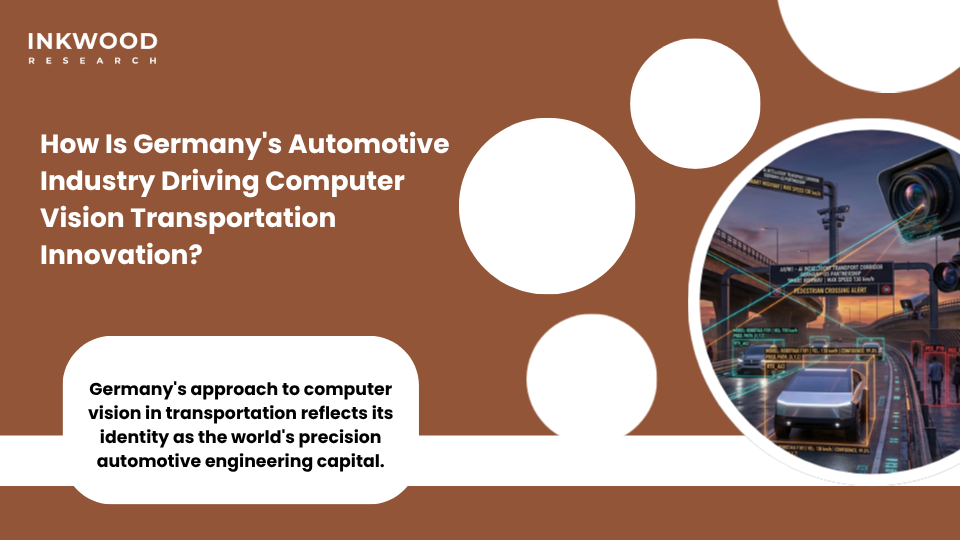
Germany’s approach to computer vision in transportation reflects its identity as the world’s precision automotive engineering capital. The Germany computer vision applications in mobility market expands from US$2.71 billion in 2026 to US$6.92 billion by 2034 at a 12.45% CAGR, a growth path anchored by the engineering depth of BMW, Mercedes-Benz, Volkswagen, and their Tier 1 supplier ecosystems.
Germany’s regulatory environment has also become one of the world’s most progressive for autonomous vehicles. The German Autonomous Driving Act (StVG amendment), which came into force in 2021, was the first national law globally to permit Level 4 autonomous vehicles on public roads in defined operational areas. This legislative clarity has directly accelerated investment in computer vision automotive market capabilities by German OEMs and their supply chains.
Tier 1 Suppliers: Germany’s Hidden Computer Vision Infrastructure
Beyond the headline OEM brands, Germany’s Tier 1 supplier network is arguably the most important layer of its intelligent mobility computer vision market. Continental, ZF, and Valeo, all with major German operations, embed computer vision mobility solutions across hundreds of vehicle programs globally. These suppliers develop the camera systems, perception processors, and sensor fusion architectures that bring computer vision for ADAS systems to production reality at scale, making Germany’s contribution to global computer vision transportation market growth significantly larger than domestic market numbers alone suggest.
What Does Smart Highway Infrastructure Mean for Computer Vision Mobility Solutions?
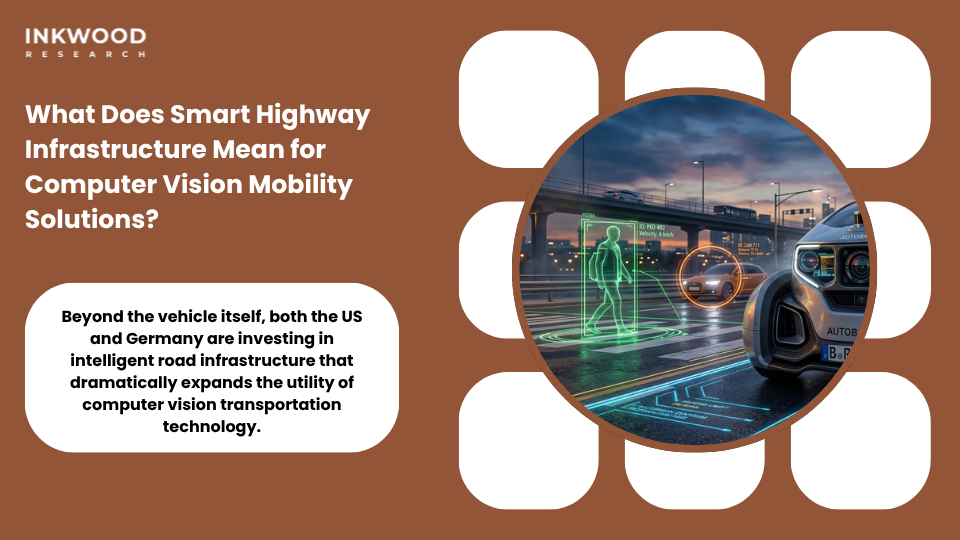
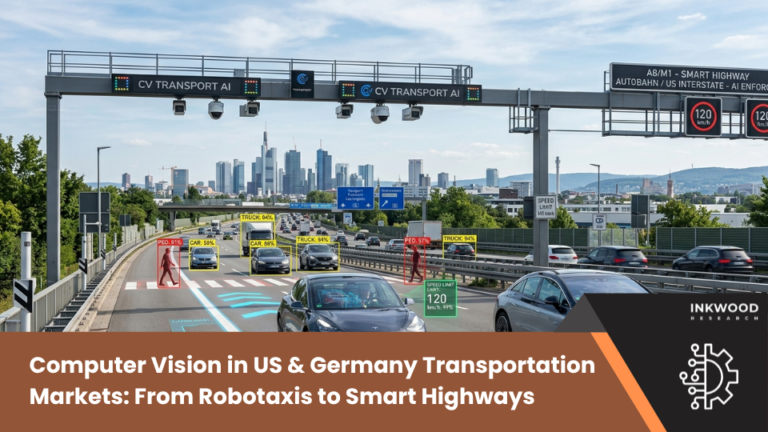
Beyond the vehicle itself, both the US and Germany are investing in intelligent road infrastructure that dramatically expands the utility of computer vision transportation technology. Smart highways equipped with roadside camera networks, V2X (vehicle-to-everything) communication nodes, and AI-driven traffic management systems create a cooperative perception environment where vehicles and infrastructure share data in real time.
In the United States, the Bipartisan Infrastructure Law allocated significant funding for intelligent transportation system upgrades, including camera-based traffic monitoring and connected infrastructure deployment across the Interstate Highway System. This investment directly supports the computer vision for traffic monitoring and mobility management market segment, creating long-term public infrastructure demand alongside private vehicle applications.
Germany’s Autobahn Goes Digital
Germany’s federal government, through the Bundesministerium für Digitales und Verkehr, is advancing digital infrastructure pilots along key Autobahn corridors, including connected RSU (roadside unit) deployments that enable real-time V2X communication with test vehicles. These initiatives directly support the computer vision in transportation market by providing controlled real-world environments where AI-powered transportation systems can be validated at highway speeds and across diverse weather conditions. Furthermore, they strengthen Germany’s position as a testing ground for production-ready computer vision autonomous vehicle market technologies.
Which Companies Lead the US and Germany Computer Vision Automotive Markets?
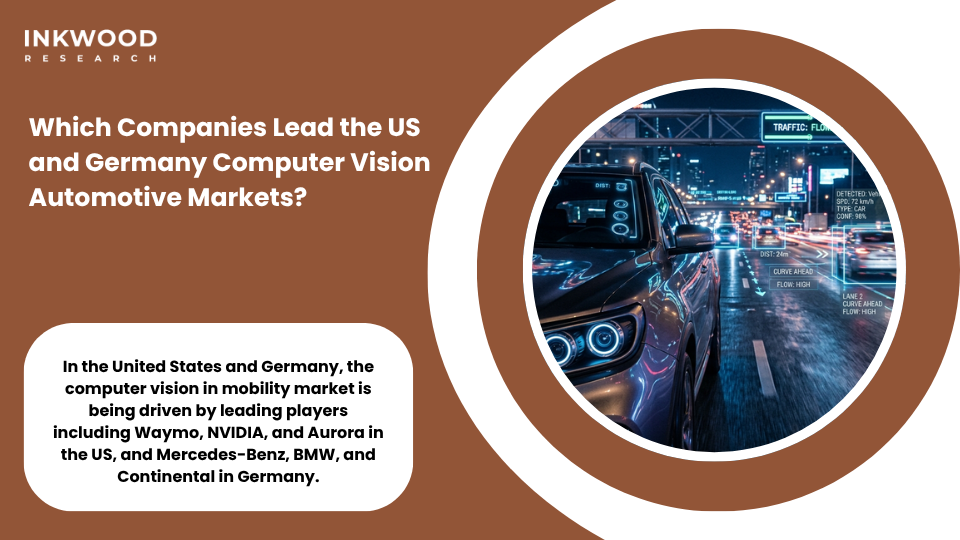
In the United States and Germany, the computer vision in mobility market is being driven by leading players including Waymo, NVIDIA, and Aurora in the US, and Mercedes-Benz, BMW, and Continental in Germany. (only img text)
United States, Key Players:
- Waymo: The most commercially advanced computer vision for autonomous vehicles operator globally, with active robotaxi services and a growing Waymo Via freight division. Its partnership with Uber Eats in 2024, utilizing Jaguar I-PACE electric vehicles for autonomous food deliveries in Phoenix, signals diversification beyond ride-hailing.
- NVIDIA: Its DRIVE Orin and DRIVE Thor platforms power AI compute for autonomous vehicles from multiple US and global OEMs. The 2024 announcement of NVIDIA DRIVE Thor, consolidating 2,000 TOPS of AI performance for next-generation vehicles, positions NVIDIA as the dominant compute platform for computer vision mobility solutions market participants.
- Aurora Innovation: Focused on autonomous trucking, Aurora’s commercial launch of its Aurora Driver system for Class 8 trucks on Texas highways in May 2025 represents a major real-time computer vision transportation systems milestone for US freight mobility.
Germany, Key Players:
- Mercedes-Benz: The auto-giant became the first automaker globally to receive regulatory approval for a Level 3 automated driving system with its Drive Pilot system, legal for highway use in Germany and California. This positions Mercedes at the frontier of production-ready intelligent mobility computer vision market deployment.
- BMW: BMW’s partnership with NVIDIA for its Neue Klasse vehicle platform integrates automotive computer vision systems market capabilities from the ground up, rather than retrofitting existing architectures, signaling a new generation of AI-native vehicle design.
- Continental: One of the world’s leading Tier 1 suppliers, Continental’s camera and perception systems are embedded in production ADAS across multiple OEM programs globally, making it a critical infrastructure layer for both the United States and Germany computer vision applications in mobility market.
What Are the Emerging Frontiers in US and Germany Computer Vision Transportation?
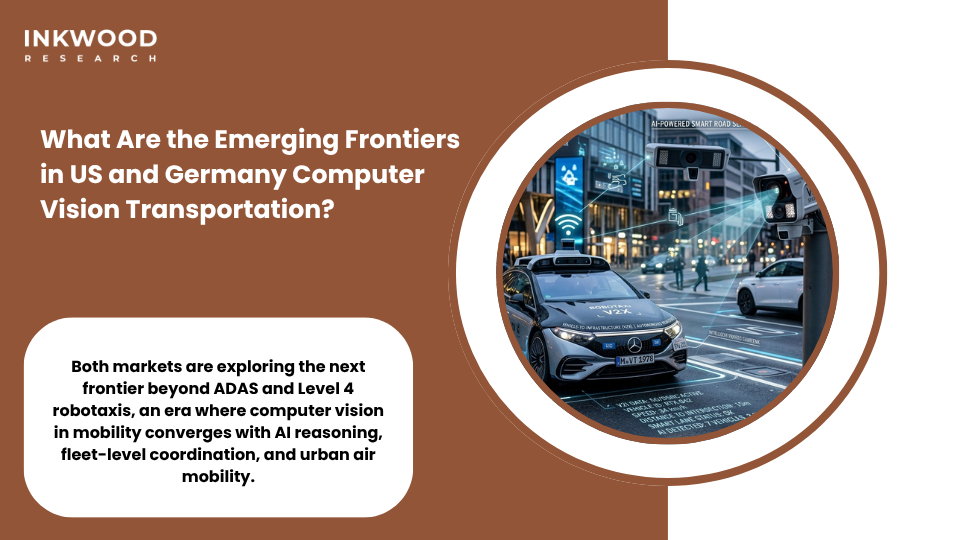
Both markets are exploring the next frontier beyond ADAS and Level 4 robotaxis, an era where computer vision in mobility converges with AI reasoning, fleet-level coordination, and urban air mobility.
- Vision-Language Models for Navigation: Emerging systems that combine visual perception with natural language understanding are enabling vehicles to interpret complex, unstructured driving scenarios with contextual reasoning, a capability that traditional computer vision architectures cannot provide. This is actively being developed by research teams at NVIDIA, Waymo, and several university-industry consortia in both the US and Germany.
- Autonomous Trucking Corridors: The US’s vast highway network is an ideal proving ground for machine vision mobility technology in long-haul freight. Aurora’s Texas operations and Kodiak Robotics’ Southwest US corridor deployments are generating commercial revenue while advancing the maturity of computer vision autonomous vehicle market systems at highway speeds.
- Urban Air Mobility (UAM): Computer vision is also central to the emerging UAM sector, where air taxis and autonomous drones require real-time object detection and airspace awareness capabilities. Companies like Lilium (Germany) and Joby Aviation (US) are developing AI-powered transportation systems that extend computer vision’s reach into three-dimensional urban mobility, an entirely new application dimension for the computer vision mobility technology market forecast.
Key Takeaways
- The United States computer vision applications in mobility market grows from US$10.07B in 2026 to US$26.15B by 2034 at a 12.67% CAGR, anchored by NHTSA safety mandates, robotaxi scaling, and autonomous freight deployment.
- The Germany computer vision applications in mobility market expands from US$2.71B in 2026 to US$6.92B by 2034 at a 12.45% CAGR, driven by OEM engineering depth, Tier 1 supplier scale, and Level 3 regulatory leadership.
- US robotaxi operators, particularly Waymo, are building data flywheels through commercial deployment that create structural competitive advantages in real-time computer vision transportation systems.
- Germany’s Autonomous Driving Act and Mercedes-Benz’s Level 3 approval together make it the most advanced regulatory environment for production of intelligent mobility computer vision in Europe.
- Smart highway infrastructure investment, via the US Bipartisan Infrastructure Law and Germany’s Autobahn digital pilots, extends the computer vision for the traffic monitoring market beyond vehicles into national transportation infrastructure.
- Emerging frontiers, including vision-language models, autonomous trucking corridors, and urban air mobility, are expanding the long-term addressable market for computer vision mobility solutions in both geographies.
Frequently Asked Questions
How large is the United States computer vision applications in mobility market?
The US market is valued at US$10.07 billion in 2026, growing to US$26.15 billion by 2034 at a 12.67% CAGR, driven by ADAS mandates, robotaxi expansion, and autonomous freight scaling.
How does the Germany computer vision applications in mobility market differ from the US?
Germany leads through precision OEM engineering and Tier 1 supplier scale, while the US leads in commercial autonomous fleet deployment and robotaxi operations, two complementary but distinct pathways in the computer vision automotive market.
What is Germany's Autonomous Driving Act and why does it matter?
The German Autonomous Driving Act was the world’s first national law permitting Level 4 autonomous vehicles on public roads in defined areas, establishing Germany as the leading regulatory environment for production computer vision autonomous vehicle market development in Europe.
Why is the US robotaxi market significant for computer vision mobility?
Commercial robotaxi operations generate real-world perception data at scale, creating training flywheels that improve AI computer vision systems significantly faster than simulation alone, giving early operators a durable competitive advantage.
Which long-tail computer vision transportation technology trends should investors watch?
Vision-language models for contextual navigation, autonomous trucking corridor expansion, and urban air mobility computer vision systems represent the highest-potential long-tail growth vectors in the computer vision mobility technology market forecast through 2034.
How does smart highway infrastructure support computer vision in transportation?
Roadside camera networks, V2X communication nodes, and AI traffic management systems create cooperative perception environments that enhance vehicle-level computer vision by sharing real-time infrastructure data, expanding the effective sensing range of autonomous systems.