Table of Contents

This analysis is brought to you by Inkwood Research, a leading market intelligence firm specializing in AI-powered transportation systems, intelligent mobility platforms, and automotive computer vision ecosystems. Our research team combines deep expertise in autonomous driving technology, advanced driver assistance systems (ADAS), and smart mobility solutions across North America, Europe, and Asia-Pacific. Through strategic partnerships with automotive OEMs, mobility technology developers, and smart city stakeholders, we deliver actionable insights for businesses navigating the evolving computer vision applications in mobility market.
TLDR
The global computer vision applications in mobility market is projected to grow from US$41.44 billion in 2026 to US$118.75 billion by 2034, reflecting a 14.07% CAGR. Multimodal AI is redefining how vehicles perceive, interpret, and respond to their environments. From ADAS to fully autonomous fleets, computer vision in transportation is unlocking a new era of intelligent, connected mobility, spanning North America, Europe, and Asia-Pacific.
This blog is essential reading for automotive executives, mobility technology investors, and smart city strategists evaluating AI-driven transportation opportunities. Additionally, policy planners, ADAS developers, logistics firms, and transportation infrastructure teams across North America, Europe, and Asia-Pacific will find targeted intelligence on market dynamics, competitive strategies, and emerging applications in the global computer vision mobility solutions market.
What Is Driving the Computer Vision Applications in Mobility Market?

Mobility is undergoing one of its most significant transformations in history, and computer vision in the mobility market is at the center of it. Unlike previous automotive technology cycles, today’s shift is driven by multimodal AI that combines cameras, radar, lidar, and deep learning to enable machines to interpret complex, real-world driving scenarios in real time.
The global computer vision applications in mobility market is on a sharp growth curve, rising from US$41.44 billion in 2026 to US$118.75 billion by 2034 at a 14.07% CAGR. Moreover, this expansion is not confined to premium vehicles; it is spreading rapidly across commercial fleets, public transit systems, and shared mobility platforms.
Why Real-Time Object Detection Is Non-Negotiable
At the heart of this growth is real-time object detection, the foundational capability that allows vehicles to identify pedestrians, cyclists, road signs, and other vehicles within milliseconds. Consequently, as vehicle safety standards tighten globally, automakers are embedding computer vision across their entire product lines rather than limiting it to luxury tiers.
Furthermore, the US Department of Transportation has been actively advancing autonomous vehicle frameworks, which directly accelerates demand for robust AI-powered transportation systems. These policy tailwinds, combined with falling sensor costs, are creating a highly favorable environment for rapid computer vision automotive market expansion.
Connected Vehicles and the Data Advantage
Beyond safety, connected vehicle technology is amplifying the value of computer vision by enabling vehicles to share perception data with traffic infrastructure and other road users. This real-time data exchange underpins smart mobility solutions that reduce congestion, lower emissions, and improve urban traffic flow, outcomes that are particularly significant for governments pursuing sustainable transportation goals.
How Are ADAS Systems Transforming Road Safety?

Advanced driver assistance systems (ADAS) represent the most widely deployed application in the computer vision in transportation market today. From lane-keeping assist and automatic emergency braking to blind-spot detection and adaptive cruise control, these features are becoming standard equipment across mid-range and premium vehicles globally.
According to the European Commission Road Safety Policy, vehicle safety technology, including ADAS-enabled systems, is central to the EU’s Vision Zero strategy to eliminate road fatalities by 2050. Similarly, NHTSA in the United States has established voluntary and mandatory ADAS standards that are progressively raising the technology baseline for all vehicles sold in the US market.
From Lane Assist to Level 4 Autonomy
The transition from ADAS to higher levels of vehicle autonomy is not a leap; it is a continuum. Each additional sensor layer and computer vision mobility solutions capability builds on the last, gradually increasing the envelope within which vehicles can operate without human input. Notably, Level 2 and Level 3 automated features are already mainstream in new vehicle launches from Toyota, Volkswagen, Hyundai, and General Motors.
Furthermore, computer vision for pedestrian detection has advanced considerably, with current systems achieving high accuracy in identifying vulnerable road users even in low-light and adverse weather conditions, scenarios that previously strained earlier-generation cameras. These improvements are directly contributing to measurable reductions in pedestrian fatalities in markets where ADAS adoption is high.
Which Regions Are Leading AI Computer Vision Mobility Adoption?

Regional dynamics in the AI computer vision mobility market vary considerably, yet all three major geographies are scaling rapidly, each led by distinct demand drivers and policy environments.
- North America (US$11.38B in 2026 → US$30.20B by 2034, 12.97% CAGR): The US leads in regulatory clarity and commercial autonomy deployment. Federal ADAS mandates, alongside state-level autonomous vehicle pilot programs, are creating sustained demand for automotive computer vision systems.
- Europe (US$9.57B in 2026 → US$25.85B by 2034, 13.22% CAGR): The EU’s General Safety Regulation, which mandated specific ADAS features on all new vehicles from 2022, has made Europe one of the most standardized markets for computer vision transportation technology. Germany, in particular, anchors European manufacturing and R&D.
- Asia-Pacific (US$16.35B in 2026 → US$50.15B by 2034, 15.04% CAGR): Asia-Pacific is the fastest-growing region, driven by China’s aggressive smart city programs, Japan’s aging population dynamics, and South Korea’s EV and autonomous vehicle manufacturing ambitions. Moreover, rapid urbanization across Southeast Asia is creating new demand for smart transportation computer vision at scale.
Asia-Pacific’s Smart City Edge
China’s Ministry of Industry and Information Technology has been actively advancing intelligent connected vehicle standards, creating a regulatory runway for mass-market computer vision for autonomous vehicles. Meanwhile, Japan’s Society 5.0 initiative directly incorporates intelligent transportation systems as a pillar of national infrastructure strategy, reinforcing the region’s long-term growth trajectory in intelligent mobility computer vision.
How Are Major Companies Shaping Intelligent Mobility Computer Vision?

The competitive landscape of the computer vision automotive market features a blend of established automotive suppliers, technology hyperscalers, and nimble mobility startups, all competing to define the architecture of next-generation transportation.
- Mobileye: Intel’s mobility technology arm continues to lead in ADAS computer vision deployment, with its SuperVision system powering hands-free driving in production vehicles. Mobileye continued to accelerate its mapping and sensing partnerships with multiple global OEMs to accelerate Level 3 feature rollouts.
- NVIDIA: NVIDIA’s DRIVE platform underpins a broad ecosystem of autonomous vehicle developers. Its 2024 partnership with Mercedes-Benz to power next-generation in-vehicle AI systems underscores its growing role in the automotive computer vision systems market dominance.
- Waymo: Alphabet’s Waymo One has expanded its commercial robotaxi service to multiple US cities, generating real-world operational data that is invaluable for refining real-time computer vision transportation systems. Plus, Waymo’s expansion into new markets reflects growing commercial confidence in computer vision for autonomous vehicles.
- Bosch: As one of the world’s largest automotive suppliers, Bosch integrates computer vision mobility solutions across its broad ADAS portfolio. Its radar-camera fusion systems are embedded in millions of vehicles globally, making Bosch a critical infrastructure layer in the computer vision in mobility market.
- Qualcomm: Qualcomm’s Snapdragon Ride platform is positioning the company as a machine vision mobility technology platform provider for next-generation vehicles. Its design wins with multiple Asian and European OEMs signal a broadening competitive footprint in the computer vision transportation market growth.
What Are the Latest Innovations in Computer Vision Transportation Technology?
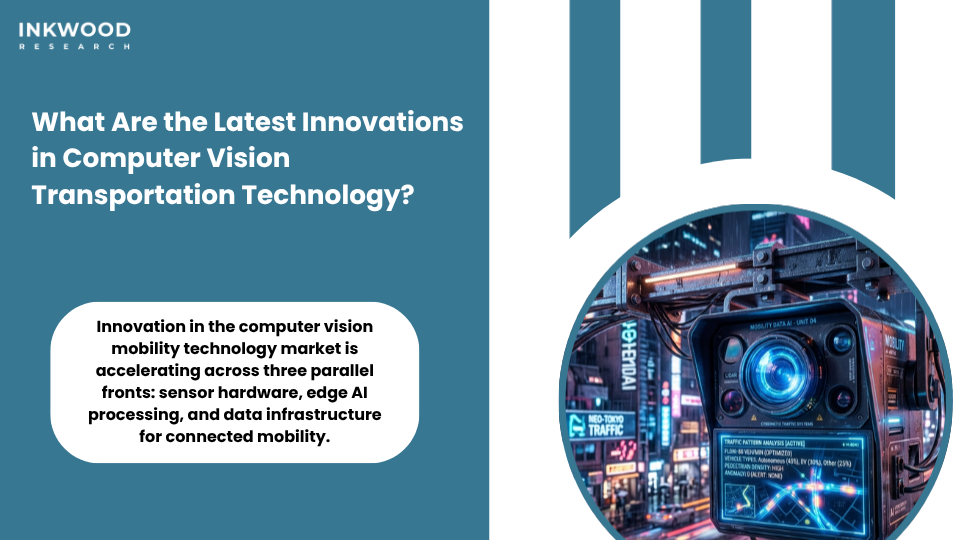
Innovation in the computer vision mobility technology market is accelerating across three parallel fronts: sensor hardware, edge AI processing, and data infrastructure for connected mobility.
Sensor Fusion and Edge AI
- The convergence of camera, radar, and lidar inputs into unified perception models, often called sensor fusion, is delivering situational awareness that no single sensor can achieve alone.
- Furthermore, the shift toward edge AI processing allows vehicles to analyze perception data onboard in real time, reducing latency and reliance on cloud connectivity.
- This capability is foundational for computer vision for traffic monitoring and mobility management in urban environments where real-time responses are non-negotiable.
Generative AI Entering the Mobility Stack
- Beyond perception, generative AI is beginning to influence computer vision applications in connected vehicles, particularly for synthetic data generation used in training autonomous systems.
- By creating diverse, simulated driving scenarios, developers can train computer vision for autonomous vehicles on rare but critical edge cases, dramatically improving system reliability without requiring billions of real-world miles.
- Additionally, vision-language models are enabling vehicles to interpret natural language navigation commands, adding a new dimension to intelligent mobility computer vision capabilities.
Key Takeaways
- The computer vision applications in mobility market grows from US$41.44B in 2026 to US$118.75B by 2034 at a 14.07% CAGR, driven by ADAS adoption, autonomous vehicle deployment, and smart city expansion.
- Asia-Pacific leads regional growth at 15.04% CAGR, followed by Europe (13.22%) and North America (12.97%), with each region shaped by distinct policy, infrastructure, and demand dynamics.
- ADAS systems are the primary near-term demand engine, while computer vision for autonomous vehicles represents the longer-term transformative growth vector.
- Mobileye, NVIDIA, Waymo, Bosch, and Qualcomm are the most consequential competitors shaping the automotive computer vision systems market across hardware, software, and platform dimensions.
- Sensor fusion, edge AI, and generative AI-driven training data are the three most important technology trends reshaping computer vision transportation technology capabilities in 2026.
- Policy frameworks from the US DOT, EU General Safety Regulation, and China’s MIIT are collectively accelerating AI computer vision transportation market growth through regulatory standardization.
Frequently Asked Questions (FAQs)
ADAS mandates, autonomous vehicle scaling, and smart city investment are the primary growth drivers, alongside declining sensor costs and rising demand for real-time object detection across global transportation networks.
Asia-Pacific leads with a 15.04% CAGR through 2034, driven by China’s intelligent connected vehicle programs, Japan’s Society 5.0 initiative, and rapid urbanization across Southeast Asia.
Traditional sensing relies on radar or proximity detection alone. Computer vision adds semantic understanding, identifying what objects are and predicting how they will behave, enabling far more accurate and context-aware autonomous decision-making in real time.
Sensor fusion combines camera, radar, and lidar data into unified perception models, delivering superior situational awareness and reliability compared to any single-sensor approach, especially in adverse weather and low-light conditions.
Mobileye, NVIDIA, Waymo, Bosch, and Qualcomm are the leading players, each competing across perception hardware, AI compute platforms, and system integration for computer vision mobility solutions.
Generative AI enables synthetic training data creation for autonomous systems, significantly reducing the real-world data collection required to develop robust computer vision for autonomous vehicles across rare but critical edge-case scenarios.