Table of Contents
This analysis is brought to you by Inkwood Research, a leading market intelligence firm specializing in China’s unmanned aerial vehicle ecosystem, advanced battery manufacturing technologies, and electric vehicle power systems. Our research team combines extensive experience analyzing the China UAV battery market, lithium-ion and lithium-polymer battery innovations, and strategic partnerships between Chinese manufacturers like CATL, BYD, Grepow, and global aerospace companies. Based on our proprietary research methodologies and direct engagement with China’s battery supply chain—from raw material extraction to finished UAV power systems—we deliver actionable insights that empower strategic decision-making for international drone manufacturers, defense contractors, and technology investors navigating China’s dominant position in global battery production and unmanned aerial systems manufacturing.
TLDR
Chinese-made UAV battery solutions dominate global markets through unprecedented manufacturing scale, advanced lithium-ion batteries technology, and aggressive research investments. China controls the majority of the worldwide battery technology production capacity while pioneering innovations in energy density, thermal management, and cost optimization. Major players like CATL, BYD, and Grepow leverage vertical integration from raw material extraction to finished drone power systems, delivering superior performance at competitive prices that reshape sustainable transportation and unmanned aerial vehicle industries worldwide.
This comprehensive analysis benefits UAV battery market procurement managers, drone manufacturers, defense contractors, automotive industry executives, and agricultural technology companies. Additionally, investment analysts evaluating the China UAV battery market opportunities, regulatory compliance officers navigating international trade, supply chain strategists, and technology innovators developing next-generation aerial platforms will gain actionable insights into Chinese battery manufacturing capabilities and competitive advantages.
1.Manufacturing Scale Dominance Drives Cost Leadership
Unmatched Production Capacity
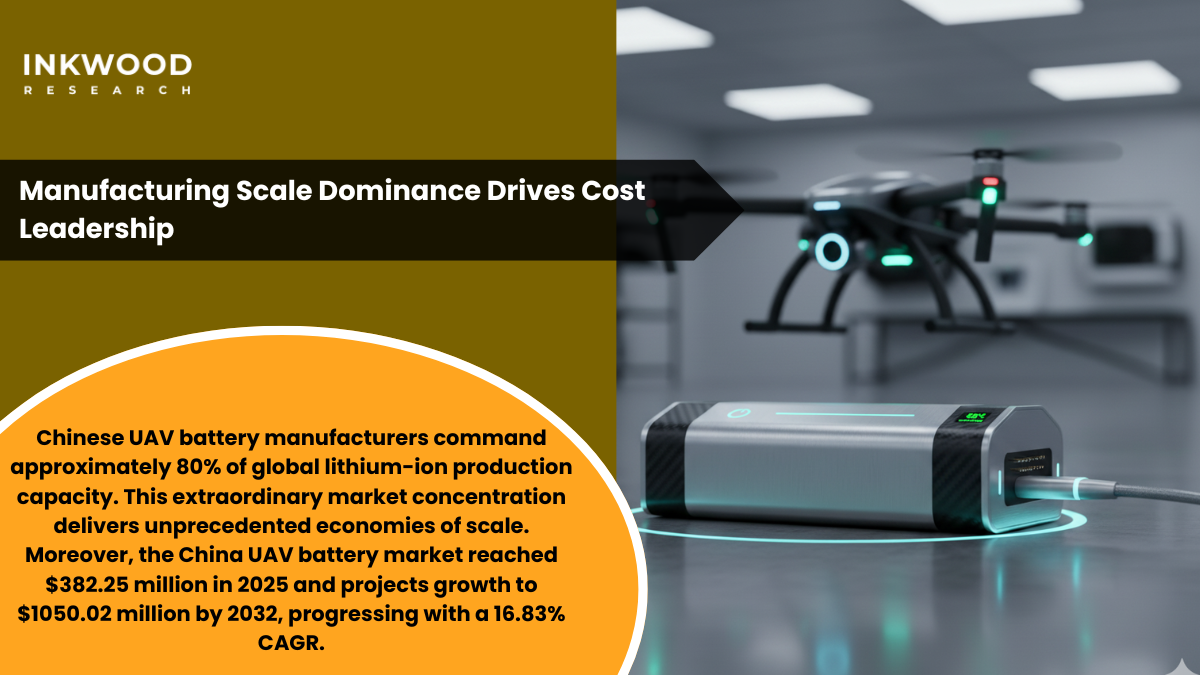
Chinese UAV battery manufacturers command approximately 80% of global lithium-ion production capacity. This extraordinary market concentration delivers unprecedented economies of scale. Moreover, the China UAV battery market reached $382.25 million in 2025 and projects growth to $1050.02 million by 2032, progressing with a 16.83% CAGR. Consequently, manufacturers achieve cost advantages impossible for competitors to replicate.
CATL exemplifies this manufacturing prowess through thirteen battery production facilities worldwide. The company maintains its position as the world’s largest EV and energy storage battery manufacturer with approximately 38% global market share. Furthermore, its Ningde headquarters produces batteries at scales exceeding any Western competitor. These massive production volumes enable aggressive pricing strategies while maintaining healthy profit margins.
Government Support Amplifies Competitive Edge
Strategic initiatives under the Made in China 2025 industrial policy accelerate research and development in lithium-ion batteries, solid-state architectures, and hydrogen fuel cell technologies, specifically targeting aerospace applications. Additionally, Production Linked Incentive schemes provide substantial financial support for expanding domestic manufacturing capabilities. These coordinated government efforts create favorable market conditions that Western battery suppliers struggle to match despite their technical expertise.
2.Advanced Energy Density Innovation
Breakthrough Condensed Battery Technology
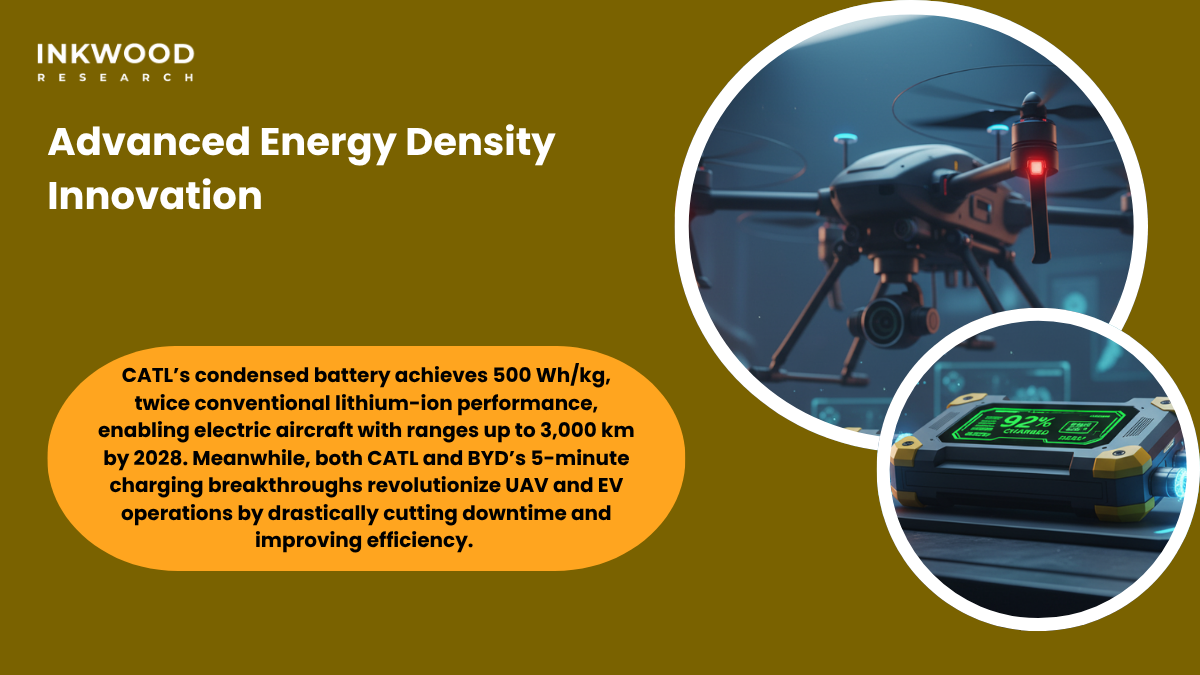
CATL unveiled its revolutionary condensed battery in April 2023, achieving an incredible 500 Wh/kg energy density. This represents more than twice the performance of conventional automotive battery technology systems. Specifically, typical lithium-ion batteries in Tesla Model 3 vehicles deliver approximately 265 Wh/kg, while CATL’s aviation-grade solution doubles this metric. Subsequently, the company successfully test-flew a 4-ton aircraft using battery power in June 2024.
The condensed battery technology specifically targets aviation applications, with safety and weight optimization paramount. Moreover, CATL announced plans for commercial electric aircraft with 2,000 to 3,000-kilometer range capabilities by 2027-2028. These ambitious targets demonstrate how Chinese manufacturers push technological boundaries beyond incremental improvements seen elsewhere in the industry.
Ultra-Fast Charging Capabilities
In April 2025, CATL introduced its upgraded Shenxing battery with revolutionary 5-minute charging capability. This breakthrough addresses one of the most significant limitations facing UAV battery operations: extended ground time between missions. Furthermore, the technology enables drone operators to complete multiple daily flight cycles without maintaining large battery inventories. Consequently, operational efficiency increases dramatically while reducing capital expenditure requirements.
BYD similarly announced 5-minute charging technology in late 2024, directly challenging CATL’s market positioning. This intense competition drives rapid technological progress, benefiting consumers globally. Additionally, both companies claim these advancements maintain cost advantages through lithium-polymer batteries chemistry optimizations rather than expensive exotic materials.
3.China UAV Battery Market: Vertical Integration Advantage
Complete Supply Chain Control
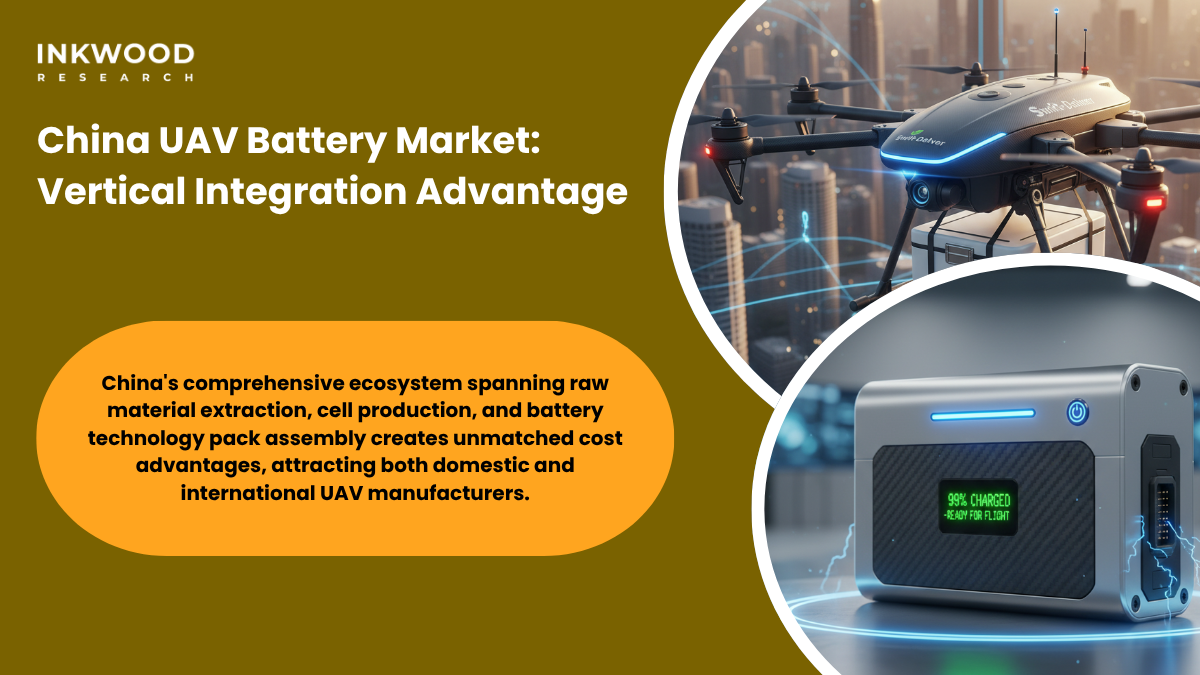
China’s comprehensive ecosystem spanning raw material extraction, cell production, and battery technology pack assembly creates unmatched cost advantages, attracting both domestic and international UAV manufacturers. The nation controls lithium mining operations, cathode material production, and cell manufacturing facilities. Therefore, Chinese battery suppliers optimize every value chain step rather than depending on external component sources.
According to the National Development and Reform Commission, technology development funds prioritize breakthrough innovations in battery chemistry and thermal management systems. These investments strengthen domestic capabilities across the entire battery development spectrum. Moreover, established supply chain relationships enable rapid scaling of production capacity, responding to surging market requirements without logistics bottlenecks.
Strategic Raw Material Access
Chinese manufacturers maintain preferential access to critical battery materials, including lithium, nickel, and cobalt, through strategic mining investments across multiple continents. Additionally, domestic processing facilities convert these raw materials into battery-grade components with minimal transportation costs. This vertical integration extends beyond basic materials to include advanced manufacturing equipment and automation technologies developed specifically for battery production.
Shenzhen Grepow Battery and Shenzhen BAK Battery leverage these supply chain advantages to deliver specialized UAV battery solutions optimized for aerial applications. Furthermore, their engineering teams collaborate directly with raw material suppliers, ensuring consistent quality while minimizing procurement complexities that plague international competitors.
4.Specialized Aviation-Grade Solutions
Tailored Performance Characteristics
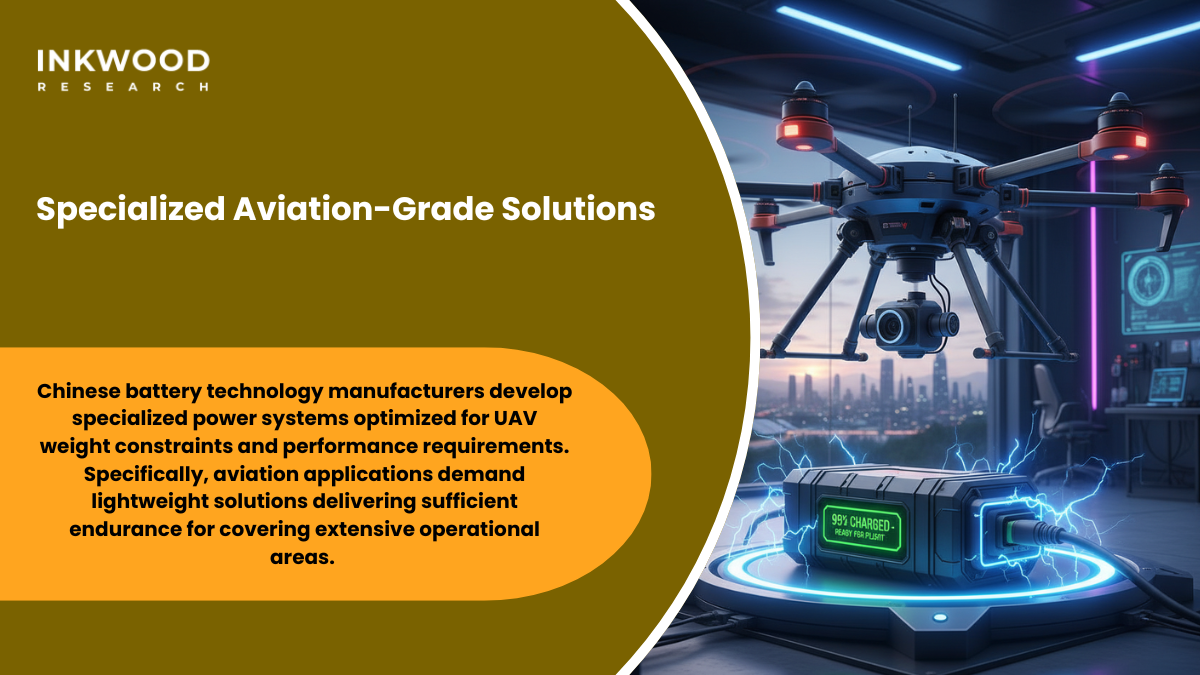
Chinese battery technology manufacturers develop specialized power systems optimized for UAV weight constraints and performance requirements. Specifically, aviation applications demand lightweight solutions delivering sufficient endurance for covering extensive operational areas. Moreover, thermal management systems become critical when batteries experience rapid discharge cycles during high-power flight profiles.
CATL’s engineering teams focus on maximizing energy storage solutions density while maintaining rigorous safety standards critical for aviation operations. Their product development processes incorporate sophisticated thermal management addressing heat generation challenges encountered during UAV missions. Additionally, extensive quality control procedures ensure consistent performance across high-volume production runs serving both domestic and international drone manufacturers.
Temperature Resilience Engineering
Chinese manufacturers invest heavily in developing battery technology systems capable of operating across extreme temperature ranges. Agricultural drones in northern China face winter temperatures below -20°C, while desert operations in Middle Eastern markets exceed 45°C ambient conditions. Consequently, battery chemistries must maintain performance across this 65-degree temperature differential without degradation.
According to the China Electronics Standardization Institute, standardization efforts increasingly align battery specifications across UAV categories, facilitating economies of scale in production. These standards emphasize thermal stability, charging safety, and lifecycle performance metrics specific to aerial platform requirements. Furthermore, compliance with aviation authority certifications ensures batteries meet international safety requirements for commercial drone operations.
5.Rapid Technological Evolution in the China UAV Battery Market
Next-Generation Chemistry Development
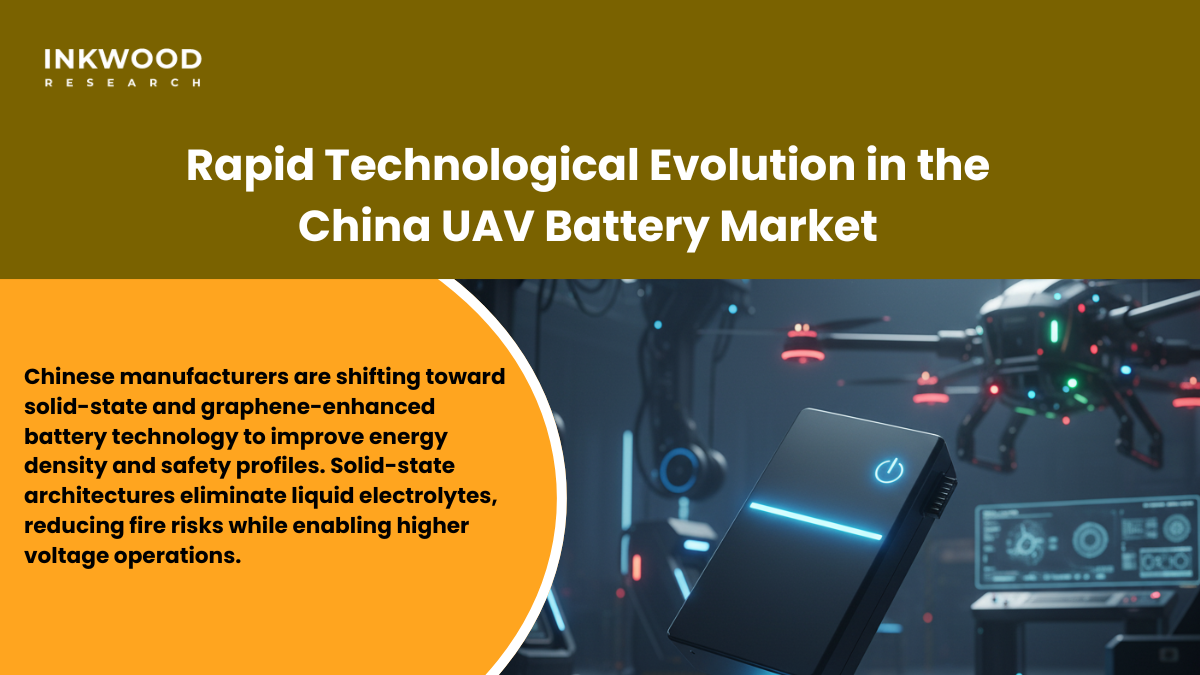
Chinese manufacturers are shifting toward solid-state and graphene-enhanced battery technology to improve energy density and safety profiles. Solid-state architectures eliminate liquid electrolytes, reducing fire risks while enabling higher voltage operations. Moreover, these next-generation chemistries promise significantly extended operational lifespans compared to current lithium-ion batteries formulations.
Local startups focus on hydrogen fuel cell UAVs to cater to defense and long-endurance commercial applications. Fuel cell systems generate electrical power through electrochemical reactions between hydrogen and oxygen, producing only water as a byproduct. Additionally, energy densities significantly exceed conventional lithium batteries, proving particularly valuable for military applications requiring multi-hour missions over vast territories.
Artificial Intelligence Integration
Increasing use of battery management systems (BMS) with AI-based monitoring enhances performance and lifecycle control across Chinese UAV battery products. These intelligent systems continuously analyze cell voltages, temperatures, and discharge rates, optimizing power delivery while preventing dangerous conditions. Furthermore, machine learning algorithms predict remaining useful life, enabling proactive battery replacement before performance degradation affects mission capabilities.
CATL’s technical support services assist UAV manufacturers with battery integration, providing guidance on pack configuration, charging infrastructure, and battery technology management system optimization. Their engineers share decades of accumulated expertise developed through automotive electric vehicle programs. Consequently, drone manufacturers accelerate development cycles while avoiding costly trial-and-error experimentation.
Recent Industry Developments
- In February 2025, CATL filed for a secondary listing on the Hong Kong Stock Exchange, aiming to raise over $5 billion to fund international expansion plans, including projects in Hungary, Spain, and Indonesia. This massive capital infusion will further accelerate research and development initiatives while expanding global manufacturing capacity. Moreover, cornerstone investors included major financial institutions demonstrating strong confidence in CATL’s long-term growth trajectory.
- Additionally, in December 2024, CATL announced a collaboration with Stellantis in a joint venture to build a large-scale lithium iron phosphate battery plant in Zaragoza, representing a €4.1 billion investment. This strategic partnership showcases how Chinese battery expertise penetrates Western automotive markets despite geopolitical tensions. Furthermore, production is anticipated to commence in 2026 with capacity reaching 50 GWh annually.
Key Takeaways
Chinese-made UAV battery solutions deliver five distinct competitive advantages, reshaping global unmanned aerial vehicle markets. First, manufacturing scale dominance through ~75-80% global production capacity creates an unassailable cost leadership impossible for Western competitors to match. Second, advanced energy density innovations, including CATL’s 500 Wh/kg condensed batteries and 5-minute ultra-fast charging capabilities, revolutionize operational efficiency for drone operators worldwide.
Third, vertical integration from lithium mining through finished battery assembly eliminates supply chain vulnerabilities while optimizing every production step. Fourth, specialized aviation-grade solutions address unique UAV requirements, including extreme temperature resilience, lightweight construction, and safety certifications essential for commercial operations. Fifth, rapid technological evolution through solid-state chemistry development, hydrogen fuel cell integration, and AI-powered battery management systems maintains Chinese manufacturers’ innovation leadership
Conclusion
According to our analysis, the China UAV battery market will experience extraordinary growth momentum driven by the country’s position as the world’s largest drone manufacturing hub and aggressive government support for advanced energy storage solutions technologies. Strategic initiatives, expanding commercial applications, and dominant export capabilities fundamentally position Chinese battery technology suppliers as indispensable partners for global UAV manufacturers navigating the transition toward sustainable transportation and unmanned aerial systems expansion.
Ready to transform your UAV operations with cutting-edge Chinese battery technology?
Contact Inkwood Research today for comprehensive market analysis, supplier evaluation, and strategic procurement guidance tailored to your specific operational requirements and budget constraints.
Frequently Asked Questions
What makes Chinese UAV batteries more cost-effective than alternatives?
Chinese UAV battery manufacturers achieve superior cost-effectiveness through massive production scale, controlling around 75% of global lithium-ion capacity, vertical integration from raw material mining to finished assembly, and substantial government subsidies under Made in China 2025 initiatives. Additionally, established supply chains connecting lithium extraction with battery manufacturing enable rapid capacity scaling without logistics bottlenecks.
How do Chinese battery manufacturers ensure aviation safety standards?
Leading Chinese manufacturers like CATL and BYD implement rigorous quality control procedures, ensuring consistent performance across high-volume production runs serving aviation applications. Moreover, products undergo extensive testing protocols verifying thermal stability, charging safety, and lifecycle performance under extreme conditions. Compliance with international aviation authority certifications guarantees batteries meet safety requirements for commercial drone operations worldwide.
What technological innovations are Chinese UAV battery makers pioneering?
Chinese manufacturers lead innovations in condensed battery technology, achieving 500 Wh/kg energy density, ultra-fast 5-minute charging capabilities, solid-state architectures eliminating fire risks, and AI-powered battery management systems optimizing performance. Furthermore, companies invest in hydrogen fuel cell development for long-endurance applications while advancing graphene-enhanced chemistries, improving safety and operational lifespans.