Table of Contents
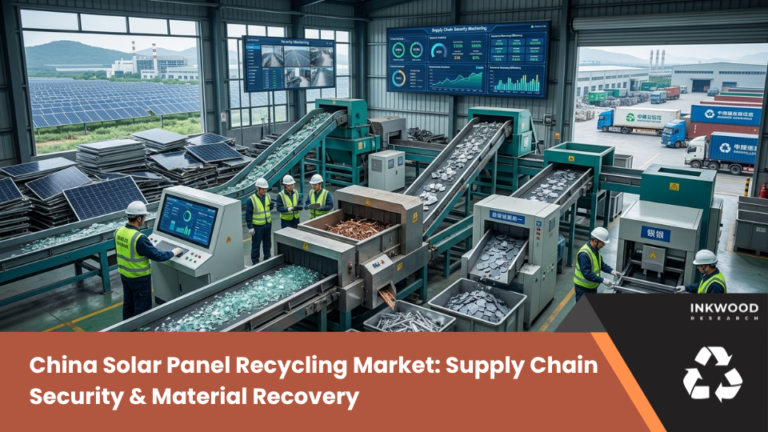
This analysis is brought to you by Inkwood Research, a leading market intelligence firm specializing in Chinese renewable energy systems, supply chain strategies, and circular economy development. Our research team combines extensive experience analyzing photovoltaic manufacturing dominance, material recovery technologies, and strategic resource management across China. Based on our proprietary research methodologies and strategic partnerships with Chinese recycling companies, solar manufacturers, and government research institutions, we deliver actionable insights that empower strategic decision-making for global enterprises navigating China’s solar panel recycling market and supply chain evolution.
TLDR
China approaches solar panel recycling as strategic resource management rather than environmental obligation alone. The market reached US$76.60 million in 2026 and projects growth to US$282.22 million by 2034. With 80% control over global photovoltaic supply chains, China recognizes recycling as critical for maintaining manufacturing dominance. Recovering silicon, silver, and copper from retired panels reduces reliance on virgin material imports while strengthening supply chain resilience.
Supply chain strategists evaluating resource security, solar manufacturers managing material costs, recycling technology developers entering Chinese markets, policy makers designing extended producer responsibility frameworks, and investment analysts assessing circular economy opportunities will discover comprehensive insights into China’s recycling infrastructure development, strategic material recovery priorities, and supply chain integration shaping global photovoltaic manufacturing competitiveness.
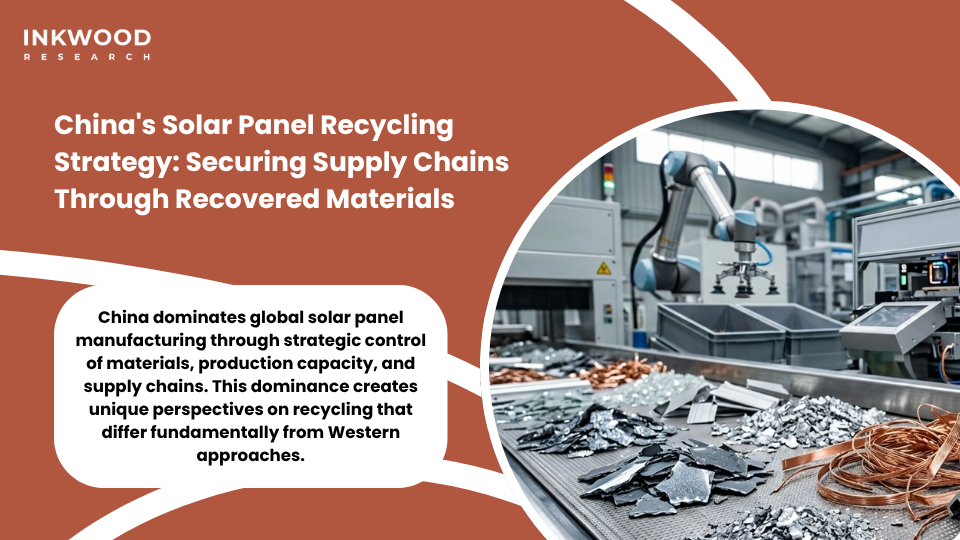
China dominates global solar panel manufacturing through strategic control of materials, production capacity, and supply chains. This dominance creates unique perspectives on recycling that differ fundamentally from Western approaches. Rather than viewing retired panels as waste requiring disposal, China sees critical materials awaiting recovery and reintegration into manufacturing processes.
The nation’s recycling strategy reflects its broader industrial planning philosophy. Material security concerns drive policy development as much as environmental considerations. With cumulative solar panel waste potentially reaching 55-66 million tons by 2050, China recognizes recycling as essential for maintaining manufacturing competitiveness without expanding mining operations.
Understanding China’s approach requires examining how recycling fits into comprehensive supply chain strategies. Additionally, the country controls 80% of critical photovoltaic manufacturing stages and 95% of critical minerals. Consequently, recycling becomes another tool for strengthening this integrated ecosystem rather than a standalone environmental initiative.
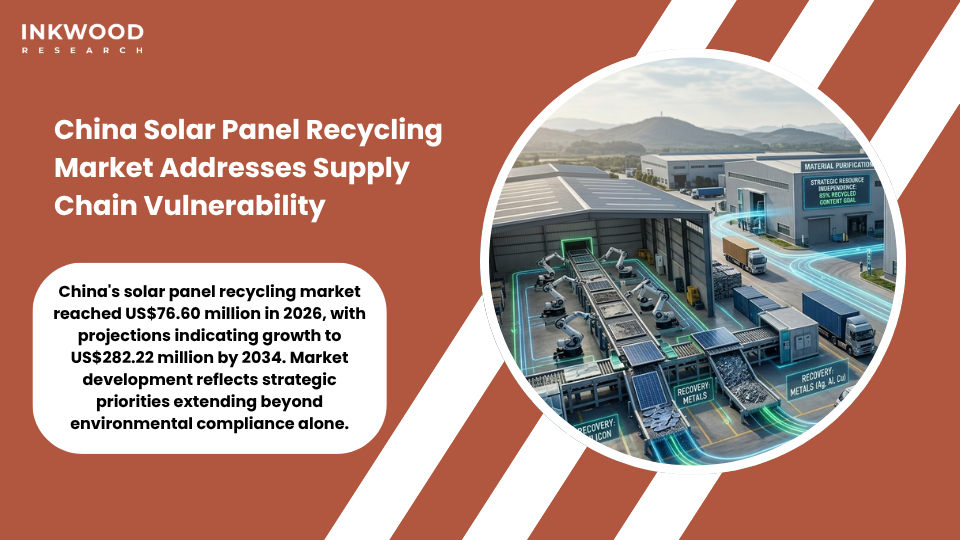
China’s solar panel recycling market reached US$76.60 million in 2026, with projections indicating growth to US$282.22 million by 2034. This represents a compound annual growth rate of 17.71% during the forecast period. Market development reflects strategic priorities extending beyond environmental compliance alone.
The country faces unprecedented photovoltaic waste volumes as the world’s largest producer and installer. Cumulative panel waste could reach 13.5 million to 19.9 million tons by 2050, according to international projections. However, Chinese industry estimates suggest even higher volumes reaching 66 million tons under early loss scenarios.
These projections underscore the urgency around infrastructure development. Current recycling capacity remains inadequate for projected volumes. Moreover, most waste occurs decades hence, creating planning challenges around capacity timing. Nevertheless, China begins developing systems now rather than waiting for a crisis.
Manufacturing Dominance Creates Recycling Imperative
China’s manufacturing dominance makes recycling particularly strategic. The nation produces over 80% of global polysilicon, wafers, cells, and modules. This concentration creates both opportunity and vulnerability. Furthermore, recycling provides domestic material sources, reducing dependence on international mining operations subject to geopolitical disruption.
Material recovery assumes greater importance as production scales continue expanding. China’s cumulative installed capacity exceeded 610 GW by the end of 2023, representing tenfold growth over a decade. Additionally, the country accounts for 63% of global new installations. These volumes eventually translate into massive recycling streams.
Strategic planning recognizes recycling as an essential component of sustainable manufacturing growth. Recovered materials supplement rather than replace virgin inputs initially. However, as waste volumes increase, recycled content percentages rise significantly. Consequently, this transition reduces environmental footprint while enhancing supply chain resilience.
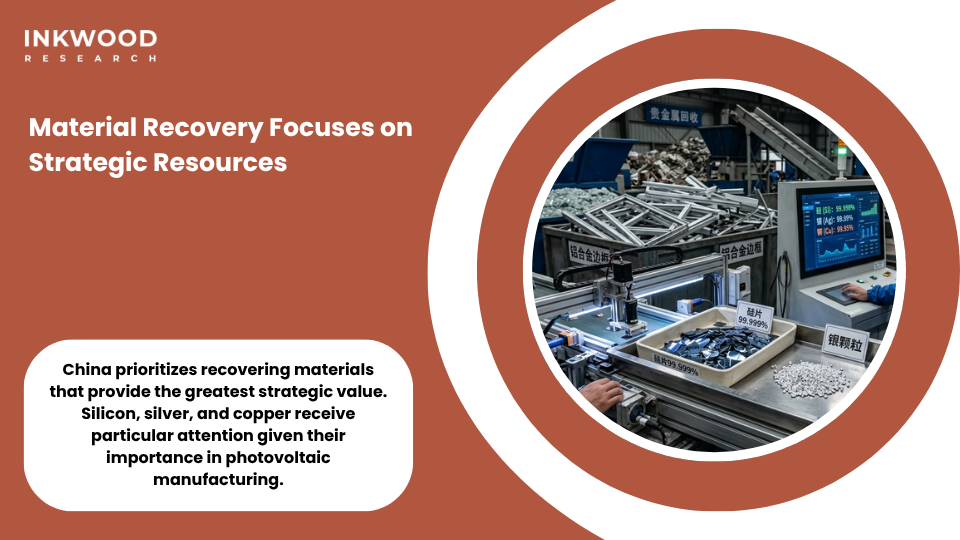
China prioritizes recovering materials that provide the greatest strategic value. Silicon, silver, and copper receive particular attention given their importance in photovoltaic manufacturing. Glass and aluminum, while representing most panel weight, prove less critical from a supply chain security perspective.
Silicon recovery addresses both economic and environmental objectives. The material accounts for 3.5% of panel weight, but there are significant production costs. Recycling reduces energy consumption by 95% compared to refining virgin polysilicon from quartz. Furthermore, it avoids environmental impacts associated with traditional silicon processing.
Silver represents the most valuable recoverable material per unit weight. Photovoltaic manufacturing consumes substantial quantities of silver for cell interconnections. Declining prices in 2023 challenged recycling economics, with silver dropping 30% from 2022 peaks. However, long-term strategic value justifies investment despite short-term price volatility.
Technology Development Targets High-Purity Recovery
Chinese companies invest in technologies extracting materials suitable for manufacturing reuse. This requires higher purity levels than general recycling applications. Consequently, research focuses on advanced separation techniques, including mechanical, thermal, and chemical processes working in combination.
Mechanical recycling forms the foundation through efficient bulk material separation. Shredding and physical separation recover aluminum and glass relatively easily. However, silicon wafer recovery demands more sophisticated approaches. Thermal and chemical treatments remove encapsulants, allowing wafer extraction.
Recent innovations address polymer encapsulation challenges that historically hindered recycling. Conventional panels use EVA or POE films bonding silicon cells to glass substrates. While these materials require high temperatures or chemical solvents for removal, new processing methods reduce energy requirements while improving separation efficiency.
Policy Framework Develops Around Producer Responsibility
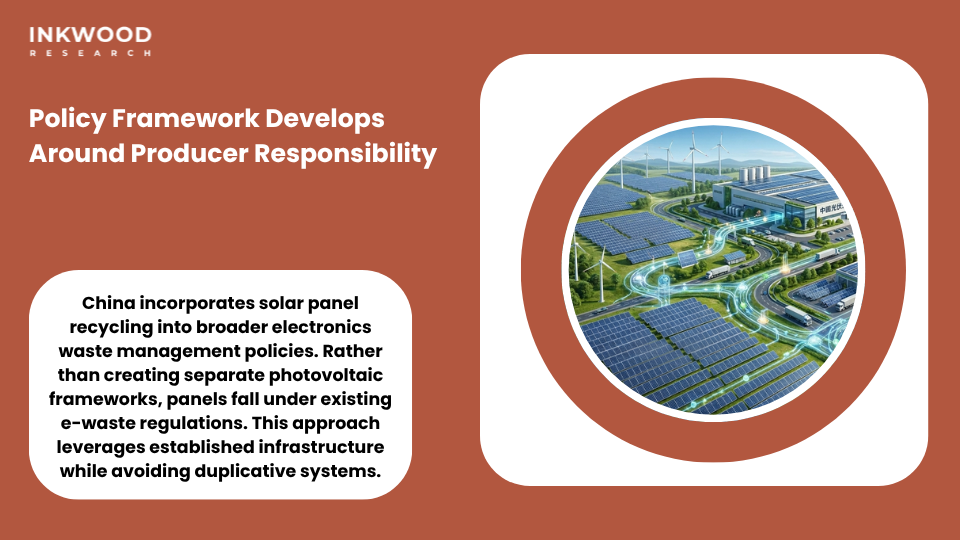
China incorporates solar panel recycling into broader electronics waste management policies. Rather than creating separate photovoltaic frameworks, panels fall under existing e-waste regulations. This approach leverages established infrastructure while avoiding duplicative systems.
Extended Producer Responsibility principles guide policy development. Manufacturers bear responsibility for product lifecycles, including end-of-life management. However, specific regulations remain under development as authorities study international approaches while designing systems suited to Chinese circumstances.
Provincial and municipal governments implement various trial programs testing different approaches. Some cities mandate recycling for large solar installations. Conversely, others establish collection networks or subsidize recycling operations. These experiments inform eventual national policy frameworks.
Industry Collaboration Accelerates Infrastructure Development
The China Green Supply Chain Alliance coordinates industry recycling efforts through its PV Committee. This body brings together manufacturers, recyclers, researchers, and policymakers to develop standards and best practices. Collaborative approaches enable faster progress than regulatory mandates alone.
Annual white papers track recycling progress while identifying challenges requiring attention. These publications analyze trade-in policies, company industrialization progress, and technology route comparisons. Furthermore, they predict future market sizes and economic efficiencies, guiding investment decisions.
Industry self-regulation complements government policy development. Companies establish voluntary recycling programs demonstrating corporate responsibility. These initiatives build public trust while creating operational experience, informing eventual regulatory requirements. Moreover, they position compliant companies favorably versus less responsible competitors.
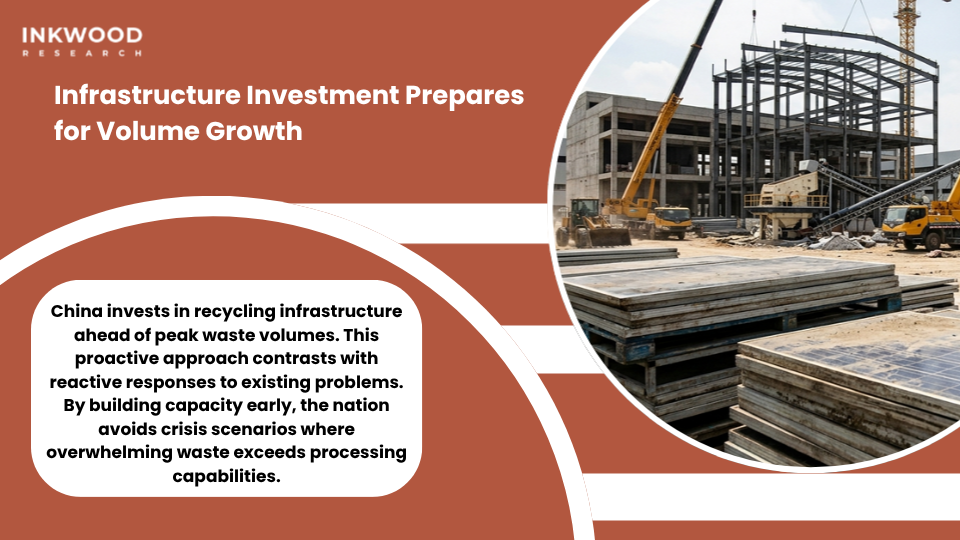
China invests in recycling infrastructure ahead of peak waste volumes. This proactive approach contrasts with reactive responses to existing problems. By building capacity early, the nation avoids crisis scenarios where overwhelming waste exceeds processing capabilities.
RESOLAR Energy Technology exemplifies Chinese recycling companies developing comprehensive solutions. The company focuses on technological innovation, building world-leading capabilities across component recycling, damaged cell impurity removal, and recycled silicon material processing. Additionally, it develops cascaded utilization approaches, maximizing material value.
Investment patterns reflect long-term strategic thinking rather than immediate profitability requirements. Moreover, government support accelerates infrastructure development through subsidies, research funding, and preferential policies. This enables capacity building before commercial viability fully emerges.
Regional Hubs Concentrate Processing Capabilities
Geographic clustering creates regional recycling hubs near major solar manufacturing centers. This reduces transportation costs while facilitating material reintegration into production. Furthermore, it enables knowledge sharing between recyclers and manufacturers, improving process optimization.
Several provinces emerge as recycling leaders through targeted investment programs. These regions offer tax incentives, land subsidies, and preferential utility rates, attracting recycling facilities. Additionally, competition between provinces accelerates development while creating multiple capacity nodes.
Hub development also addresses environmental concerns around concentrated industrial activities. Proper recycling prevents hazardous materials like cadmium and lead from contaminating landfills. Plus, centralized facilities enable more effective environmental monitoring versus dispersed informal operations.
Circular Economy Vision Guides Long-Term Strategy
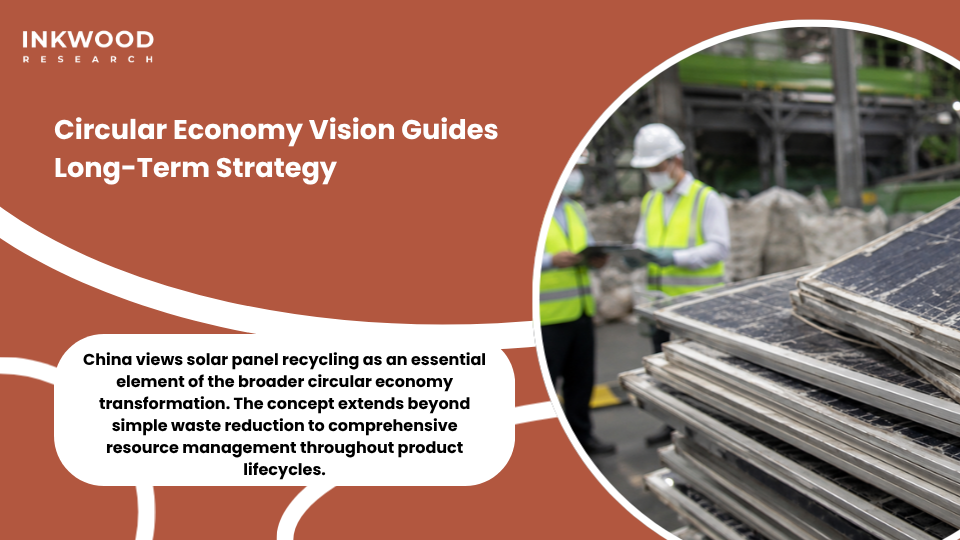
China views solar panel recycling as an essential element of the broader circular economy transformation. The concept extends beyond simple waste reduction to comprehensive resource management throughout product lifecycles. Recycling completes loops, enabling sustained manufacturing growth without proportional resource extraction increases.
Additionally, closed-loop systems where recovered materials return directly to manufacturing represent the ideal. However, achieving this requires coordination across multiple stakeholders. Panel designers must consider recyclability. Manufacturers need specifications accepting recycled content. Recyclers must deliver materials meeting quality standards.
Government policies incentivize circular approaches through multiple mechanisms. Recycled content requirements for new products create guaranteed markets. Moreover, tax advantages reward companies using recovered materials. Public procurement preferences favor circular economy participants. These tools collectively drive behavior change.
Key Takeaways
- China approaches solar panel recycling strategically as a supply chain security measure rather than environmental compliance alone.
- Manufacturing dominance creates both opportunity and imperative for developing comprehensive material recovery capabilities. Recycling provides domestic sources, reducing dependence on international mining operations.
- Material recovery prioritizes strategic resources, including silicon, silver, and copper essential for photovoltaic manufacturing.
- Technology development focuses on achieving purity levels suitable for production reuse.
- Further, innovations target polymer encapsulation challenges while improving separation efficiency and reducing energy consumption.
- Policy frameworks develop around extended producer responsibility principles adapted to Chinese circumstances.
- Industry collaboration through organizations like the China Green Supply Chain Alliance accelerates progress beyond regulatory mandates alone. Also, regional pilot programs test approaches informing eventual national requirements.
- Infrastructure investment prepares for future waste volume growth through proactive capacity building.
- Regional hubs near manufacturing centers reduce costs while facilitating material reintegration. Circular economy vision guides long-term strategy connecting recycling with sustained manufacturing competitiveness.
Conclusion
China’s solar panel recycling strategy reflects industrial planning extending decades into the future. The nation recognizes that sustained manufacturing dominance requires reliable material sources independent of international supply disruptions. Recycling provides this security while delivering environmental benefits.
Additionally, massive projected waste volumes create both challenges and opportunities. Challenges include developing adequate processing capacity before crisis volumes overwhelm systems. Opportunities emerge from recovered materials supplementing virgin inputs at lower environmental cost. Strategic thinking emphasizes capturing opportunities while mitigating challenges.
Future developments will demonstrate whether China’s proactive infrastructure investment proves prescient. However, the strategic logic appears sound given manufacturing scale and material requirements. Recycling completes circular economy loops essential for sustainable industrial growth.
Ready to navigate China’s solar panel recycling market evolution?
Inkwood Research provides comprehensive market intelligence and strategic analysis for global enterprises. Contact our expert team for actionable insights supporting successful market engagement.
Frequently Asked Questions
Why does China prioritize solar panel recycling?
China prioritizes solar panel recycling to secure critical raw materials, reduce reliance on imported mining resources, and support the long-term sustainability of its dominant solar manufacturing industry.
Which materials does China focus on recovering from recycled solar panels?
China primarily targets the recovery of silicon, silver, and copper due to their high value and importance in photovoltaic manufacturing.
How does China’s solar panel recycling strategy differ from other countries?
China’s approach emphasizes strategic resource security and proactive infrastructure investment, while many other countries focus primarily on environmental waste management.
How is China expanding its solar panel recycling infrastructure?
China is investing in specialized recycling facilities and advanced material recovery technologies to manage the growing volume of end-of-life solar panels.
What role do government policies play in China’s solar panel recycling market?
Government policies encourage recycling through industrial planning, resource efficiency initiatives, and support for circular economy development in the renewable energy sector.
How will China’s solar waste volumes impact the global recycling industry?
China’s massive solar deployment is expected to generate significant future panel waste, accelerating innovation and scale in global solar panel recycling technologies.