Table of Contents
This analysis is brought to you by Inkwood Research, a leading market intelligence firm specializing in advanced battery technologies, energy storage innovations, and Asian manufacturing ecosystems. Our research team combines extensive experience analyzing China’s new energy vehicle policies, graphene industrialization programs, and collaborative partnerships across research institutions, government agencies, and commercial enterprises. Based on our proprietary research methodologies and strategic partnerships with Chinese battery manufacturers, university research centers, and government industrial development agencies, we deliver actionable insights that empower strategic decision-making for global enterprises navigating China’s graphene battery revolution and energy storage market expansion.
TLDR
China’s graphene battery market is experiencing extraordinary momentum through strategic government initiatives and industry partnerships. Valued at US$99.00 million in 2026, projections indicate explosive growth to US$730.07 million by 2034, reflecting a remarkable 28.37% CAGR. Manufacturing giants like CATL, BYD, and NanFu Battery are pioneering lithium-ion batteries enhanced with graphene technology. Government subsidies, dedicated research funding, and collaborative frameworks between universities and enterprises are transforming China graphene battery market dynamics, positioning the nation as the global epicenter for next-generation energy storage solutions.
Business executives evaluating Asian battery technology investments, policy analysts tracking sustainable transportation initiatives, automotive industry strategists monitoring EV supply chains, and investment professionals seeking emerging opportunities in energy storage markets will find actionable intelligence here. Technology procurement specialists, research directors at battery manufacturers, and sustainability officers implementing green energy programs will gain strategic insights into China’s leadership in advancing graphene-enhanced batteries commercialization.
China’s Strategic Vision: Government Policies Fueling Graphene Innovation
China’s commitment to achieving carbon neutrality by 2060 has catalyzed unprecedented graphene battery development initiatives. Moreover, the Ministry of Industry and Information Technology reported lithium-ion output reached 480 GWh in early 2024, marking a 20% year-over-year increase. Consequently, government subsidies specifically target advanced battery technology research, with allocations exceeding 300 million yuan for graphene industrialization platforms. These investments demonstrate China’s determination to dominate next-generation energy storage markets.
Policy Frameworks Accelerating Market Growth
National development plans explicitly prioritize graphene integration into lithium-ion batteries for electric vehicles. Furthermore, provincial governments offer substantial tax incentives, reducing operational costs for manufacturers by 15-20%. Strategic policies encourage collaboration between state-owned enterprises and private innovators. Additionally, regulatory frameworks streamline approval processes for graphene-enhanced products, accelerating commercialization timelines significantly.
Carbon Neutrality Goals Driving Battery Innovation
China’s environmental commitments necessitate revolutionary sustainable transportation solutions. Subsequently, the China graphene battery market benefits from dedicated funding streams supporting clean energy technologies. Battery manufacturers receive preferential treatment for projects demonstrating emissions reductions. Meanwhile, carbon credit systems incentivize the adoption of advanced energy storage technologies across industrial applications
Major Partnerships Reshaping Battery Manufacturing Landscape
Strategic alliances between manufacturers, research institutions, and technology providers are revolutionizing production capabilities. Consequently, Dongxu Optoelectronics established comprehensive industrialization platforms combining manufacturing infrastructure with investment mechanisms. Moreover, partnerships facilitate knowledge transfer, enabling rapid scaling of graphene-enhanced batteries production. These collaborations create synergies that individual entities cannot achieve independently.
Cross-Sector Collaboration Models
Manufacturing giants partner with university research centers, combining theoretical expertise with practical applications. Additionally, joint ventures between Chinese and international firms accelerate technology transfer. For instance, equipment manufacturers collaborate with battery producers to optimize production lines specifically for graphene integration. Therefore, these partnerships reduce development timelines while improving product quality metrics substantially.
Technology Transfer and Intellectual Property Sharing
Collaborative frameworks encourage intellectual property sharing under structured licensing agreements. Furthermore, government-sponsored consortia facilitate knowledge exchange between competing manufacturers for national technological advancement. Patent pools allow smaller innovators to access foundational graphene technologies. Meanwhile, universities retain research rights while commercial partners gain exclusive production licenses, creating mutually beneficial arrangements.
CATL and BYD: Leading the Graphene Integration Revolution

In December 2024, the fourth annual J L Power New Luxury Rankings for Smart EVs in China were released, revealing that 75% of the 20 models ranked in the top five across four categories (Pure Electric Sedans, Pure Electric Sports Cars, Pure Electric SUVs, and Pure Electric MPVs) are powered by CATL batteries. Notably, all the top five SUVs and 80% of the top five sedans use CATL battery packs.
Meanwhile, BYD actively explores graphene integration across its massive production infrastructure. Both companies leverage first-mover advantages, positioning themselves as global leaders in next-generation energy storage.
CATL’s Graphene-Enhanced Product Pipeline
CATL’s research division focuses on graphene applications that improve lithium-ion batteries performance metrics. Notably, their development roadmap includes high-power cells for premium electric vehicles and energy storage systems. Testing data demonstrates enhanced thermal stability, critical for safety-conscious consumers and regulatory compliance. Subsequently, CATL’s partnerships with European automakers facilitate international market penetration for graphene-enhanced products.
BYD’s Vertical Integration Strategy
As the world’s largest battery manufacturer, BYD possesses unique advantages in scaling graphene production. Moreover, vertical integration allows comprehensive control over supply chains, from raw materials to finished cells. Their manufacturing facilities can rapidly prototype and test graphene formulations. Consequently, BYD reduces time-to-market for innovative battery chemistries while maintaining stringent quality control throughout production processes.
Research Infrastructure: Universities and Industrial Collaboration
China’s extensive graphene research infrastructure encompasses numerous institutions dedicated to unlocking material potential. Universities collaborate with industrial partners, conducting fundamental research that commercial entities translate into marketable products. Moreover, government funding supports laboratory equipment, enabling cutting-edge experimentation. Research centers achieve significant breakthroughs in graphene synthesis, improving purity levels to 99.9% while increasing monolayer production rates beyond 99%.
Academic Excellence in Materials Science
Leading universities pursue graphene applications in energy storage, developing novel electrode configurations and electrolyte formulations. Additionally, doctoral programs produce thousands of skilled researchers annually, feeding industry talent pipelines. Collaboration between chemistry, engineering, and physics departments fosters interdisciplinary innovation. Subsequently, published research findings accelerate global knowledge advancement while strengthening China’s intellectual leadership in graphene technologies.
Government-Funded Research Centers
Specialized graphene research facilities receive sustained government investment, ensuring long-term project continuity. These centers maintain state-of-the-art characterization equipment for analyzing graphene properties at atomic scales. Moreover, they provide testing services for commercial manufacturers, validating product specifications and performance claims. Therefore, government-backed infrastructure reduces barriers for smaller companies pursuing graphene innovations.
Market Dynamics and Commercial Applications
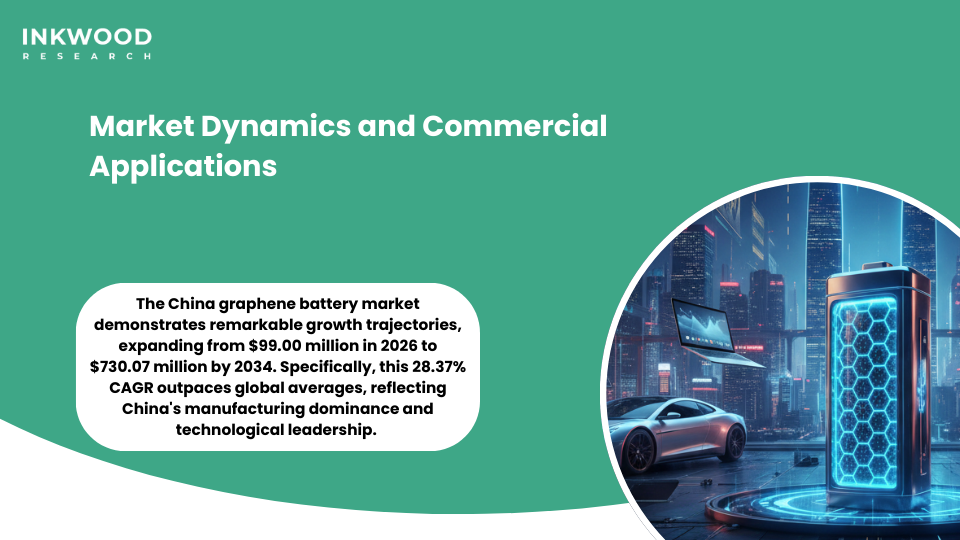
The China graphene battery market demonstrates remarkable growth trajectories, expanding from $99.00 million in 2026 to $730.07 million by 2034. Specifically, this 28.37% CAGR outpaces global averages, reflecting China’s manufacturing dominance and technological leadership. Electric vehicle applications drive primary demand, with consumer electronics and industrial sectors contributing substantial market shares. Additionally, energy storage systems for renewable integration represent emerging opportunities.
Electric Vehicle Sector Dominance
China, Europe, and the US combined accounted for nearly 95% of global EV sales, which is supported by data from the International Energy Agency (IEA). Consequently, automotive manufacturers prioritize graphene-enhanced batteries offering superior performance characteristics. Range anxiety concerns diminish as graphene integration enables faster charging and higher energy densities. Furthermore, government mandates requiring specific EV production percentages ensure sustained market growth.
Consumer Electronics Applications
Smartphones, laptops, and wearable devices benefit from graphene’s exceptional conductivity and lightweight properties. Moreover, consumer demand for longer battery life and rapid charging drives manufacturer adoption. Graphene integration allows thinner device profiles without sacrificing performance. Subsequently, premium product segments command higher prices, improving profit margins for early adopters of graphene technologies.
Industrial and Grid Storage
Renewable energy systems require efficient storage solutions for managing intermittent generation patterns. Therefore, graphene batteries provide ideal characteristics for grid-scale applications, including long cycle life and thermal stability. Industrial facilities adopt graphene-enhanced systems for backup power and load management. Additionally, telecommunications infrastructure utilizes compact, high-performance batteries for remote installations.
Investment Patterns and Financial Mechanisms
Chinese investors channel substantial capital into graphene battery ventures, recognizing transformative market potential. Dongxu Optoelectronics established a 300 million yuan industrial development fund specifically for graphene initiatives. Moreover, venture capital firms prioritize battery technology startups demonstrating viable commercialization pathways. Government-backed investment vehicles provide patient capital, supporting long-term research and development cycles.
Venture Capital and Private Equity
Private investment in Chinese graphene companies accelerated dramatically since 2020, with funding rounds exceeding historical averages significantly. Investors recognize the strategic importance of securing positions in emerging energy storage technologies. Additionally, successful exits through public offerings create positive feedback loops, attracting additional capital. Sophisticated investors conduct thorough technical due diligence, ensuring funded companies possess defensible intellectual property and scalable production capabilities.
Government Investment Vehicles
State-owned investment funds support projects aligned with national strategic priorities, including graphene industrialization. These vehicles offer favorable terms, including below-market interest rates and extended repayment periods. Moreover, government investors provide valuable connections to regulatory agencies and potential customers. Therefore, companies receiving state backing enjoy credibility advantages when pursuing commercial partnerships.
Competitive Advantages Driving Global Leadership
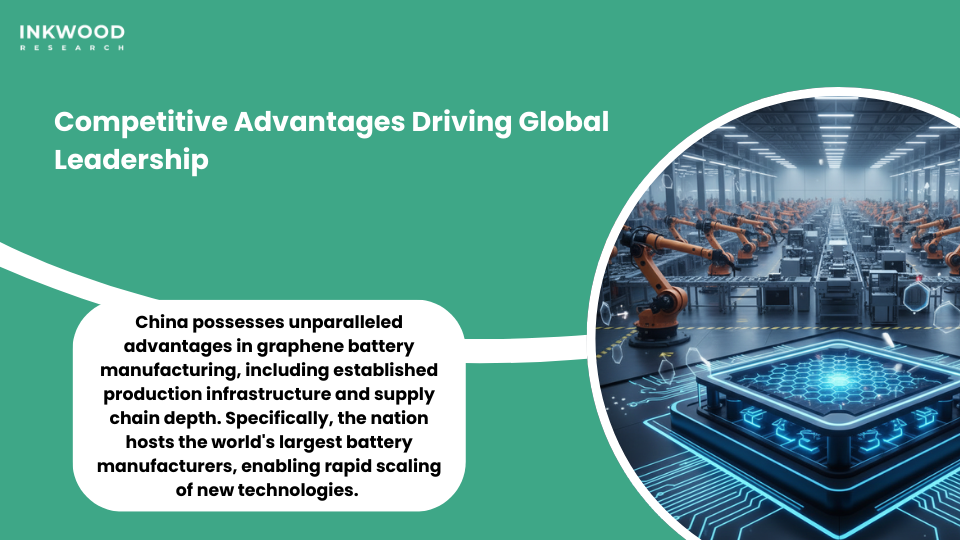
China possesses unparalleled advantages in graphene battery manufacturing, including established production infrastructure and supply chain depth. Specifically, the nation hosts the world’s largest battery manufacturers, enabling rapid scaling of new technologies. Moreover, proximity to raw material sources reduces transportation costs significantly. Skilled labor pools and engineering talent ensure high-quality manufacturing processes.
Manufacturing Scale and Efficiency
Chinese facilities achieve production volumes unmatched globally, driving economies of scale that reduce per-unit costs. Advanced automation minimizes labor expenses while maintaining consistent quality standards. Furthermore, continuous process optimization improves yields and reduces waste. Subsequently, Chinese manufacturers offer competitive pricing that challenges international competitors.
Supply Chain Integration
Vertical integration across supply chains provides Chinese companies with strategic advantages. Raw graphite processing, electrode production, and cell assembly occur within concentrated geographic regions. Additionally, component suppliers rapidly adapt to manufacturer requirements, accelerating innovation cycles. Therefore, integrated supply chains reduce lead times and improve responsiveness to market demands.
Skilled Workforce Development
Engineering universities produce thousands of battery technology graduates annually, creating deep talent pools. Moreover, government-sponsored training programs upskill existing workers in advanced manufacturing techniques. Companies invest heavily in employee development, recognizing human capital as a critical competitive advantage. Subsequently, skilled workforces enable rapid technology adoption and continuous improvement initiatives.
Key Takeaways
- China’s graphene battery market will expand from US$99.00 million (2026) to US$730.07 million (2034), achieving a 28.37% CAGR through government policies and industry partnerships
- Government subsidies exceed 300 million yuan, supporting graphene industrialization platforms while provincial tax incentives reduce manufacturer costs by 15-20%
- Strategic partnerships between manufacturers, universities, and research institutions accelerate technology transfer and commercialization timelines
- Research infrastructure achievements include 99.9% graphene purity and 99%+ monolayer production rates, supporting advanced battery applications
- Vertical supply chain integration and skilled workforce development provide Chinese manufacturers with unmatched competitive advantages in scaling production
Conclusion:
China’s graphene battery market represents one of the most dynamic sectors in global energy storage, propelled by unprecedented government support and strategic industry collaborations. The projected growth from $99.00 million in 2026 to $730.07 million by 2034 reflects more than market expansion—it demonstrates China’s systematic approach to technological leadership. Partnerships between manufacturing giants like CATL and BYD, combined with robust university research infrastructure, create innovation ecosystems that rapidly translate discoveries into commercial products.
However, sustained success requires navigating technical challenges, including graphene production scaling and long-term performance validation. Nevertheless, China’s integrated approach—combining policy support, financial incentives, manufacturing expertise, and research excellence—positions the nation favorably for continued dominance. As global demand for advanced lithium-ion batteries intensifies amid electrification trends, China’s graphene initiatives will likely set industry standards worldwide.
Ready to navigate China’s evolving graphene battery landscape? Contact Inkwood Research for customized market intelligence and strategic consulting services tailored to your business objectives.
Frequently Asked Questions
What makes China's graphene battery market different from other regions?
China combines extensive manufacturing infrastructure, government policy support, and robust research capabilities, creating unique advantages. Moreover, vertical supply chain integration and massive production scales enable rapid technology commercialization at competitive costs.
Which Chinese companies lead graphene battery development?
CATL and BYD dominate automotive applications, while NanFu Battery focuses on consumer electronics. Additionally, Dongxu Optoelectronics established comprehensive industrialization platforms supporting graphene commercialization across multiple sectors.
How do government policies support graphene battery growth in China?
Policies include direct research subsidies exceeding 300 million yuan, provincial tax incentives reducing costs by 15-20%, and streamlined regulatory approvals. Furthermore, carbon neutrality commitments by 2060 create sustained demand for advanced energy storage technologies.