Table of Contents
This analysis is brought to you by Inkwood Research, a leading market intelligence firm specializing in Asia-Pacific healthcare technology, wearable medical devices, and digital health ecosystems. Our research team combines extensive experience analyzing electrocardiography innovations, home healthcare adoption patterns, and consumer medical device markets across China, East Asia, and global emerging economies. Based on our proprietary research methodologies and strategic partnerships with Chinese medical device manufacturers, healthcare providers, government health agencies, and digital health platforms, we deliver actionable insights that empower strategic decision-making for global enterprises navigating China’s revolutionary transition to home-based cardiac monitoring.
TLDR
China’s ECG equipment market is undergoing a radical transformation as cardiac monitoring shifts from hospitals to homes. Valued at US$840.70 million in 2026, the market will surge to US$1621.11 million by 2034 at an 8.55% CAGR. Wearable ECG devices, AI-powered diagnostics, and government-backed digital health initiatives are democratizing cardiac care. With 254 million people over age 60 and cardiovascular disease causing 32% of Asia-Pacific deaths, China’s home-based monitoring revolution addresses unprecedented healthcare demands.
Healthcare technology companies developing consumer medical devices will identify market entry strategies. Hospital administrators adapting to shifting care models will understand infrastructure implications. Medical device investors seeking high-growth opportunities will discover lucrative sectors. Policy experts analyzing China’s Healthy China 2030 initiative will recognize implementation progress. Telemedicine platforms integrating diagnostic capabilities will learn from partnership opportunities essential for penetrating China’s vast home healthcare ecosystem.
China’s Cardiac Care Paradigm Shifts
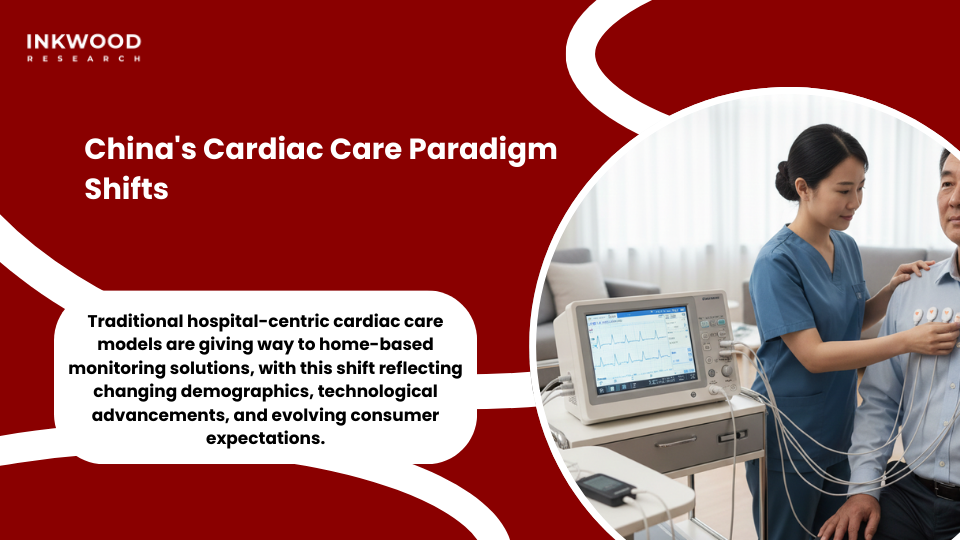
China’s healthcare system is experiencing unprecedented transformation. Traditional hospital-centric cardiac care models are giving way to home-based monitoring solutions, with this shift reflecting changing demographics, technological advancements, and evolving consumer expectations. The China ECG equipment market stands at the epicenter of this revolution.
Understanding the Fundamental Transition
Hospitals traditionally dominated cardiac diagnostics in China. Patients visited facilities for routine ECG examinations. However, this model creates inefficiencies and accessibility barriers. Urban hospitals face overcrowding while rural populations travel hours for basic cardiac assessments.
Home-based monitoring eliminates these constraints entirely. Patients conduct ECG examinations in comfortable surroundings. Subsequently, they transmit results electronically to physicians for interpretation. This decentralized approach reduces healthcare system burden while improving patient experiences.
Electrocardiography equipment represents a crucial component in China’s medical device market. Aligning with this, the National Medical Products Administration regulates all ECG devices, ensuring safety and effectiveness standards.
Technological Enablers Drive Change
Several technological breakthroughs make home ECG monitoring feasible. While miniaturized sensors now fit into wrist-worn devices, wireless connectivity transmits data instantly across vast distances. Moreover, cloud computing platforms store and analyze enormous datasets. These innovations collectively enable the hospital-to-home transition.
Chinese manufacturers lead global innovation in portable cardiac devices. Mindray Medical International and Contec Medical Systems dominate domestic markets. Their products incorporate cutting-edge features at competitive prices. Meanwhile, international players like Philips and GE Healthcare adapt strategies for Chinese preferences.
Aging Population Drives Home Monitoring Demand

China faces dramatic demographic shifts that reshape healthcare requirements. The nation’s elderly population grows at unprecedented rates, and this aging cohort requires intensive cardiac monitoring capabilities. Home-based ECG solutions address these expanding needs efficiently.
Demographic Realities Create Urgency
China had 254 million people aged 60 and above as of 2019, according to World Health Organization data. Another 176 million exceeded the age of 65. By 2040, projections show 402 million people, representing 28% of China’s population, will have surpassed age 60. This demographic tsunami creates enormous healthcare demands.
Elderly individuals experience cardiovascular disease at dramatically higher rates. Accordingly, heart conditions, hypertension, and arrhythmias become increasingly common. Consequently, this population requires regular cardiac monitoring. Traditional hospital visits prove impractical for millions of mobility-challenged seniors.
Home Monitoring Solves Access Challenges
Wearable ECG devices enable continuous monitoring without hospital visits. Elderly patients wear comfortable sensors throughout daily activities. Plus, devices detect abnormalities automatically and alert caregivers immediately. This proactive approach prevents emergencies through early intervention.
Family members gain peace of mind through remote monitoring capabilities. They track elderly relatives’ cardiac health from distant cities. Alert notifications enable quick responses during concerning events. These features prove particularly valuable in China’s mobile society.
Chronic Disease Management Improves
China’s Healthy China 2030 initiative emphasizes preventive healthcare and chronic disease management. Home ECG monitoring aligns perfectly with these goals. Patients with known cardiac conditions track their status continuously. As a result, physicians adjust treatment protocols based on real-world data rather than periodic office measurements.
Wearable Technology Transforms Daily Health Management

Wearable ECG devices revolutionize how Chinese consumers approach cardiac health. These sophisticated sensors, disguised as everyday accessories, enable effortless health monitoring. The technology removes friction from preventive care while providing clinical-grade data.
Consumer Adoption Accelerates Rapidly
Chinese consumers embrace wearable health technology enthusiastically. Smartwatch ownership grows exponentially across all demographics. Plus, these devices initially focused on fitness tracking. However, medical-grade sensors now enable serious health monitoring. The transition from wellness to healthcare blurs traditional boundaries.
Huawei, Xiaomi, and Apple compete fiercely for China’s wearable market. Each company integrates increasingly sophisticated health sensors. Moreover, ECG functionality becomes standard rather than premium. This commoditization drives prices down while expanding accessibility.
Integration with Digital Health Ecosystems
Wearable ECG data flows seamlessly into broader health management platforms. While users view cardiac trends alongside blood pressure, glucose levels, and activity metrics, this holistic perspective empowers informed health decisions. Moreover, integration enables AI algorithms to identify subtle correlations.
Chinese tech giants develop comprehensive digital health ecosystems. Accordingly, Alibaba Health, Tencent Healthcare, and JD Health compete for market dominance. Their platforms combine wearable data collection, telemedicine consultations, and e-pharmacy services, as ECG monitoring becomes one component of integrated healthcare experiences.
Government Initiatives Accelerate Digital Health Adoption
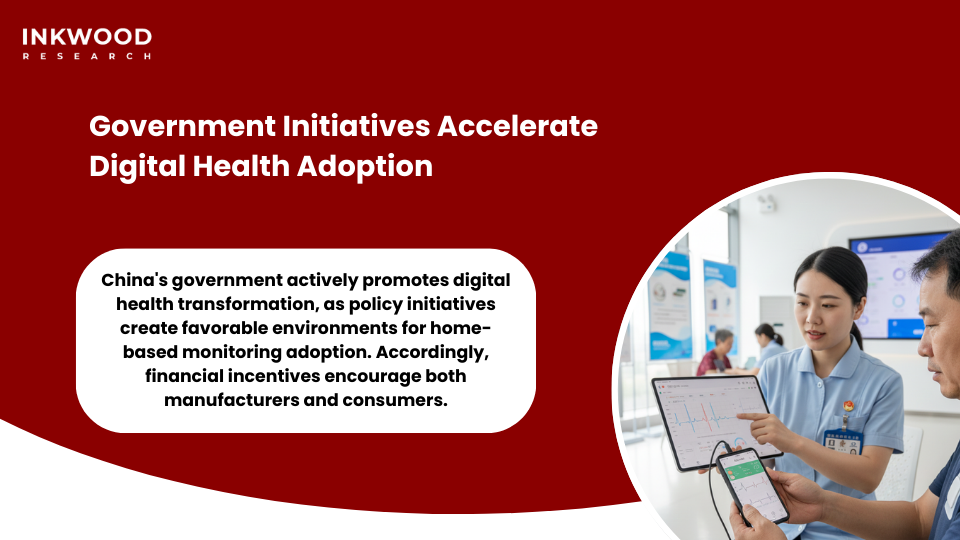
China’s government actively promotes digital health transformation, as policy initiatives create favorable environments for home-based monitoring adoption. Accordingly, financial incentives encourage both manufacturers and consumers. These coordinated efforts accelerate the hospital-to-home transition dramatically.
Healthy China 2030 Shapes Healthcare Future
The Healthy China 2030 initiative represents China’s comprehensive health strategy. It emphasizes preventive care over reactive treatment. Plus, digital health technologies play central roles in achieving these objectives, as wearable ECG devices exemplify the preventive monitoring approach.
Government spending on healthcare infrastructure continues expanding. The initiative promotes AI, analytics, and IoT integration. According to industry analysis, China’s progress in medical reforms significantly influences wearable device adoption. Moreover, investment in 5G networks enables sophisticated remote monitoring capabilities.
Rural Healthcare Expansion Priorities
China’s government recognizes urban-rural healthcare disparities as remote provinces lack adequate medical infrastructure. Aligning with this, government-sponsored screening initiatives conducted over a million free ECGs in rural districts during 2023. These programs demonstrate a commitment to equitable healthcare access.
Portable and wearable ECG devices enable rural healthcare initiatives. Medical teams visit underserved communities with mobile diagnostic equipment. Moreover, they conduct screenings, distribute wearable monitors, and establish remote consultation networks. This approach, in turn, dramatically expands cardiac care availability.
Reimbursement Policies Evolve
The National Healthcare Security Administration oversees reimbursement for ECG equipment. Policies increasingly cover home monitoring devices and telemedicine consultations. These changes remove financial barriers to adoption. Patients no longer bear full costs for preventive monitoring equipment.
AI and 5G Enable Remote Diagnostics
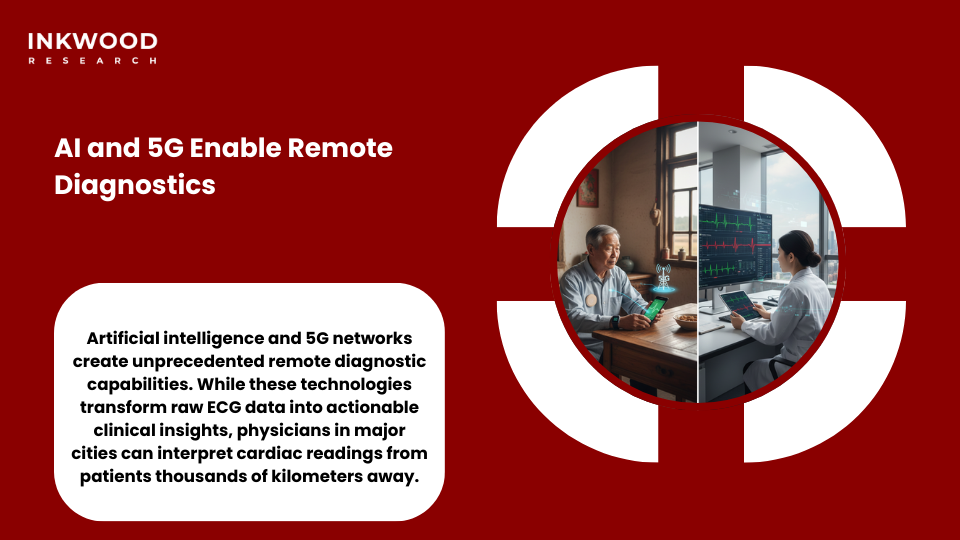
Artificial intelligence and 5G networks create unprecedented remote diagnostic capabilities. While these technologies transform raw ECG data into actionable clinical insights, physicians in major cities can interpret cardiac readings from patients thousands of kilometers away.
AI Enhances Diagnostic Accuracy
Machine learning algorithms excel at ECG pattern recognition. They identify subtle abnormalities that human interpreters might miss. Moreover, AI systems learn continuously from millions of cardiac readings. Their accuracy improves constantly through exposure to diverse patient populations.
Chinese AI companies develop sophisticated cardiac diagnostic tools. These systems integrate seamlessly with wearable ECG devices. Algorithms provide preliminary interpretations within seconds. As a result, patients receive immediate feedback about concerning findings.
Philips launched an AI ECG marketplace platform, allowing multiple AI algorithms to operate simultaneously. Healthcare providers select optimal tools for specific diagnostic scenarios. This flexibility optimizes clinical workflows.
5G Networks Enable Real-Time Transmission
China’s extensive 5G infrastructure supports medical-grade data transmission. High bandwidth enables instant ECG transfer from remote locations. Low latency ensures real-time monitoring for critical patients. In all, these capabilities make remote diagnostics clinically viable.
According to research analysis, AI in 5G networks can predict patient diagnoses and treatment durations. This predictive capability revolutionizes preventive care approaches. Healthcare systems shift from reactive to proactive models.
Telemedicine Platforms Integrate ECG Capabilities
Major Chinese telemedicine platforms incorporate ECG monitoring features. Patients upload wearable device data before virtual consultations. Subsequently, physicians review cardiac trends during video appointments, and in turn, this integration creates seamless diagnostic experiences.
Remote diagnosis improves healthcare efficiency dramatically. Urban specialists serve rural populations without physical travel. Hospital capacity focuses on complex cases requiring in-person treatment. Meanwhile, routine monitoring occurs remotely through digital channels.
Major Players Reshape Competitive Landscape
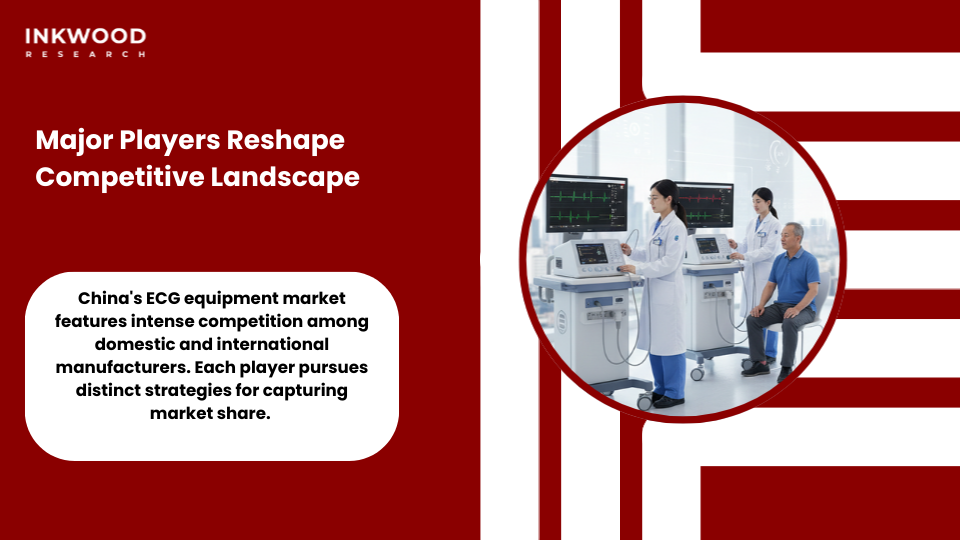
China’s ECG equipment market features intense competition among domestic and international manufacturers. Each player pursues distinct strategies for capturing market share. Plus, the transition to home-based monitoring creates new opportunities while disrupting established business models.
Domestic Champions Lead Innovation
Mindray Medical International dominates China’s patient monitoring market. The company develops, manufactures, and markets sophisticated medical devices globally. Moreover, their product portfolio includes patient monitoring, medical imaging, and in-vitro diagnostics.
Contec Medical Systems specializes in portable monitoring devices. Their products emphasize affordability and reliability. The company serves both domestic and international markets. Contec develops multi-parameter monitors, ECG systems, and pulse oximeters. Moreover, their focus on cost-effectiveness appeals to price-sensitive segments.
International Players Adapt Strategies
GE Healthcare maintains a significant presence in China’s hospital equipment market. The company supplied electrocardiography devices worth substantial volumes according to trade statistics. GE adapts products specifically for Chinese preferences and regulations. Specifically, their 12-lead ECG with voice commands’ multilingual system reduces manual data entry by 35%.
Philips actively pursues premium positioning in Chinese markets. The company’s expanded production in Suzhou reduces costs while improving supply chain responsiveness. Subsequently, Philips emphasizes integration with hospital information systems.
Emerging Tech Companies Disrupt Markets
Chinese technology giants are entering healthcare markets aggressively. For instance, Huawei Corporation operates manufacturing and distribution networks globally. The company provides wearable medical devices, including smartwatches with ECG capabilities. Plus, Huawei’s consumer electronics expertise translates effectively to health monitoring.
Xiaomi Technologies competes in the affordable wearable segments, and its products combine attractive designs with accessible prices. Xiaomi leverages extensive retail networks across China as the company’s ecosystem approach creates sticky customer relationships. Plus, users integrate multiple Xiaomi devices for comprehensive health tracking.
Challenges in Transitioning Care Models
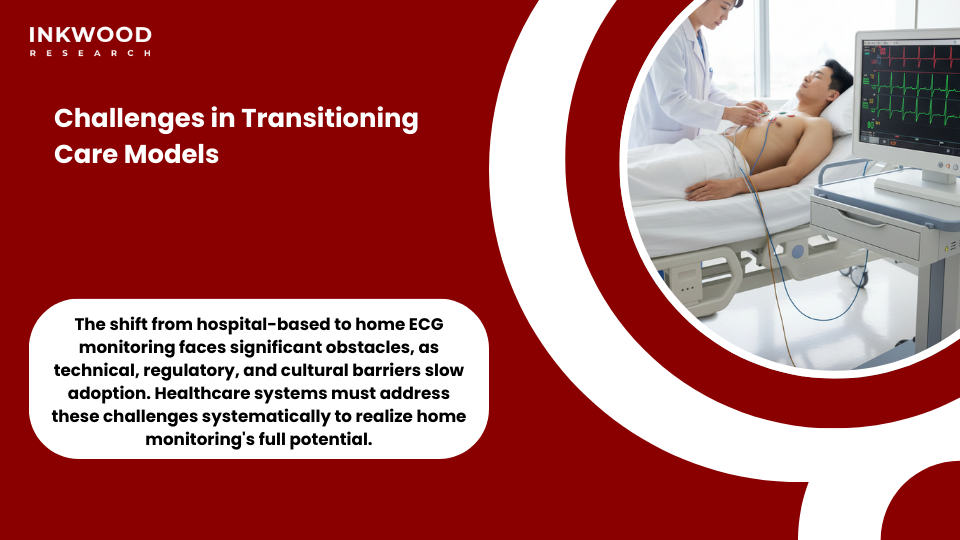
The shift from hospital-based to home ECG monitoring faces significant obstacles, as technical, regulatory, and cultural barriers slow adoption. Healthcare systems must address these challenges systematically to realize home monitoring’s full potential.
Data Security and Privacy Concerns
Home monitoring generates enormous volumes of personal health data. This information requires robust security protection. Plus, cyberattacks targeting healthcare systems are increasing globally, with Chinese consumers expressing concerns about data privacy.
Regulatory frameworks struggle to keep pace with technological advancement. Aligning with this, the National Medical Products Administration updates guidelines continuously. Manufacturers must navigate complex compliance requirements. Meanwhile, healthcare providers implement strict data handling protocols.
Quality Assurance and Standardization
Home ECG devices vary widely in quality and accuracy, although some consumer products lack medical-grade certifications. This variation creates diagnostic reliability concerns, and physicians question whether they can trust home-generated data.
Standardization efforts aim to establish minimum performance criteria. Industry associations collaborate with regulators on guidelines. However, rapid technological evolution outpaces standard development, and markets continue to adopt new devices before comprehensive testing occurs.
Healthcare Professional Training Requirements
Traditional medical education emphasizes hospital-based diagnostics. Physicians require training in remote monitoring methodologies and must learn to interpret data collected outside controlled environments. Additionally, clinicians need skills in virtual patient interactions.
Chinese medical schools are gradually incorporating telemedicine training. Continuing education programs address knowledge gaps. However, widespread competency development takes time. Meanwhile, the pace of technological change accelerates.
Reimbursement and Insurance Complexities
Insurance coverage for home monitoring devices remains inconsistent. Some wearable ECG systems qualify for reimbursement while others don’t. Patients face confusion about covered expenses, and this uncertainty dampens adoption enthusiasm.
Healthcare payers evaluate the cost-effectiveness of home monitoring carefully. They weigh device costs against reduced hospitalizations. Evidence supporting positive outcomes continues accumulating, and gradually, reimbursement policies expand to cover more home monitoring scenarios.
Future Outlook for China's Home ECG Market
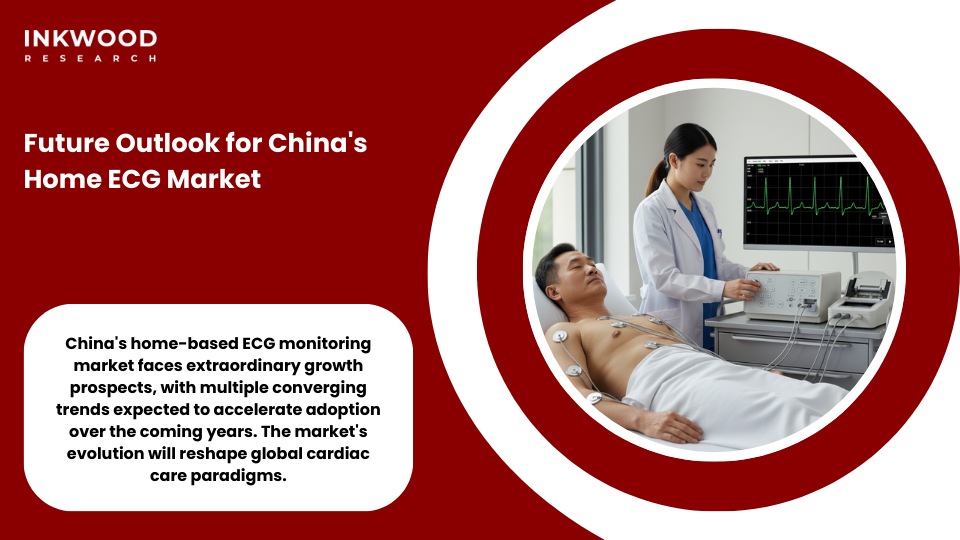
China’s home-based ECG monitoring market faces extraordinary growth prospects, with multiple converging trends expected to accelerate adoption over the coming years. The market’s evolution will reshape global cardiac care paradigms.
Market Growth Projections
The China ECG equipment market will expand from US$840.70 million in 2026 to US$1621.11 million by 2034, representing an 8.55% annual growth. While home-based and wearable segments are set to outpace traditional hospital equipment, consumer demand drives this transformation fundamentally.
Asia-Pacific conducted over 34 million ECG tests annually in 2024, with China and India performing a combined 22 million procedures. These volumes will increase substantially as home monitoring proliferates. Moreover, prevention-focused healthcare reduces emergency interventions.
Technology Integration Deepens
Future ECG devices will integrate seamlessly into comprehensive health ecosystems. Wearables will monitor multiple parameters simultaneously, while AI algorithms will correlate cardiac patterns with nutrition, exercise, and medication. This holistic approach optimizes health outcomes.
Virtual reality and augmented reality may enhance patient education. Users could visualize their cardiac function in real-time. Additionally, gamification elements might improve medication adherence as technology makes preventive care engaging rather than burdensome.
Regulatory Frameworks Mature
China’s regulatory environment will continue evolving. While standards for home medical devices will become more comprehensive, international harmonization efforts are expected to facilitate global trade. Also, manufacturers will navigate clearer compliance pathways.
The National Medical Products Administration will streamline approval processes. Innovation cycles will accelerate as regulatory certainty increases. Meanwhile, post-market surveillance will ensure ongoing safety, and in this regard, balanced regulation protects consumers while encouraging innovation.
Key Takeaways
- China’s ECG equipment market undergoes a historic transformation from hospital-centric to home-based monitoring. Aging demographics create urgent demands for accessible cardiac care.
- Wearable technology enables continuous monitoring without disrupting daily life, while government initiatives through Healthy China 2030 accelerate digital health adoption.
- AI and 5G networks make remote diagnostics clinically viable. Major manufacturers like Mindray, GE Healthcare, and Philips adapt strategies for home monitoring markets.
- Domestic tech companies, including Huawei and Xiaomi, disrupt traditional medical device paradigms.
- Challenges around data security, quality standardization, professional training, and reimbursement require systematic solutions.
- Nevertheless, market growth projections remain robust. China’s home ECG revolution influences global healthcare delivery models. The 8.55% CAGR through 2034 reflects sustained momentum.
Conclusion:
The shift from hospital-based to home ECG monitoring represents more than technological advancement—it fundamentally reimagines cardiac healthcare delivery. China leads this global transformation through demographic necessity, government support, and technological innovation. The journey from US$840.70 million in 2026 to US$1621.11 million by 2034 signifies millions of Chinese citizens gaining convenient access to life-saving cardiac monitoring.
Wearable devices, AI-powered diagnostics, and digital health platforms converge to create unprecedented preventive care capabilities. As these technologies mature, the distinction between consumer electronics and medical devices will blur further. Healthcare systems worldwide will study China’s experience to inform their own transitions.
Organizations seeking to capitalize on this transformation require comprehensive market intelligence and strategic guidance.
Contact Inkwood Research to explore detailed insights into China’s ECG equipment market dynamics and identify optimal positioning strategies for home monitoring opportunities.
Frequently Asked Questions
How does home ECG monitoring accuracy compare to hospital equipment?
Modern wearable ECG devices achieve clinical-grade accuracy for specific parameters like atrial fibrillation detection. Consumer devices provide reliable, continuous monitoring data. However, hospital-grade 12-lead ECG systems remain necessary for comprehensive cardiac diagnoses requiring detailed waveform analysis. Home devices excel at early detection and trending, while clinical equipment provides definitive diagnostic assessments.
What government policies support home-based cardiac monitoring in China?
China’s Healthy China 2030 initiative prioritizes preventive healthcare and digital health adoption. Government investments in 5G infrastructure enable remote monitoring capabilities. The National Healthcare Security Administration expands reimbursement coverage for home monitoring devices. Rural healthcare programs distribute wearable ECG equipment through government-sponsored screening initiatives. These coordinated policies create favorable environments for home monitoring growth.
Which companies dominate China's wearable ECG device market?
Domestic manufacturers like Mindray Medical International, Contec Medical Systems, Huawei, and Xiaomi lead China’s wearable ECG market. International players, including GE Healthcare, Philips, and NIHON KOHDEN, maintain a significant presence. Each company pursues distinct strategies—domestic manufacturers emphasize affordability and local preferences, while international brands focus on premium positioning and advanced features. Competition drives rapid innovation and price reductions.