Table of Contents
This analysis is brought to you by Inkwood Research, a leading market intelligence firm specializing in Asia-Pacific urban mobility solutions, electric two-wheeler ecosystems, and battery technology adoption patterns across China, India, Japan, and Southeast Asia. Our research team combines extensive experience analyzing e-bike market dynamics, consumer behavior patterns, government transportation policies, and battery supply chain development in emerging Asian markets. Based on our proprietary research methodologies and strategic partnerships with Chinese battery manufacturers, e-bike producers, urban planning agencies, and environmental policy organizations, we deliver actionable insights that empower strategic decision-making for enterprises navigating China’s transformative urban transportation landscape.
TLDR
China’s electric bicycle market thrives on lead-acid battery technology, powering millions of daily commutes across urban landscapes. While lithium-ion batteries capture premium segments, cost-effective lead-acid solutions dominate mass-market e-bikes serving price-sensitive consumers. Additionally, government policies promoting green transportation accelerate adoption rates, while manufacturers balance affordability against performance demands. Consequently, China’s e-bike revolution demonstrates how traditional battery technology enables sustainable urban mobility at a massive scale across diverse socioeconomic groups.
This analysis serves e-bike manufacturers optimizing battery procurement strategies, urban transportation planners developing sustainable mobility programs, battery suppliers targeting Chinese markets, policy makers crafting electric vehicle regulations, investment analysts evaluating two-wheeler markets, and environmental consultants assessing green transportation initiatives. Furthermore, international brands entering China’s e-bike sector and battery recycling operators will discover valuable market intelligence.
China’s E-Bike Phenomenon: Scale Beyond Imagination
China’s E-Bike Revolution: A Manufacturing Success Story
China’s electric bicycle industry experienced extraordinary expansion between 1998 and 2008, with annual production surging from 58,000 units to 21.88 million units—a nearly 400-fold increase in just one decade, according to industry authorities. By 2007, cumulative production had reached approximately 30 million units, establishing e-bikes as the most successful battery electric vehicle application in transportation history. Moreover, this phenomenon occurred largely independent of government subsidies, driven purely by consumer demand for affordable, convenient transportation alternatives.
Urban congestion and limited public transportation capacity in rapidly growing Chinese cities created perfect conditions for e-bike adoption. These vehicles navigate crowded streets effectively while avoiding long traffic delays plaguing automobiles. Furthermore, e-bikes require no special licensing in most jurisdictions, eliminating regulatory barriers preventing adoption among diverse demographic groups.
Market Size and Growth Trajectory
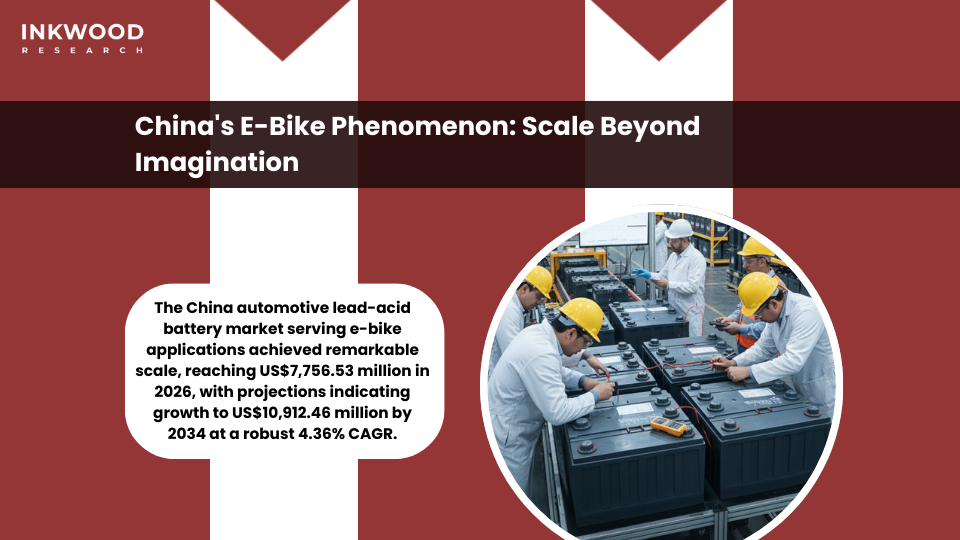
The China automotive lead-acid battery market serving e-bike applications achieved remarkable scale, reaching US$7,756.53 million in 2026, with projections indicating growth to US$10,912.46 million by 2034 at a robust 4.36% CAGR. This substantial market reflects both replacement demand from existing e-bike fleets and continued new vehicle sales across urban and suburban regions.
Additionally, market dynamics differ significantly between coastal megacities and interior provinces. Tier-1 cities demonstrate higher lithium-ion adoption rates driven by affluent consumers prioritizing performance and weight reduction. Conversely, tier-2 and tier-3 cities maintain a strong lead-acid preference reflecting initial price sensitivity and established distribution networks serving mass-market consumers.
E-Bike Category Diversity
Chinese e-bike markets encompass diverse vehicle categories serving distinct consumer needs and preferences. Pedal-assist bicycles provide natural riding experiences while reducing physical exertion on longer commutes. Meanwhile, throttle-controlled models resemble electric scooters, offering convenience for riders prioritizing speed over exercise benefits.
Class 1 e-bikes dominate sales through regulatory alignment with urban infrastructure policies. These pedal-assist vehicles access public bike lanes and dedicated cycling infrastructure without comprehensive licensing requirements. Subsequently, manufacturers focus product development on this category, optimizing battery performance for typical urban commuting distances and usage patterns.
Lead-Acid’s Dominance in China’s Mass Market

The Economics of Affordability
Lead-acid batteries capture a significant percentage of China’s electric bicycle market, demonstrating overwhelming dominance in mainstream segments. This market position reflects fundamental economics favoring low-cost automotive battery solutions for price-sensitive consumers. Standard lead-acid batteries for e-bikes cost CNY 300-500 (approximately USD 45-75), while lithium alternatives command CNY 1,500-2,500 (USD 225-375) or higher.
Moreover, total e-bike pricing heavily influences battery technology selection. Mass-market e-bikes retail for CNY 1,500-3,000, making lead-acid batteries essential for maintaining affordable price points. Consequently, manufacturers targeting mainstream consumers prioritize cost optimization over performance enhancements requiring premium battery technologies.
Performance Adequate for Urban Use
Chinese urban commuting patterns typically involve 5-15 kilometer daily distances perfectly matched to lead-acid battery capabilities. These batteries deliver 30-70 kilometer ranges on single charges under typical operating conditions, providing adequate performance for most users’ daily transportation needs. Furthermore, charging infrastructure availability in residential areas enables overnight charging, supporting daily commute requirements.
However, lead-acid batteries demonstrate several limitations affecting user experience. Heavier weight compared to lithium alternatives impacts vehicle handling and maneuverability, particularly for smaller riders. Additionally, shorter lifespan necessitates more frequent replacements, creating ongoing maintenance costs partially offsetting initial purchase savings.
The Replacement Market Dynamic
Battery replacement represents a significant business opportunity within China’s massive e-bike fleet. Average lead-acid battery lifespan ranges from 3-5 years for standard applications, while premium industrial models can function effectively for 10+ years, depending on usage patterns, climate conditions, and charging practices. Subsequently, replacement demand generates substantial ongoing revenue for battery manufacturers and distribution networks serving aftermarket channels.
Nevertheless, replacement purchasing behavior differs from new vehicle battery selection. Consumers often choose economy-tier replacements, minimizing immediate costs rather than investing in premium products offering extended lifespan. This preference pattern reinforces low-cost automotive battery demand, supporting continued lead-acid dominance in replacement segments.
Regional Market Variations
Northern Chinese cities experience accelerated battery degradation from extreme winter temperatures, affecting chemical performance. Cold weather reduces available capacity and starting power, frustrating users and shortening replacement cycles. Conversely, southern regions face heat-related degradation, accelerating internal corrosion and electrolyte evaporation in flooded lead-acid designs.
These regional variations influence battery technology preferences and product specifications. Manufacturers develop climate-optimized formulations addressing specific regional challenges while maintaining cost competitiveness essential for market success. Additionally, sealed maintenance-free lead-acid battery variants gain popularity in regions where consumer convenience outweighs marginal price premiums.
Government Policy Shaping Market Evolution
Transportation Policy Framework
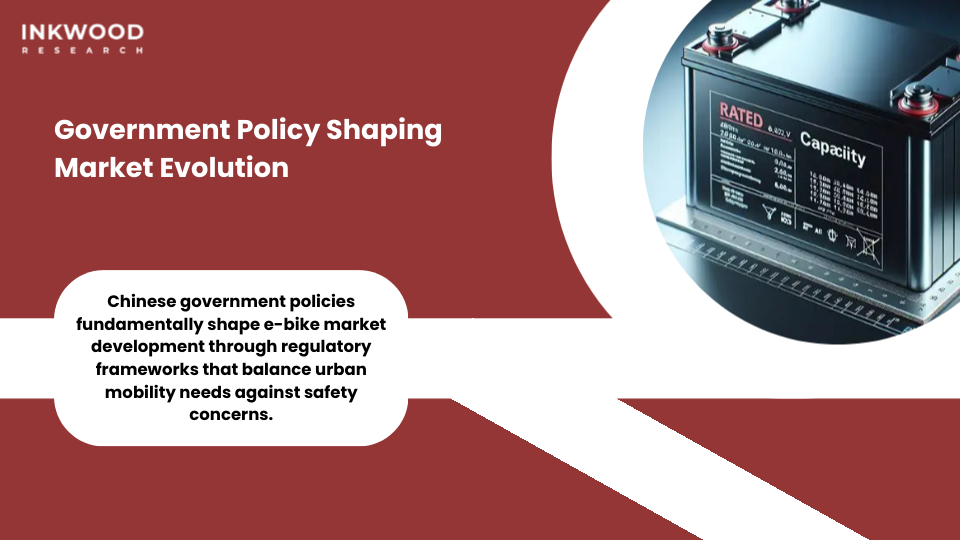
Chinese government policies fundamentally shape e-bike market development through regulatory frameworks that balance urban mobility needs against safety concerns. National and local regulations establish vehicle specifications, speed limits, and usage restrictions, attempting to manage rapid e-bike proliferation. However, policy implementation varies significantly across jurisdictions, creating complex compliance landscapes for manufacturers.
Moreover, recent regulatory initiatives target safety improvements addressing fire incidents and traffic accidents involving e-bikes. These evolving standards influence battery technology selection and vehicle design parameters.
Environmental Sustainability Initiatives
Green transportation promotion represents a core government policy objective addressing urban air quality and carbon emission reduction. E-bikes produce zero tailpipe emissions while consuming minimal electricity compared to automobiles, aligning perfectly with environmental sustainability goals. Consequently, most Chinese cities encourage rather than restrict e-bike usage, contrasting with regulatory approaches in some international markets.
Furthermore, government initiatives increasingly emphasize battery recycling and proper disposal, addressing environmental concerns from lead-acid battery waste. Although recycling infrastructure remains underdeveloped compared to European standards, regulatory pressure accelerates investment in collection networks and processing facilities. This policy direction creates opportunities for companies offering closed-loop recycling solutions.
The 2025 Trade-In Program
In January 2025, China’s Ministry of Commerce and four other departments unveiled updated guidelines for electric bicycle trade-in programs, providing subsidies for consumers replacing used e-bikes with new qualified models. This initiative aims to accelerate fleet renewal while promoting higher safety and environmental standards through newer vehicle technologies.
Additionally, such programs indirectly influence battery technology adoption by incentivizing consumers toward newer vehicles potentially equipped with lithium-ion batteries. However, subsidy amounts and eligibility criteria ultimately determine program effectiveness in shifting market dynamics away from traditional lead-acid solutions dominating current sales.
Urban Infrastructure Development
Chinese cities invest heavily in cycling infrastructure supporting e-bike adoption through dedicated lanes, parking facilities, and charging stations. These infrastructure improvements reduce barriers to e-bike usage while enhancing safety and convenience for riders. Subsequently, improved infrastructure correlates with increased e-bike adoption rates across urban populations.
Nevertheless, infrastructure development varies dramatically between cities, reflecting different priorities and fiscal capacities. Tier-1 cities typically provide comprehensive facilities supporting premium e-bike adoption with advanced features. Meanwhile, smaller cities focus on basic infrastructure adequate for conventional lead-acid powered e-bikes serving mass-market consumers.
The Battery Technology Battle: Lead-Acid vs. Lithium-Ion
Technology Performance Comparison
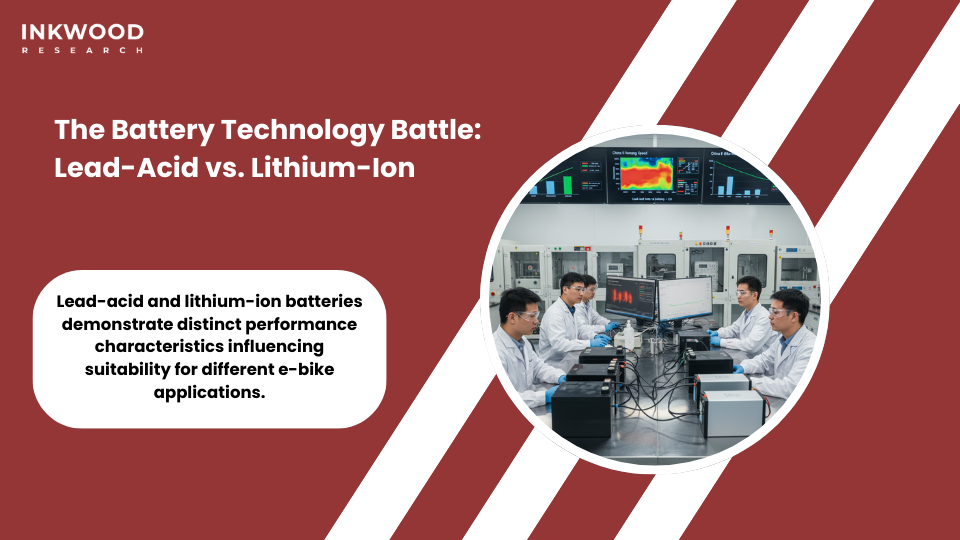
Lead-acid and lithium-ion batteries demonstrate distinct performance characteristics influencing suitability for different e-bike applications. Lithium-ion technology offers superior energy density, enabling lighter vehicles with extended ranges. Additionally, lithium batteries accept faster charging and deliver more consistent power output throughout discharge cycles compared to lead-acid alternatives.
However, performance advantages come with substantial cost premiums, limiting lithium adoption to premium market segments. Chinese consumers typically prioritize affordability over performance enhancements when purchasing transportation vehicles. Therefore, lead-acid battery demand remains robust despite lithium-ion technical superiority in measurable performance metrics.
Safety Considerations Drive Decisions
Battery safety emerged as a critical concern following numerous fire incidents involving lithium-ion-powered e-bikes. Cell variability and thermal management challenges create risks in cost-optimized lithium battery implementations lacking sophisticated battery management systems. These incidents generated negative publicity, affecting consumer confidence in lithium technology.
Conversely, lead-acid batteries demonstrate excellent safety records through mature technology with well-understood failure modes and risks. Although lead-acid batteries contain hazardous materials requiring proper disposal, fire risks remain minimal compared to lithium alternatives. This safety advantage resonates strongly with consumers and regulatory authorities evaluating technology tradeoffs.
The Lithium-Ion Market Share Evolution
Despite overwhelming lead-acid dominance, lithium-ion market share gradually increases within the Chinese e-bike market. Aligning with this, estimates suggest lithium batteries’ market share has grown from negligible percentages in earlier years. This expansion reflects improving cost-performance ratios as lithium battery prices decline through manufacturing scale and technology improvements.
Moreover, premium e-bike manufacturers position lithium-ion batteries as differentiating features, justifying higher vehicle prices. Brands like Yadea and Aima offer lithium-equipped models targeting affluent urban consumers willing to pay premiums for reduced weight and enhanced performance. Subsequently, lithium adoption accelerates in tier-1 cities while remaining limited in price-sensitive regional markets.
Hybrid and Alternative Technologies
Battery manufacturers explore alternative chemistries addressing specific market needs and cost points. Sodium-ion batteries generate increasing interest as potential low-cost alternatives to both lead-acid and lithium technologies. These emerging solutions could disrupt current market dynamics if successfully commercialized at competitive prices.
Furthermore, some manufacturers experiment with hybrid battery systems combining lead-acid and lithium-ion elements, optimizing cost-performance tradeoffs. These innovative approaches attempt to capture middle-market consumers seeking performance improvements without full lithium-ion price premiums. However, complexity and reliability concerns limit the widespread adoption of hybrid configurations.
Consumer Preferences and Purchase Drivers
Price Sensitivity Dominates Decisions
Chinese e-bike consumers demonstrate extreme price sensitivity when making purchase decisions, particularly in mass-market segments. Vehicle prices ranging from CNY 1,500-3,000 place e-bikes within reach of working-class consumers for whom automobiles remain unaffordable. Battery cost represents a substantial portion of total vehicle cost, making technology selection critical for maintaining target price points.
Additionally, replacement battery purchasing reinforces price-focused behavior patterns. When facing battery replacement decisions, most consumers select the cheapest options meeting basic performance requirements rather than investing in premium products. This behavior perpetuates lead-acid dominance in aftermarket channels despite lithium alternatives offering superior lifecycle economics.
Range Anxiety and Daily Usage Patterns
Although range anxiety affects electric vehicle adoption broadly, e-bike users demonstrate different concerns compared to automobile drivers. Short urban commuting distances typically falling within lead-acid battery capabilities reduce range anxiety for most users. Furthermore, overnight home charging provides adequate charging opportunities for daily commute cycles.
However, users with longer commutes or multiple daily trips increasingly consider lithium-ion options offering extended ranges and faster charging. These consumers represent growing market segments as Chinese cities expand geographically and suburban populations increase. Subsequently, battery technology preferences correlate strongly with commuting distance patterns across different urban environments.
Quality Perceptions and Brand Loyalty
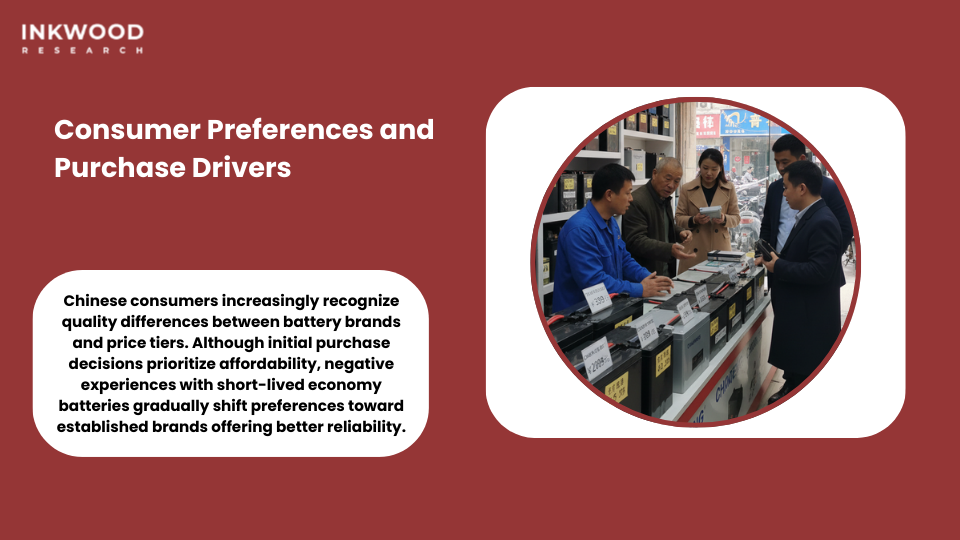
Chinese consumers increasingly recognize quality differences between battery brands and price tiers. Although initial purchase decisions prioritize affordability, negative experiences with short-lived economy batteries gradually shift preferences toward established brands offering better reliability. This trend benefits major manufacturers like Tianneng and Chaowei, dominating the Chinese e-bike battery market.
Moreover, warranty periods become important purchase considerations as consumers learn to evaluate the total cost of ownership. Batteries offering 12-18 month warranties command price premiums over 6-month warranty economy products. Nevertheless, warranty claims processes and enforcement remain challenging in fragmented distribution channels, limiting warranty value for some consumers.
Generational and Demographic Variations
Younger urban professionals demonstrate a greater willingness to adopt lithium-ion e-bikes, reflecting higher disposable incomes and technology orientation. These consumers value lighter weight for apartment storage and stairway navigation while appreciating fast-charging convenience, fitting modern lifestyles. Consequently, premium e-bike brands target younger demographics through product features and marketing messaging.
Conversely, older consumers and rural populations maintain stronger preferences for proven lead-acid technology. These groups prioritize affordability and familiarity over performance enhancements while expressing skepticism toward newer battery technologies. Therefore, successful e-bike manufacturers develop diverse product portfolios addressing segmented consumer preferences across demographic groups.
Manufacturing and Supply Chain Dynamics
China’s Battery Production Capacity
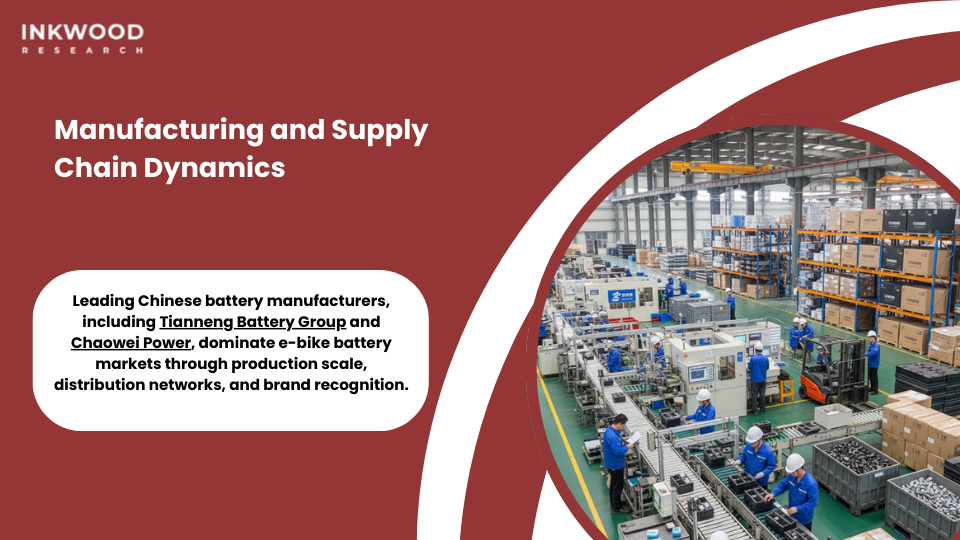
China established itself as a global leader in lead-acid battery manufacturing through massive production capacity serving domestic and export markets. More than 2,000 companies produce lead-acid batteries domestically, with 300 specializing in e-bike applications. This fragmented manufacturing landscape creates intense competition, driving prices downward while challenging quality consistency.
Furthermore, large manufacturers invest in automation and quality control systems, differentiating products in increasingly competitive markets. Meanwhile, smaller producers compete primarily on price, serving local and regional distribution networks.
Major Market Players and Competition
Leading Chinese battery manufacturers, including Tianneng Battery Group and Chaowei Power, dominate e-bike battery markets through production scale, distribution networks, and brand recognition. These companies leverage vertical integration, controlling raw material sourcing, manufacturing, and retail distribution. Subsequently, market leadership positions enable sustained profitability despite intense price competition.
However, market fragmentation creates opportunities for regional players serving specific geographic markets or customer segments. Smaller manufacturers compete through specialized products, local relationships, or cost advantages from lower overhead structures. This competitive dynamic maintains pressure on pricing while driving continuous efficiency improvements across the industry.
Raw Material Supply and Pricing
Lead prices fluctuate based on global commodity markets, mining production levels, and recycling supply availability. Chinese manufacturers increasingly rely on domestic recycling sources, providing price stability and reducing import dependencies. Nevertheless, quality requirements for battery-grade lead necessitate careful supply chain management, balancing cost against material specifications.
Additionally, other raw materials, including sulfuric acid, plastic components, and grid alloys, contribute to production costs. Manufacturers develop strategic supplier relationships, ensuring reliable material flows while negotiating favorable pricing terms. These supply chain capabilities become competitive advantages in cost-sensitive e-bike battery markets.
Recycling Infrastructure Development
Chinese battery recycling infrastructure remains underdeveloped compared to European standards despite environmental concerns and regulatory pressure. Informal recycling operations lacking proper environmental controls process substantial battery volumes, creating environmental and health risks. Nevertheless, government initiatives increasingly target recycling infrastructure improvement through regulations and investment incentives.
Moreover, leading battery manufacturers establish collection and recycling programs, capturing used batteries while securing recycled lead supplies. These closed-loop systems provide environmental benefits while supporting raw material security and cost management. As regulations tighten, companies with established recycling capabilities gain competitive advantages over competitors lacking such infrastructure.
Key Takeaways
- China’s e-bike revolution demonstrates successful mass-market electric vehicle adoption through affordable lead-acid battery technology serving millions of daily commuters. The market’s scale, reaching US$7,756.53 million in 2026 and growing to US$10,912.46 million by 2034, confirms sustained demand supporting continued investment and innovation.
- Lead-acid batteries maintain a significant market share through overwhelming cost advantages, meeting performance requirements for typical urban commuting distances. This dominance reflects Chinese consumer price sensitivity and the practical sufficiency of lead-acid technology for mass-market applications.
- Government policies promoting green transportation while addressing safety concerns shape market evolution through regulations, infrastructure investment, and consumer incentive programs. Recent initiatives, including the 2025 trade-in program, accelerate fleet renewal while potentially influencing battery technology adoption patterns.
- Lithium-ion batteries gradually gain market share in premium segments, driven by improving cost-performance ratios and consumer preferences for reduced weight and enhanced performance. Nevertheless, lithium adoption remains concentrated among affluent urban consumers while mass markets maintain lead-acid preferences.
- Manufacturing landscape features intense competition among thousands of producers, creating downward price pressure while challenging quality consistency. Leading manufacturers differentiate through brand strength, distribution networks, and vertical integration, capturing sustainable profitability despite competitive intensity.
Conclusion:
China’s e-bike market exemplifies how traditional battery technology enables transformative mobility solutions at a massive scale when cost-effectiveness matters more than cutting-edge performance. Lead-acid batteries proved essential in democratizing electric transportation across diverse socioeconomic groups, fundamentally reshaping urban mobility patterns.
Looking forward, continued market evolution will balance traditional lead-acid dominance against gradually increasing lithium-ion adoption as prices decline and consumer preferences evolve. Battery manufacturers succeeding in this dynamic environment must optimize product portfolios, addressing diverse consumer needs while maintaining cost competitiveness essential for market leadership.
If you’re seeking strategic intelligence on China’s e-bike market dynamics, battery technology trends, or consumer behavior patterns, contact Inkwood Research for customized analysis supporting market entry strategies, product development decisions, and investment planning initiatives.
Frequently Asked Questions
Why do lead-acid batteries dominate China's e-bike market despite lithium-ion advantages?
Chinese consumers prioritize affordability over performance enhancements, making low-cost solutions essential for mass-market success. Additionally, lead-acid technology demonstrates excellent safety records, avoiding fire risks associated with some lithium implementations.
How do government policies influence e-bike battery technology adoption in China?
Government regulations establish safety standards, usage restrictions, and environmental requirements shaping battery technology selection. Recent initiatives like the 2025 trade-in program provide subsidies encouraging fleet renewal with newer vehicles potentially equipped with advanced batteries. Furthermore, infrastructure investment in cycling lanes and charging facilities supports continued e-bike adoption across urban populations.
Will lithium-ion batteries eventually replace lead-acid in Chinese e-bike markets?
Lithium-ion market share gradually increases in premium segments as prices decline and performance advantages justify cost premiums for affluent consumers. However, complete replacement appears unlikely given persistent price sensitivity in mass markets and lead-acid’s adequate performance for typical applications. Instead, market segmentation will likely persist with different technologies serving distinct consumer groups and vehicle categories.