Table of Contents
This analysis is brought to you by Inkwood Research, a leading market intelligence firm specializing in Latin American energy transformation, renewable hydrogen development, and export-oriented clean energy strategies. Our research team combines extensive experience analyzing government policy frameworks, electrolyzer deployment programs, and international hydrogen trade across Chile and broader South American markets. Based on our proprietary research methodologies and strategic partnerships with regional energy producers, technology developers, and export agencies, we deliver actionable insights that empower strategic decision-making for enterprises navigating Chile’s green hydrogen emergence as a global export hub.
TLDR
The Chile green hydrogen market grows from US$124.07 million in 2026 to US$2,099.17 million by 2034 at 42.41% CAGR. Chile’s National Green Hydrogen Strategy targets 5 gigawatts of electrolyzer capacity by 2025 and 25 gigawatts by 2030 through renewable energy green power integration. Six pilot projects totaling 396 megawatt capacity receive government support from Enel Green Power and Air Liquide. Wind energy green hydrogen development leverages exceptional solar and wind power resources, enabling cost-competitive hydrogen energy production for Asian and European export markets.
International hydrogen importers seeking supply diversity, Chilean businesses evaluating hydrogen opportunities, renewable energy investors analyzing South American markets, mining companies exploring green hydrogen applications, technology providers identifying deployment opportunities, export agencies developing trade relationships, and policy analysts studying national hydrogen strategies will gain comprehensive insights into how Chile positions itself as a major clean fuel exporter through strategic resource advantages and comprehensive government support programs.
Chile Green Hydrogen Market Outlook
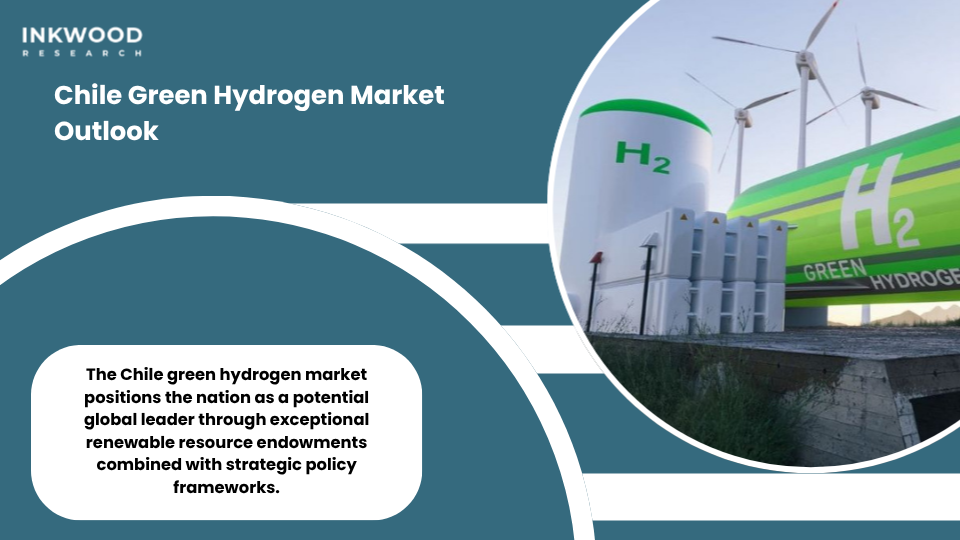
The Chile green hydrogen market positions the nation as a potential global leader through exceptional renewable resource endowments combined with strategic policy frameworks. According to our research, the green hydrogen sector expands from US$124.07 million in 2026 toward US$2,099.17 million by 2034, reflecting an impressive 42.41% compound annual growth. This trajectory demonstrates how hydrogen development leverages abundant renewable energy capacity across diverse geographic regions.
Moreover, government initiatives establish comprehensive support systems encouraging private sector investments in hydrogen energy infrastructure. Companies, including Enel Green Power, pioneer wind energy and green hydrogen production, leveraging renewable source electricity from extensive solar and wind power installations throughout northern and southern regions, enabling cost-competitive renewable energy green hydrogen production.
Chile’s strategic vision extends beyond domestic energy transition toward establishing major export operations supplying international markets. Asian economies, including Japan, South Korea, and Singapore, represent primary target customers seeking clean hydrogen imports. Additionally, European markets pursuing aggressive decarbonization create substantial demand opportunities. These international relationships justify large-scale infrastructure investments supporting export-oriented production strategies.
Geographic advantages provide Chile with a unique competitive positioning in emerging global hydrogen trade networks. The Atacama Desert offers the world’s best solar resources combined with strong wind potential. Southern regions feature exceptional wind resources suitable for large-scale generation. Furthermore, port infrastructure along extensive coastlines enables efficient export logistics. These natural endowments create foundations for cost leadership in international hydrogen markets.
Understanding Chile’s Green Hydrogen Market Potential
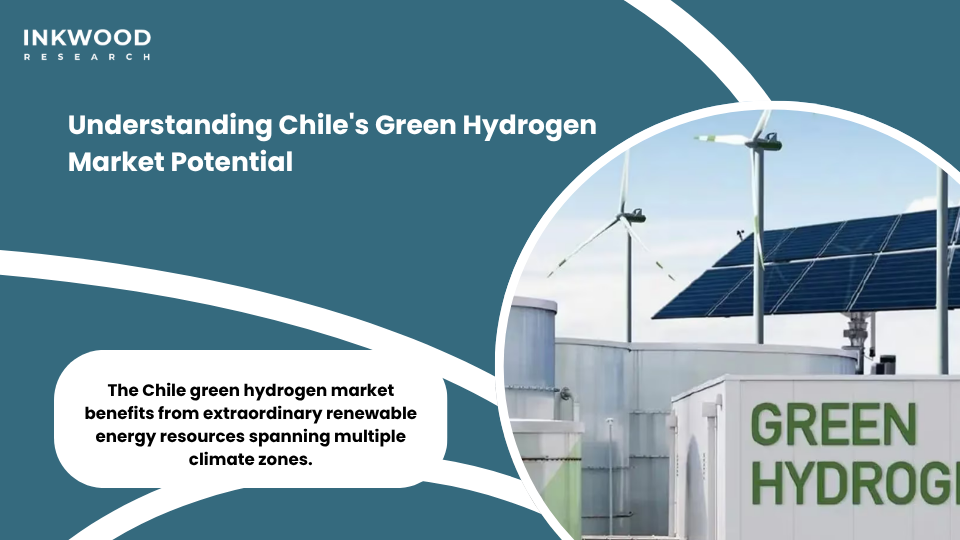
The Chile green hydrogen market benefits from extraordinary renewable energy resources spanning multiple climate zones. Northern regions, including the Atacama Desert, receive exceptional solar irradiation exceeding most global locations. This advantage enables cost-effective photovoltaic generation supporting hydrogen production through electrolysis. Meanwhile, southern regions offer strong, consistent wind resources complementing solar generation patterns.
Resource Advantages and Cost Competitiveness
Based on our analysis, Chile’s renewable electricity costs rank among the world’s lowest following aggressive capacity expansion over recent years. This cost advantage directly translates to hydrogen production economics, potentially positioning Chile as the cheapest green hydrogen producer globally. Government strategy explicitly targets this cost leadership objective, recognizing it as essential for export market success.
Moreover, available land across the desert and remote regions provides space for massive solar and wind installations without competing with agricultural or urban uses. Water availability, while challenging in northern regions, can be addressed through desalination facilities powered by renewable electricity. These solutions enable hydrogen production, overcoming resource constraints that might limit other locations.
Geographic Distribution of Renewable Resources
According to our research, Chile’s unusual geography spanning diverse climate zones creates opportunities for varied renewable energy developments. Northern regions focus primarily on solar installations, capturing exceptional irradiation. Central areas combine moderate solar and wind resources. Southern regions, particularly Patagonia, offer world-class wind potential, attracting major project developments.
This geographic diversity enables portfolio approaches balancing different generation profiles. Solar output peaks during the summer months in the north. Wind resources in the south provide stronger winter generation. Such complementary patterns improve overall system reliability while maximizing renewable energy utilization throughout annual cycles. Consequently, electrolyzer capacity factors improve, enhancing project economics.
National Strategy: 5 GW by 2025, 25 GW by 2030
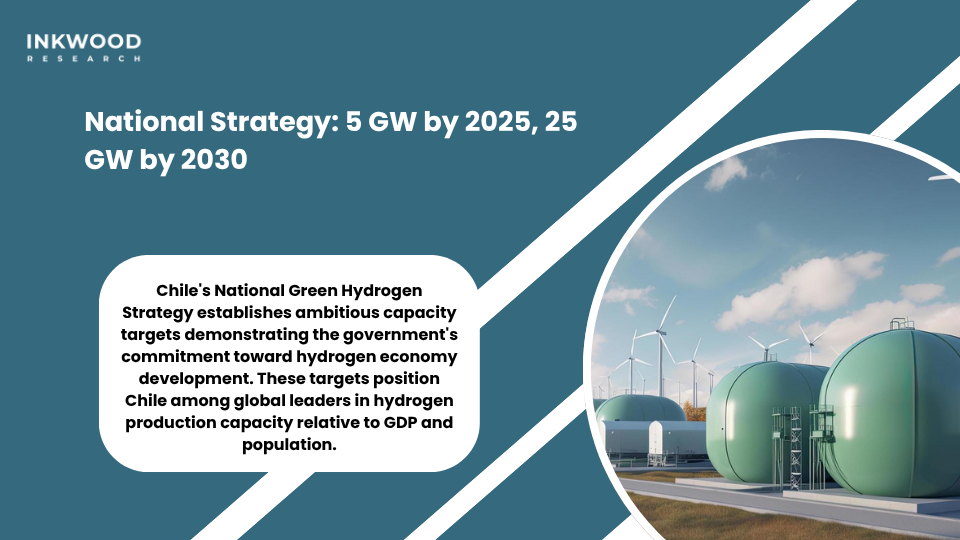
Chile’s National Green Hydrogen Strategy establishes ambitious capacity targets demonstrating the government’s commitment toward hydrogen economy development. The strategy aims for 5 gigawatts of electrolyzer capacity under development by 2025, expanding to 25 gigawatts by 2030. These targets position Chile among global leaders in hydrogen production capacity relative to GDP and population.
Three primary objectives guide the national strategy implementation. First, having 5 gigawatts of electrolyzer capacity under development by 2025 establishes early momentum. Second, producing the cheapest green hydrogen globally by 2030 captures cost leadership positions. Third, becoming among the world’s three largest exporters by 2040 secures market share in emerging international trade networks.
Policy Measures Supporting Strategy Implementation
Based on our findings, comprehensive policy measures address multiple barriers constraining hydrogen development. Research and development funding accelerates technology advancement at universities and research centers. Financial support for pilot projects enables demonstrations proving technical and commercial viability. Streamlined permitting processes reduce development timelines and regulatory uncertainties.
Tax incentives encourage private sector investments in hydrogen production and electrolyzer manufacturing. Proposed reforms include reduced corporate income tax rates for companies developing decarbonization technologies. Additionally, tax credits for research and development expenditures support innovation activities. These financial mechanisms improve project returns, attracting capital that might otherwise flow to competing opportunities.
International Collaboration and Knowledge Transfer
According to our analysis, Chile has established strategic partnerships with leading hydrogen markets, including Germany, the Netherlands, and South Korea. These agreements facilitate technology transfer, establish certification frameworks, and develop export relationships. German cooperation particularly focuses on regulatory development and project finance mechanisms. Dutch partnerships emphasize import-export corridors and port infrastructure.
Knowledge sharing through international working groups accelerates Chile’s hydrogen sector maturation. Participants exchange best practices regarding safety standards, certification systems, and operational procedures. This collaboration prevents costly mistakes by learning from more experienced markets. Moreover, international engagement enhances Chile’s credibility with potential customers and investors evaluating hydrogen supply opportunities.
Six Pilot Projects Launching Chile's Hydrogen Economy
In December 2021, Chile’s development agency CORFO selected six projects receiving US$50 million in public subsidies supporting commercial demonstrations. These initiatives total 396 megawatts of electrolyzer capacity expected to produce over 45,000 tonnes of green hydrogen annually. Target operations beginning in 2025 establish Chile’s production capabilities while proving technical and economic viability.
Enel Green Power leads with the largest allocation, receiving US$16.9 million, supporting 240 megawatt capacity. This project leverages Enel’s extensive renewable energy portfolio in Chile. Air Liquide received US$11.7 million for an 80-megawatt facility, bringing its global hydrogen expertise. Engie secured US$9.5 million for 26 megawatts, while GNL Quintero, CAP, and Linde received smaller allocations for their respective projects.
Enel Green Power’s Leadership Role
Based on our research, Enel Green Power’s substantial Chilean renewable energy presence positions them ideally for hydrogen development. The company operates multiple solar and wind facilities providing clean electricity feedstock. Their 240-megawatt hydrogen project represents the largest pilot initiative, demonstrating confidence in Chile’s hydrogen potential. Moreover, Enel’s international network facilitates technology transfer and market access.
Integration with existing renewable assets improves project economics through shared infrastructure and operational synergies. Power purchase agreements between Enel’s generation and hydrogen production optimize overall system performance. This vertical integration model may prove advantageous compared to standalone hydrogen projects purchasing electricity from third parties.
Diverse Applications Across Pilot Projects
According to our findings, pilot projects target various applications demonstrating hydrogen’s versatility. Some focus on export-oriented production, establishing supply chains for international markets. Others supply domestic industrial consumers, including mining operations. Transportation applications include hydrogen refueling infrastructure for commercial vehicles. This diversity proves multiple use cases supporting broader market development.
Lessons learned from these pilots inform subsequent commercial-scale developments. Technical performance data validates equipment selections and operational approaches. Economic results demonstrate actual costs versus projections, guiding future investment decisions. Moreover, regulatory experiences identify policy improvements facilitating smoother project approvals for the following initiatives.
Renewable Energy Advantages Enabling Cost Leadership
Chile’s renewable energy advantages create pathways toward global cost leadership in green hydrogen production. The Atacama Desert’s solar irradiation levels exceed 3,000 kilowatt-hours per square meter annually, among the world’s highest. This exceptional resource enables solar installations to achieve capacity factors above 30%, significantly higher than many competing locations.
Wind resources in Patagonia offer similarly exceptional characteristics with consistent, strong winds enabling high capacity factors. These conditions reduce the levelized cost of electricity from renewable sources. Since electricity represents the largest component of hydrogen production costs through electrolysis, these advantages directly translate to hydrogen cost competitiveness.
Declining Renewable Energy Costs
Based on our analysis, Chile’s renewable electricity auctions have achieved record-low prices globally. Recent solar contracts settled below US$20 per megawatt-hour, demonstrating extraordinary cost competitiveness. Wind energy similarly achieved prices enabling economic hydrogen production. These cost reductions result from technology improvements, scale economies, and favorable resource conditions.
Continuing cost declines improve hydrogen production economics even as projects develop. Forward-looking strategies anticipate further reductions as renewable capacity expands and technologies mature. This creates favorable conditions for long-term hydrogen investments with confidence that costs will remain competitive throughout project lifetimes.
Infrastructure Investments Supporting Development
According to our research, Chile invests substantially in transmission infrastructure connecting renewable resources with consumption centers and ports. These grid investments enable renewable energy export through hydrogen conversion. Additionally, port upgrades accommodate hydrogen and ammonia export facilities. Such infrastructure spending demonstrates the government’s commitment to supporting the hydrogen strategy implementation.
Water infrastructure represents another critical investment area, particularly for northern desert regions. Desalination facilities powered by renewable electricity provide feedwater for electrolysis. While adding costs, these solutions prove economically viable given overall system economics. Furthermore, desalination co-benefits include water supply for mining operations and local communities.
Export Markets and International Partnerships
Chile’s hydrogen strategy prioritizes export markets, recognizing domestic consumption alone cannot justify massive production capacity. Asian economies represent the primary target customers, particularly Japan, South Korea, and Singapore. These countries pursue hydrogen imports as part of comprehensive decarbonization strategies. Long-term offtake commitments from Asian customers provide revenue certainty supporting Chilean project development.
European markets offer additional export opportunities as the continent pursues aggressive climate targets. Germany and the Netherlands have signed cooperation agreements with Chile, establishing frameworks for hydrogen trade. These partnerships address technical standards, certification requirements, and logistics arrangements essential for efficient trade operations.
Ammonia as Hydrogen Carrier
Based on our findings, Chile likely exports hydrogen as green ammonia rather than pure hydrogen. Ammonia serves as a hydrogen carrier enabling practical long-distance shipping. This approach leverages existing ammonia transport infrastructure with modifications rather than developing entirely new systems for hydrogen shipping. Destination facilities reconvert ammonia to hydrogen for end-use applications.
Some Chilean ammonia may also serve directly as maritime fuel or chemical feedstock. International Maritime Organization emissions regulations create demand for clean shipping fuels. Chilean ports along major shipping routes could supply bunker fuel to vessels transiting between Asia, South America, and beyond. This diversification creates multiple revenue streams beyond pure hydrogen carrier applications.
Competitive Positioning Against Other Exporters
According to our analysis, Chile competes with other potential hydrogen exporters, including Australia, Saudi Arabia, and North African countries. Each location offers distinct advantages regarding resources, costs, or market proximity. Chile’s Pacific coast positioning provides natural access to Asian markets. Additionally, cost leadership aspirations differentiate Chilean hydrogen from competitors, potentially charging premium prices.
Strategic partnerships with importing countries strengthen Chile’s competitive positioning through relationship-building and technical cooperation. Early mover advantages, establishing export infrastructure, and customer relationships create barriers to protecting market share. Consequently, Chile’s aggressive timeline pursuing 2025 targets aims to capture these first-mover benefits before competition intensifies.
Policy Framework and Government Support Programs
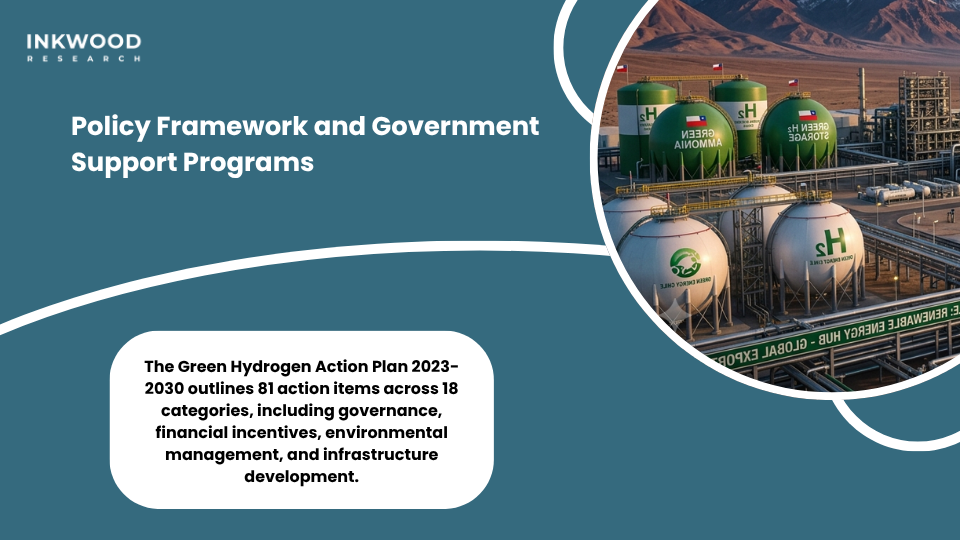
Chile’s comprehensive policy framework addresses multiple barriers constraining hydrogen development. The Green Hydrogen Action Plan 2023-2030 outlines 81 action items across 18 categories, including governance, financial incentives, environmental management, and infrastructure development. This holistic approach recognizes that successful hydrogen economies require coordinated interventions rather than isolated measures.
Implementation proceeds through two phases. The initial period from 2023 to 2026 focuses on establishing enabling conditions, including regulatory frameworks, environmental standards, and workforce development. The second phase, from 2026 to 2030, emphasizes productive development and decarbonization with a regional focus. This staged approach manages implementation complexity while maintaining strategic momentum.
Financial Incentives and Investment Support
Based on our research, proposed tax reforms establish incentives for hydrogen project development. Reduced corporate income tax rates for companies developing clean technologies improve investment returns. Research and development tax credits encourage innovative activities. These financial measures complement direct subsidies like CORFO’s pilot project funding, creating comprehensive support systems.
State-owned land allocation programs reduce site acquisition barriers for hydrogen facilities. The “Ventana al Futuro” initiative provides direct awards of public lands for hydrogen production developments. Streamlined permitting processes reduce regulatory timelines and uncertainties. These measures address non-financial barriers that might constrain development despite favorable project economics.
Certification and Standards Development
According to our findings, international certification systems verify that Chilean hydrogen meets importing countries’ sustainability requirements. These frameworks assess greenhouse gas emissions across production lifecycles. Stringent standards ensure Chilean exports qualify for premium market segments demanding verifiable carbon-free characteristics. Certification development involves collaboration with major importing markets and establishing mutual recognition agreements.
Safety regulations govern hydrogen production, storage, and transportation throughout value chains. These standards protect workers, communities, and infrastructure while enabling commercial operations. Harmonization with international standards facilitates technology imports and operational best practices. Moreover, robust safety frameworks build public confidence, essential for a social license supporting industry development.
Industrial Applications in Mining and Transportation
Chile’s massive mining sector represents a significant potential hydrogen consumer, creating domestic demand complementing export strategies. Copper, lithium, and other mining operations require substantial energy for processing and transportation. Hydrogen offers pathways to replace diesel fuel in heavy equipment and trucks. Additionally, mining processes could utilize hydrogen for heat generation or chemical applications.
Transportation applications focus initially on heavy-duty commercial vehicles where hydrogen fuel cells offer advantages over battery-electric alternatives. Long-haul trucking serving mining operations and general freight represents promising early markets. Hydrogen buses could serve urban transit systems. These mobility applications create distributed demand across Chile’s geography, supporting broader infrastructure development.
Public-Private Partnerships for Sector Adoption
Based on our analysis, Chile establishes public-private partnerships addressing barriers preventing hydrogen adoption in mining and transportation. These collaborations identify technical requirements, develop infrastructure plans, and coordinate investments. Mining companies participate in designing hydrogen solutions meeting operational needs. Such engagement ensures developments align with actual industry requirements rather than theoretical applications.
Government support includes infrastructure investments in refueling stations and pipeline networks serving industrial clusters. Shared infrastructure reduces individual company costs while enabling broader adoption. Additionally, demonstration projects prove technical viability, building confidence for larger commercial deployments. These collaborative approaches accelerate adoption timelines compared to purely market-driven development.
Environmental and Social Benefits
According to our research, hydrogen adoption in mining and transportation reduces emissions from sectors challenging to electrify through batteries alone. Chile’s mining contributes substantially to national emissions. Transitioning toward hydrogen-powered equipment and processes addresses these footprints while maintaining economic competitiveness. Moreover, reduced local air pollution benefits communities near mining operations and transportation corridors.
Employment opportunities throughout hydrogen value chains support social objectives alongside environmental goals. Manufacturing, construction, operations, and maintenance create diverse job categories. Workforce development programs prepare workers for hydrogen sector careers. These employment benefits enhance political support for hydrogen strategies while addressing economic development objectives beyond pure climate considerations.
Key Takeaways
- The Chile green hydrogen market expands at 42.41% annually, reaching US$2,099.17 million by 2034 as strategic policies and exceptional resources enable rapid development.
- National strategy targets 5 gigawatts of electrolyzer capacity by 2025 and 25 gigawatts by 2030, positioning Chile among global leaders.
- Six pilot projects totaling 396 megawatt capacity receive US$50 million government support, with Enel Green Power leading 240-megawatt deployment.
- Exceptional solar resources in the Atacama Desert and wind potential in Patagonia enable cost-competitive hydrogen production.
- Export-oriented strategy targets Asian and European markets through ammonia-based transport leveraging port infrastructure.
- International partnerships with Germany, the Netherlands, and South Korea establish frameworks for technology transfer and trade relationships.
- A comprehensive policy framework includes tax incentives, streamlined permitting, state land allocation, and certification systems.
- Industrial applications in mining and transportation create domestic demand, complementing export strategies.
- Workforce development and local content requirements support economic diversification objectives alongside environmental goals.
Conclusion
According to our research, Chile’s green hydrogen strategy demonstrates how comprehensive planning, combining natural advantages with policy support, can position nations as emerging clean energy leaders. Exceptional renewable resources create fundamental cost competitiveness. Government commitment through financial incentives and regulatory frameworks reduces investment risks. International partnerships establish market access and knowledge transfer channels.
Pilot projects transitioning toward commercial operations validate technical and economic assumptions underlying ambitious national targets. Success stories will attract additional investments, accelerating capacity development. Conversely, challenges encountered provide learning opportunities informing subsequent projects. This iterative approach balances ambition with pragmatism, managing risks while maintaining strategic momentum.
Chile’s hydrogen journey offers valuable lessons for other nations pursuing similar strategies. Resource advantages alone prove insufficient without supportive policies and strategic planning. International engagement accelerates development through technology transfer and market access. Ultimately, Chile’s success or challenges will inform global hydrogen economy development as countries worldwide pursue clean energy transitions.
Frequently Asked Questions
What makes Chile competitive in global green hydrogen markets?
Chile’s green hydrogen competitiveness is driven by ultra low cost solar power in the Atacama Desert and strong wind resources in Patagonia, enabling cost efficient renewable powered electrolysis for large scale hydrogen exports
How does Chile plan to reach 25 gigawatts of electrolyzer capacity by 2030?
Chile aims to achieve 25 gigawatts of electrolyzer capacity through national hydrogen strategies, investment incentives, streamlined permitting, state backed land access, pilot project deployment, and international partnerships scaling to commercial production
Which companies lead Chile’s green hydrogen development?
Major players in Chile’s green hydrogen sector include Enel Green Power, Air Liquide, Engie, GNL Quintero, CAP, and Linde supported by government pilot funding
What export markets is Chile targeting for green hydrogen?
Chile is targeting green hydrogen exports to Europe and Asia, positioning itself as a key supplier of renewable ammonia and synthetic fuels to decarbonize heavy industry and maritime transport
What are Chile’s cost advantages in green hydrogen production?
Chile’s competitive advantage lies in high capacity factor renewables, large scale project potential, declining electrolyzer costs, and proximity to Pacific trade routes supporting low cost hydrogen and ammonia exports
What challenges could affect Chile’s green hydrogen expansion?
Key challenges include infrastructure development needs, desalination requirements for water supply, transmission expansion, global hydrogen price volatility, and securing long term international offtake agreements