TLDR
The United States CBD skincare market is experiencing unprecedented growth, projected to reach US$3.95 billion by 2032 from US$996.52 million in 2025. Key trends include mainstream retail adoption by Sephora and Ulta Beauty, increased consumer acceptance of hemp-derived skincare, and innovative CBD anti-inflammatory benefits formulations. Natural CBD products are reshaping the premium CBD skincare landscape through organic CBD cosmetics that combine cannabidiol with advanced beauty technologies.
Beauty industry executives, CBD skincare entrepreneurs, retail buyers, investment analysts tracking cannabis skin cream opportunities, product developers formulating CBD wellness products, marketing professionals promoting natural skincare solutions, and consumers seeking information about emerging hemp skin care benefits and CBD therapeutic properties in America’s evolving beauty marketplace.
CBD Skincare Market Trends | United States
The American beauty industry stands at the threshold of a remarkable transformation. Traditional skincare formulations increasingly incorporate cannabidiol extracts, while mainstream retailers embrace hemp-derived skincare products once considered niche wellness offerings.
Meanwhile, consumer attitudes toward cannabis skin cream continue evolving rapidly, driven by scientific research and changing social perceptions.
What makes 2025 particularly significant? According to Inkwood Research, the United States CBD skincare market reached US$996.52 million in 2025 and projects explosive expansion to US$3.95 billion by 2032, representing an impressive 21.76% compound annual growth rate (CAGR). This growth trajectory reflects fundamental shifts in consumer behavior, retail distribution, and product innovation.
However, beneath these impressive statistics lies a complex landscape of regulatory evolution, competitive dynamics, and consumer education challenges. Understanding these trends becomes crucial for beauty industry participants seeking to capitalize on America’s burgeoning natural CBD products marketplace. Moreover, the convergence of clean beauty movements and wellness culture positions CBD skin care products as premium solutions for health-conscious consumers.
Why does this matter now?
The 2018 Farm Bill’s legalization of hemp-derived CBD products created regulatory clarity that enabled mainstream retail adoption. Simultaneously, growing scientific research supporting CBD therapeutic properties has increased consumer confidence in organic CBD cosmetics. These factors combine to create unprecedented opportunities for brands and retailers in America’s dynamic beauty marketplace.
Mainstream Retail Revolution
Major Beauty Retailers Embrace CBD Skincare
The transformation of America’s CBD skincare market gained unprecedented momentum through mainstream retail adoption. Sephora, Ulta Beauty, and CVS Pharmacy now stock extensive natural CBD product selections, fundamentally changing consumer access and brand legitimacy. This retail revolution represents a watershed moment for hemp-derived skincare acceptance among mainstream beauty consumers.
- Sephora’s CBD expansion strategy particularly demonstrates industry confidence in cannabidiol products. The retailer now carries over 50 different premium CBD skincare brands, including established players like Lord Jones, Kiehl’s, and Saint Jane Beauty. Moreover, Sephora’s dedicated CBD education initiatives help consumers understand CBD anti-inflammatory benefits through in-store demonstrations and digital content marketing.
- Ulta Beauty’s approach focuses on curated selections that emphasize quality and education. The retailer partners with brands that provide comprehensive customer education about CBD therapeutic properties, usage instructions, and expected benefits. Additionally, Ulta’s loyalty program integration helps organic CBD cosmetics brands build customer retention while gathering valuable consumer data.
- CVS Pharmacy’s entry into CBD wellness products represents healthcare legitimacy for the category. The pharmacy chain’s rigorous vendor qualification processes ensure product safety and quality standards. Furthermore, CVS locations provide convenient access for consumers seeking CBD skin care products as part of comprehensive wellness routines.
E-commerce Platform Integration.
Direct-to-consumer e-commerce continues driving CBD skincare brand growth through subscription models, personalized product recommendations, and educational content marketing. Brands like Charlotte’s Web and Lazarus Naturals achieve 60-70% of sales through owned e-commerce platforms, enabling higher margins and direct customer relationships.
Social media integration transforms how consumers discover and purchase natural skincare solutions. Instagram Shopping, TikTok Shopping, and Pinterest’s product catalogs enable seamless transitions from content consumption to product purchase. Additionally, user-generated content showcasing real hemp skin care benefits provides authentic testimonials that influence buying decisions.
Traditional Beauty Retailers Adapt
Department stores, including Nordstrom, Bloomingdale’s, and Macy’s, increasingly feature dedicated organic CBD cosmetics sections. These premium retail environments provide credible third-party validation for emerging brands while offering sophisticated customer service experiences. Moreover, department store placement enables brands to reach affluent consumers willing to pay premium prices for quality products.
Specialty beauty retailers like Sally Beauty and Beauty Brands create opportunities for emerging premium CBD skincare companies seeking retail partnerships. These channels provide more accessible entry points compared to major department stores while offering knowledgeable staff who can educate consumers about cannabidiol benefits and usage recommendations.
Professional beauty distributors serving salons and spas represent another growing channel for CBD skin care products. Professional applications allow aestheticians to demonstrate CBD anti-inflammatory benefits through facial treatments and skincare consultations. Additionally, professional recommendations carry significant weight with consumers seeking expert guidance about natural CBD products.
Consumer Demographics and Behavior Shifts
Millennial and Gen Z Adoption Patterns
American millennials and Gen Z consumers drive CBD skincare market adoption through their openness to innovative wellness products and comfort with cannabis skin cream concepts. These demographics, representing 38% of CBD skincare purchasers according to industry research, demonstrate a sophisticated understanding of hemp-derived skincare benefits and willingness to pay premium prices for quality products.
- Millennial consumers, particularly women aged 25-40, seek natural CBD products that address specific skin concerns, including inflammation, acne scarring, and early aging signs. This demographic prioritizes ingredient transparency, sustainability messaging, and brand authenticity when evaluating organic CBD cosmetics options. Furthermore, millennials rely heavily on social media recommendations and user reviews when making purchase decisions.
- Gen Z consumers approach CBD wellness products with even greater acceptance and integration into daily routines. This cohort views cannabidiol as a normal skincare ingredient comparable to retinol or hyaluronic acid rather than an exotic wellness trend. Additionally, Gen Z consumers expect brands to provide educational content about CBD therapeutic properties through social media channels and influencer partnerships.
Urban markets, including Los Angeles, New York City, Seattle, and Denver, show the highest penetration rates for premium CBD skincare products. These metropolitan areas feature educated consumer bases with higher disposable incomes and cultural openness to cannabis-related innovations. Moreover, urban environments provide greater retail access to specialty CBD beauty market products through dedicated wellness stores and progressive beauty retailers.
Consumer Education and Awareness Growth
Consumer understanding of CBD anti-inflammatory benefits has improved dramatically through educational marketing efforts by leading brands and retailers. Scientific research published by institutions like the National Center for Biotechnology Information provides credible evidence supporting cannabidiol skincare applications, increasing consumer confidence in product efficacy.
Educational content marketing proves particularly effective for natural skincare solutions brands seeking to differentiate from competitors. Blog articles, video tutorials, and social media content that explain hemp skin care benefits help consumers make informed purchase decisions. Additionally, partnerships with dermatologists and aestheticians provide professional endorsements that influence consumer trust.
Misconceptions about CBD oil psychoactive properties continue declining as consumer education efforts succeed. Industry surveys indicate that 78% of Americans now understand that hemp-derived skincare products cannot produce intoxicating effects, compared to 45% awareness levels in 2020. This improved understanding removes significant adoption barriers for conservative consumer segments.
Transparency demands continue increasing as consumers seek detailed information about ingredient sourcing, manufacturing processes, and testing protocols. Brands that provide certificates of analysis, sustainable sourcing documentation, and comprehensive product information typically achieve higher customer loyalty and word-of-mouth referrals in the CBD skin care products marketplace.
Regional Adoption Variations
- State-level variations in CBD skincare market adoption reflect different regulatory environments and cultural attitudes toward cannabis products. California, Colorado, Oregon, and Washington demonstrate the highest per-capita consumption rates, benefiting from progressive cannabis policies and wellness-focused consumer cultures. These states serve as test markets for organic CBD cosmetics innovations before national rollouts.
- Conservative states, including Texas, Florida, and Georgia, show rapidly increasing adoption rates as consumer education reduces stigma and mainstream retail availability improves. However, these markets require more extensive educational marketing to address lingering concerns about natural CBD products safety and legality. Successfully penetrating conservative markets requires authentic brand messaging that emphasizes wellness benefits rather than cannabis associations.
- Climate variations influence product preferences across different regions. Dry climates, including Arizona, Nevada, and Colorado, drive demand for intensive moisturizing CBD wellness products, while humid regions prefer lighter formulations with cannabidiol extracts. Additionally, sun-exposed markets show particular interest in hemp-derived skincare products, claiming antioxidant and protective benefits.
- Disposable income variations across regions affect premium CBD skincare penetration rates. Affluent metropolitan areas readily adopt luxury CBD beauty market products priced above $75 per item, while price-sensitive regions require more accessible product lines and value-oriented messaging to achieve meaningful market penetration.
Product Innovation and Formulation Trends
Advanced Delivery Technologies
Innovation in CBD skincare formulations increasingly focuses on enhanced bioavailability and targeted ingredient delivery. Nanotechnology applications enable better skin penetration for cannabidiol molecules, potentially improving efficacy while reducing required concentrations. These technological advances differentiate premium brands while justifying higher price points for natural CBD products.
- Microencapsulation technologies protect CBD oil stability while providing time-released benefits throughout the day. These formulation innovations address historical challenges with hemp-derived skincare ingredient degradation and inconsistent potency. Moreover, encapsulated formulations enable brands to combine CBD anti-inflammatory benefits with other active ingredients without compatibility concerns.
- Liposomal delivery systems represent another frontier in organic CBD cosmetics innovation. These technologies enhance ingredient absorption while reducing potential skin irritation, particularly important for sensitive skin consumers. Additionally, liposomal formulations enable brands to achieve higher cannabidiol concentrations without texture or stability compromises.
- Patch-based delivery systems gain traction for targeted CBD therapeutic properties applications. These innovative formats provide controlled ingredient release over extended periods while enabling precise application to specific problem areas. Furthermore, patches appeal to consumers seeking convenient, mess-free alternatives to traditional premium CBD skincare creams and serums.
Multi-Functional Product Categories
- Hybrid formulations combining natural skincare solutions with multiple active ingredients dominate new product development trends. Brands increasingly combine hemp skin care benefits with popular ingredients like retinol, vitamin C, hyaluronic acid, and peptides. These multi-functional approaches provide comprehensive skincare benefits while simplifying consumer routines.
- Anti-aging formulations represent the fastest-growing CBD beauty market segment, addressing consumer demands for natural alternatives to conventional anti-aging ingredients. Cannabidiol antioxidant properties complement traditional anti-aging actives while potentially reducing inflammation associated with aging skin. Additionally, these products command premium pricing that improves brand profitability.
- Acne treatment formulations leverage CBD anti-inflammatory benefits to address breakout concerns without harsh chemical ingredients. These products appeal to consumers seeking gentler alternatives to benzoyl peroxide and salicylic acid treatments. Moreover, organic CBD cosmetics targeting acne-prone skin tap into substantial market demand from teenagers and young adults.
- Men’s grooming products infused with CBD wellness products address the rapidly expanding male skincare market. These formulations typically focus on post-shave soothing, beard conditioning, and general skin health maintenance. Additionally, masculine packaging and marketing approaches help normalize cannabis skin cream usage among male consumers who might otherwise avoid cannabis-associated products.
Sustainable Formulation Approaches
Environmental consciousness drives innovation toward sustainable CBD skin care products that minimize environmental impact throughout their lifecycle.
- Brands increasingly prioritize organic hemp-derived skincare ingredients sourced from sustainable farming operations. Additionally, renewable packaging materials and refillable containers reduce waste while appealing to environmentally conscious consumers.
- Waterless formulations gain momentum as brands seek to reduce environmental impact while creating more concentrated natural CBD products. These innovative approaches eliminate water content, resulting in smaller packaging, reduced shipping emissions, and longer product shelf life. Furthermore, waterless products often deliver higher concentrations of cannabidiol and other active ingredients per application.
- Clean beauty trends continue influencing premium CBD skincare formulations as consumers demand products free from controversial ingredients, including parabens, sulfates, and synthetic fragrances. Brands respond by developing minimalist formulations that highlight CBD therapeutic properties alongside other recognizable, naturally-derived ingredients. This approach appeals to consumers seeking transparency and ingredient integrity.
- Zero-waste packaging initiatives address growing consumer concerns about environmental impact. Brands like Herbivore Botanicals and Lord Jones pioneer refillable containers, compostable packaging materials, and take-back programs that minimize waste generation. These sustainability efforts particularly resonate with younger demographics who prioritize environmental responsibility in purchase decisions.
Regulatory Evolution and Market Impact
FDA Guidance and Compliance Landscape
The United States Food and Drug Administration’s evolving stance on CBD skincare market regulation continues shaping industry development and commercial opportunities. While topical cannabidiol applications face fewer restrictions compared to ingestible products, brands must navigate complex labeling requirements and therapeutic claims limitations. Current FDA guidance prohibits specific medical claims while allowing general wellness messaging.
State-level regulations create additional complexity for hemp-derived skincare companies operating across multiple jurisdictions. California, Colorado, and Oregon maintain comprehensive cannabis-friendly frameworks that encourage innovation and market development. Conversely, states like Idaho and Nebraska impose stricter limitations that complicate interstate commerce and marketing strategies.
Industry self-regulation initiatives gain importance as formal regulatory frameworks develop slowly. Organizations like the U.S. Hemp Authority provide voluntary certification programs that establish quality standards and consumer confidence. Additionally, these certification programs help natural CBD products brands differentiate from lower-quality competitors while building retail acceptance.
Quality control requirements increasingly influence organic CBD cosmetics manufacturing processes and cost structures. Third-party testing for potency, pesticides, heavy metals, and microbial contaminants becomes standard practice across the industry. Moreover, a certificate of analysis documentation helps brands build consumer trust while satisfying retailer requirements for premium CBD skincare products.
Interstate Commerce and Banking Challenges
Banking restrictions continue complicating CBD wellness products business operations despite hemp legalization under federal law.
- Many financial institutions maintain conservative policies that limit services to cannabis-related businesses, forcing companies to operate with cash transactions or seek specialized banking relationships. These challenges particularly impact smaller brands lacking resources to navigate complex financial services requirements.
- Credit card processing limitations affect e-commerce operations for CBD beauty market participants. Major processors, including Visa and Mastercard, maintain restrictions on cannabis-related transactions, forcing brands to utilize specialized payment solutions that may increase transaction costs. Additionally, payment processing challenges can negatively impact customer experience and conversion rates for online sales.
- Interstate shipping regulations create logistical complexities for natural skincare solutions brands serving national markets. Different state requirements for product registration, labeling, and testing can significantly increase operational complexity and compliance costs. Furthermore, shipping carriers maintain varying policies regarding cannabis skin cream products that can impact delivery options and customer satisfaction.
- Advertising restrictions across digital platforms continue to limit marketing opportunities for CBD skin care products. Google, Facebook, and Instagram maintain policies that restrict or prohibit hemp skin care benefits advertising, forcing brands to rely on organic content marketing and influencer partnerships. These limitations particularly challenge emerging brands seeking cost-effective customer acquisition strategies.
Future Regulatory Developments
Industry observers anticipate continued regulatory evolution that could significantly impact the CBD anti-inflammatory benefits market opportunities:
- Potential FDA approval of specific therapeutic claims could unlock new product categories and marketing opportunities. However, increased regulation might also raise barriers for smaller brands lacking resources to navigate complex compliance requirements.
- Congressional legislation addressing cannabis banking restrictions could resolve ongoing financial services challenges for cannabidiol businesses. The SAFE Banking Act and similar proposals aim to provide regulatory clarity that would enable normal banking relationships for legal cannabis businesses. Passage of such legislation could significantly reduce operational costs and complexity for industry participants.
- State-level harmonization efforts seek to reduce interstate commerce barriers while maintaining local regulatory authority. Industry associations advocate for standardized testing requirements, labeling standards, and quality certifications that would simplify multi-state operations for organic CBD cosmetics brands. These efforts could significantly reduce compliance costs while improving product consistency across markets.
- International trade considerations become increasingly relevant as premium CBD skincare brands explore export opportunities. Different countries maintain varying regulatory frameworks for hemp-derived skincare products, creating potential opportunities and challenges for American manufacturers. Moreover, international regulatory developments could influence domestic policies and market dynamics.
Competitive Landscape Transformation
Established Beauty Giants Enter CBD Market
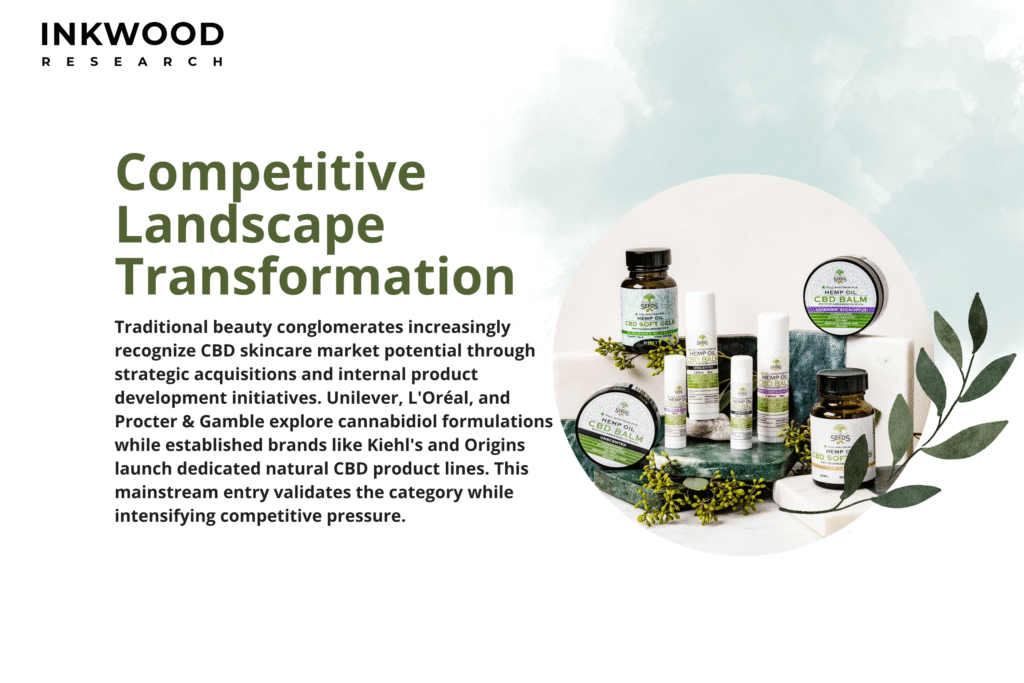
Traditional beauty conglomerates increasingly recognize CBD skincare market potential through strategic acquisitions and internal product development initiatives. Unilever, L’Oréal, and Procter & Gamble explore cannabidiol formulations while established brands like Kiehl’s and Origins launch dedicated natural CBD product lines. This mainstream entry validates the category while intensifying competitive pressure.
Luxury beauty houses, including Estée Lauder Companies and LVMH, investigate premium CBD skincare opportunities through venture investments and partnership agreements. These companies bring sophisticated marketing capabilities, global distribution networks, and substantial financial resources that could accelerate market development. However, their entry also threatens independent brands that pioneered the hemp-derived skincare category.
Celebrity beauty brands increasingly incorporate CBD wellness products into their portfolios as mainstream acceptance grows. Rihanna’s Fenty Beauty, Jessica Alba’s Honest Company, and Gwyneth Paltrow’s Goop all explore organic CBD cosmetics opportunities. Celebrity endorsement provides powerful marketing advantages while lending credibility to the CBD therapeutic properties messaging.
Mass market retailers develop private label CBD beauty market products that compete directly with branded offerings. Target’s Goodfellow & Co., CVS’s Beauty 360, and Walmart’s Equate brands all investigate natural skincare solutions incorporating cannabidiol extracts. These developments could significantly impact pricing dynamics while making hemp skin care benefits more accessible to price-sensitive consumers.
Startup Innovation and Venture Investment
Venture capital investment in CBD skin care products startups reached record levels throughout 2024, reflecting investor confidence in long-term market potential. Companies like Saint Jane Beauty, Vertly, and Cannuka attract significant funding rounds that enable rapid scaling and market expansion. These investments accelerate product development while intensifying competitive dynamics across the category.
Direct-to-consumer premium CBD skincare brands continue attracting consumer attention through innovative marketing approaches and product differentiation strategies. Brands like Herbivore Botanicals and Lord Jones build loyal customer bases through authentic storytelling, social media engagement, and exceptional product quality. Moreover, these companies often achieve higher margins compared to traditional retail-dependent beauty brands.
Technology-enabled personalization represents an emerging competitive frontier for natural CBD products. Companies like Proven Skincare and Function of Beauty expand into cannabidiol formulations while offering customized products based on skin analysis and consumer preferences. This approach could provide significant competitive advantages while commanding premium pricing.
International brands increasingly enter the United States CBD skincare market through distribution partnerships and direct investment. European companies with established hemp processing capabilities and Asian beauty giants with advanced formulation technologies all seek American market opportunities. These international entrants bring different perspectives and capabilities that could accelerate innovation.
Strategic Partnerships and Consolidation
Horizontal partnerships between organic CBD cosmetics brands and complementary wellness companies create opportunities for cross-promotion and customer acquisition.
- Collaborations between skincare brands and yoga studios, meditation apps, and wellness influencers align with consumer desires for holistic wellness solutions. Additionally, these partnerships provide cost-effective marketing alternatives to traditional advertising approaches.
- Vertical integration strategies help hemp-derived skincare companies control quality and costs while reducing supply chain risks. Companies like Charlotte’s Web invest in cultivation, extraction, and manufacturing capabilities to ensure ingredient quality and availability. This integration provides competitive advantages while potentially improving product margins.
- Acquisition activity accelerates as successful independent brands attract interest from strategic and financial buyers. Recent transactions demonstrate significant valuations for established CBD beauty market companies with strong brand recognition and customer loyalty. However, acquisition premiums reflect both growth potential and competitive intensity within the category.
- International expansion partnerships enable American CBD wellness products brands to access global markets while sharing regulatory and operational risks. Collaborations with established international beauty distributors provide market expertise and retail relationships that would be difficult to develop independently. Furthermore, international partnerships can provide valuable insights about global consumer preferences and regulatory trends.
Key Takeaways
Market Growth Drivers and Opportunities
- The United States CBD skincare market benefits from multiple converging trends that support continued rapid expansion. Mainstream retail adoption by major beauty chains provides unprecedented consumer access while lending category legitimacy. Meanwhile, growing scientific research supporting CBD anti-inflammatory benefits increases consumer confidence in cannabidiol skincare applications.
- Consumer demographics strongly favor continued growth as millennials and Gen Z represent core customer segments with established hemp-derived skincare acceptance. These demographics also possess increasing purchasing power and willingness to pay premium prices for quality natural CBD products. Additionally, expanding awareness among older demographics creates new growth opportunities for age-focused premium CBD skincare formulations.
- Product innovation continues to create new market segments and use cases for organic CBD cosmetics. Multi-functional formulations, advanced delivery technologies, and specialized applications all expand addressable markets while justifying premium pricing. Moreover, sustainability trends align well with natural skincare solutions positioning, providing additional competitive advantages.
Challenges and Risk Factors
- Regulatory uncertainty remains the primary risk factor for CBD beauty market participants. Potential FDA restrictions or state-level policy changes could significantly impact operations and profitability. Companies must maintain compliance flexibility while preparing for various regulatory scenarios that could affect business models and growth strategies.
- Competitive intensity continues increasing as established beauty companies enter the CBD wellness products category. These well-resourced competitors bring significant marketing capabilities and distribution advantages that could challenge independent brands. Successful differentiation requires authentic brand positioning, superior product quality, and exceptional customer experiences.
- Supply chain complexities affect ingredient availability and pricing for hemp skin care benefits products. Limited domestic cultivation capacity and import restrictions can create supply constraints that impact production planning. Additionally, quality control requirements increase operational costs while demanding sophisticated testing and documentation capabilities.
Strategic Recommendations for Market Participants
- Brands seeking CBD skin care products market success should prioritize regulatory compliance while building authentic relationships with target consumers. Educational marketing that emphasizes CBD therapeutic properties helps overcome remaining consumer skepticism while building brand credibility. Additionally, transparent communication about ingredient sourcing and testing builds trust that differentiates quality brands.
- Retail partnerships require a strategic evaluation of channel compatibility with brand positioning and target demographics. Premium brands benefit from selective distribution through high-end retailers, while mass market approaches require different partnership strategies. Moreover, omnichannel approaches that integrate online and offline touchpoints provide optimal customer experiences.
- Innovation investments should focus on demonstrable consumer benefits rather than technology for its own sake. Products that solve specific skin concerns while providing superior experiences command premium pricing and customer loyalty. Furthermore, sustainability initiatives increasingly influence consumer choices and provide competitive differentiation opportunities.
Conclusion
The United States CBD skincare market stands poised for exceptional growth as regulatory clarity, consumer acceptance, and product innovation converge to create unprecedented opportunities. Market expansion from US$996.52 million in 2025 to nearly US$4 billion by 2032 reflects fundamental shifts in American beauty consumer behavior and retail landscape transformation.
Success in this dynamic marketplace requires a sophisticated understanding of regulatory requirements, consumer education needs, and competitive dynamics. Brands that navigate these complexities while delivering authentic value propositions position themselves to capture significant market share during this crucial growth phase.
The convergence of clean beauty trends, wellness culture, and natural CBD products mainstream acceptance creates favorable conditions for quality brands with clear differentiation strategies. However, increasing competitive intensity demands exceptional execution across product development, marketing, and customer experience dimensions.
Looking ahead, continued innovation in formulation technologies, delivery systems, and sustainable practices will likely define next-generation premium CBD skincare offerings. Companies that anticipate these trends while building solid operational foundations position themselves to lead America’s evolving organic CBD cosmetics marketplace.
Industry participants who embrace transparency, prioritize consumer education, and maintain unwavering quality standards will likely emerge as long-term winners in this transformative market. The opportunity is substantial, but success requires strategic thinking, operational excellence, and authentic commitment to serving consumer needs in this rapidly evolving landscape.
Ready to explore comprehensive market intelligence that supports strategic decision-making in America’s CBD beauty market?
Contact Inkwood Research’s expert consultants for detailed analysis that drives informed business planning and investment strategies.