Table of Contents
This analysis is brought to you by Inkwood Research, a leading market intelligence firm specializing in digital economy transformation, enterprise automation ecosystems, and AI-driven fintech innovation across Asia’s largest markets. Our research team brings deep expertise in Indian fintech regulatory environments, Chinese enterprise AI adoption, and the deployment of intelligent RPA bots across South and East Asian digital economies. Through strategic research partnerships with enterprise technology providers, financial services institutions, and government innovation agencies, we deliver actionable intelligence for organizations navigating the global autonomous robotic process automation bots market.
TLDR
India and China are approaching intelligent process automation from entirely different angles, and both are scaling fast. Indian fintech is using agentic automation to solve compliance, credit, and customer service challenges at a speed legacy banks cannot match. Chinese enterprises, meanwhile, are deploying intelligent process automation bots across supply chains, manufacturing, and financial services at a national scale. Together, these two digital economies are reshaping what enterprise autonomous RPA automation means in practice. The Asia-Pacific autonomous RPA bots market is set to grow from $524.24 million in 2026 to $6938.86 million by 2034 at a 38.11% CAGR, and India and China are key growth engines.
This blog is directly relevant for fintech executives, enterprise technology leaders, and digital transformation strategists operating across India and China. Additionally, venture capital and private equity investors tracking AI-driven robotic process automation bots, policy analysts monitoring regulatory approaches to automation, and enterprise software vendors assessing market entry opportunities in Asia’s two largest digital economies will find rigorous, evidence-grounded intelligence here.
India – Why Indian Fintech is Betting Big on Agentic Automation

India’s fintech sector has grown faster than almost any financial ecosystem in the world, and a significant part of that growth is powered by intelligent process automation bots. Where traditional banks operate on legacy infrastructure that takes years to upgrade, fintech firms are building natively automated workflows from the ground up. Autonomous RPA automation sits at the heart of this, handling KYC verification, credit scoring, fraud detection, and customer onboarding at a scale that manual processes simply cannot sustain.
According to our analysis, the India autonomous robotic process automation (RPA) bots market size is valued at $66.37 million as of 2026 and is expected to reach $1,033.20 million by 2034, progressing with a CAGR of 40.94% during the forecast years, 2026–2034.
The scale of India’s digital financial inclusion drive makes this particularly consequential. The Reserve Bank of India has consistently published data showing rapid growth in digital payment volumes and new account openings, with hundreds of millions of Indians entering the formal financial system over the past decade. Serving this user base efficiently requires autonomous RPA solutions that can process high volumes with low error rates and minimal human oversight.
What Makes Agentic Automation Different for Indian Financial Services?
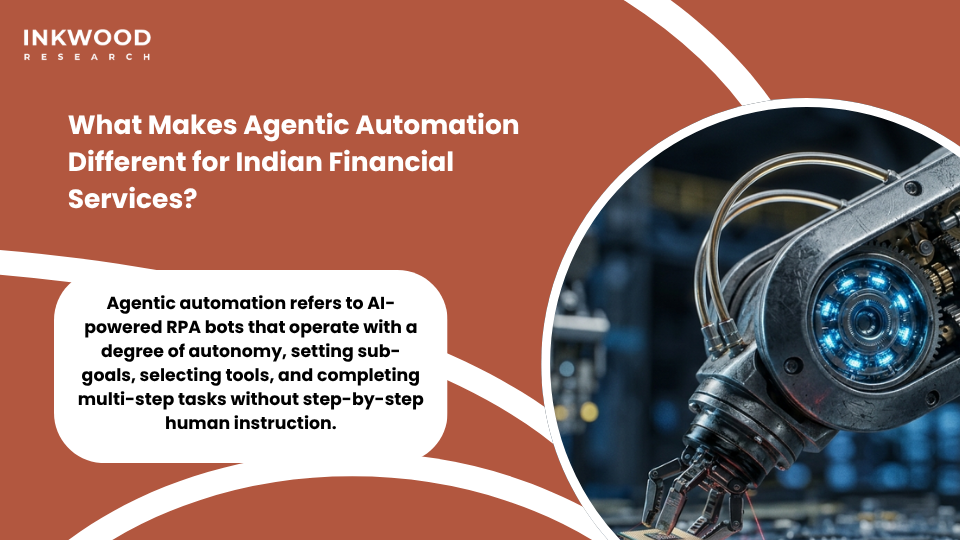
Agentic automation refers to AI-powered RPA bots that operate with a degree of autonomy, setting sub-goals, selecting tools, and completing multi-step tasks without step-by-step human instruction. For Indian fintech, this capability addresses a specific challenge: regulatory complexity.
Also, India’s financial regulatory environment involves multiple overlapping frameworks, and compliance workflows are both high-volume and high-stakes. Self-learning automation bots that understand regulatory context can handle these workflows far more reliably than rule-based systems.
Furthermore, India’s language diversity creates a layer of complexity that only cognitive robotic process automation can handle at scale. Intelligent RPA bots capable of processing documents, queries, and communications across multiple Indian languages are a genuine competitive differentiator for platforms serving tier-2 and tier-3 city populations.
How Are Autonomous RPA Bots Transforming Indian Fintech Workflows?
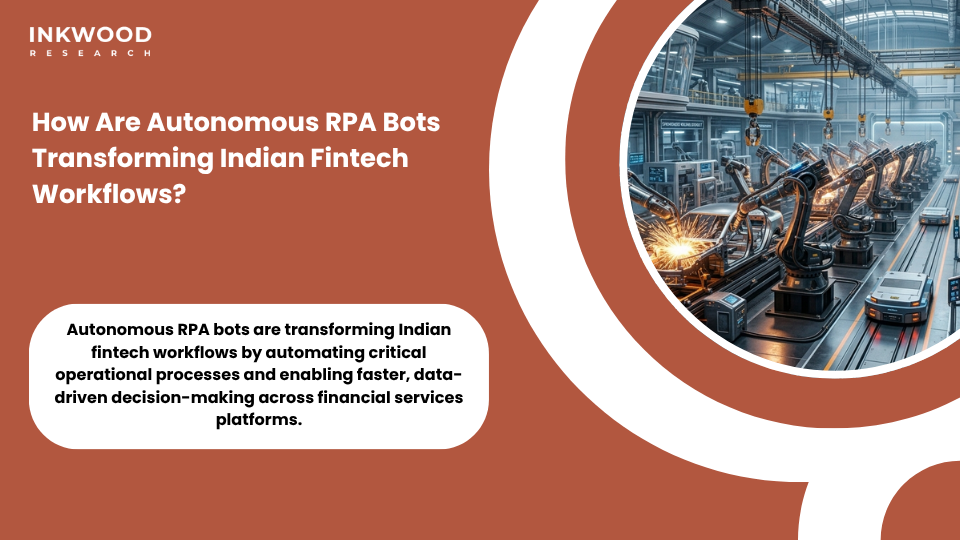
Autonomous RPA bots are transforming Indian fintech workflows by automating critical operational processes and enabling faster, data-driven decision-making across financial services platforms. These intelligent automation systems:
- Analyze alternative data for credit underwriting
- Streamline regulatory reporting under RBI and SEBI frameworks
- Handle large volumes of customer service interactions through natural language processing, and
- Monitor transactions in real time to detect fraud.
By reducing manual intervention and improving accuracy, autonomous RPA is helping fintech firms scale operations efficiently while strengthening compliance and risk management. Across Indian fintech, enterprise automation bots are reshaping four core workflows:
- Credit underwriting: Autonomous digital workforce automation analyzes alternative data sources, utility payments, mobile usage patterns, and e-commerce history to generate credit scores for customers without formal credit histories.
- Regulatory reporting: AI-driven robotic process automation bots compile and file compliance reports across RBI and SEBI frameworks, reducing the risk of manual errors in high-stakes regulatory submissions.
- Customer service: Intelligent process automation bots handle Tier-1 and Tier-2 customer queries, account management tasks, and dispute resolution with natural language understanding, escalating to human agents only for complex cases.
- Fraud detection: Adaptive workflow automation monitors transaction patterns in real time, flagging suspicious activity and triggering investigation workflows without waiting for human review.
Which Companies Are Shaping India’s Intelligent Automation Landscape?
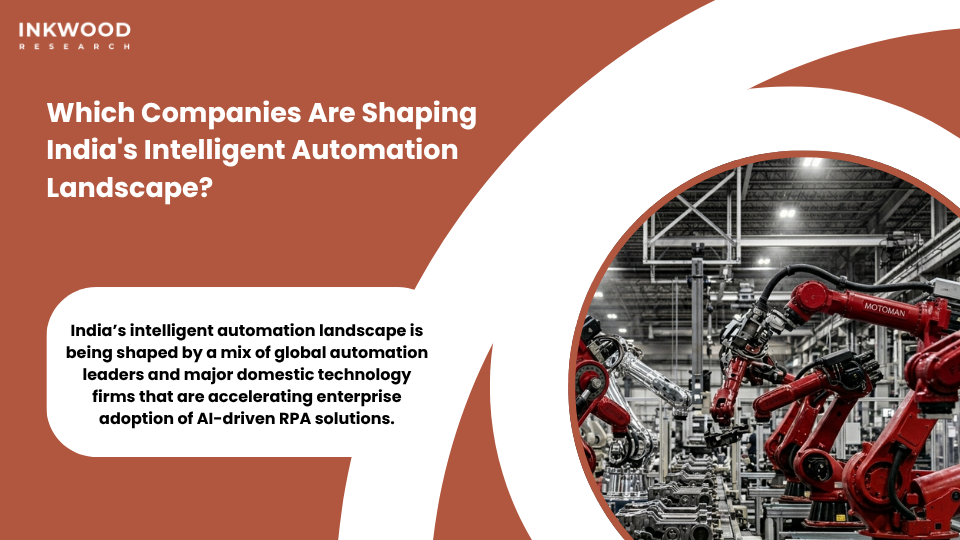
India’s intelligent automation landscape is being shaped by a mix of global automation leaders and major domestic technology firms that are accelerating enterprise adoption of AI-driven RPA solutions. Companies such as UiPath, Infosys BPM, Tata Consultancy Services (TCS), and Persistent Systems are deploying intelligent automation platforms across banking, fintech, and enterprise operations.
Moreover, they are enabling organizations to streamline back-office processes, strengthen regulatory compliance, and scale digital financial services through autonomous RPA bots and cognitive automation tools.
- UiPath has established a strong presence in India’s enterprise automation market, working with major banks, insurance firms, and government agencies to deploy next-generation RPA automation platforms.
- Infosys BPM has launched AI-powered process automation solutions for financial services clients, integrating autonomous RPA bots into back-office operations across its global delivery centers.
- Tata Consultancy Services (TCS) offers intelligent automation bots through its Ignio platform, applying cognitive robotic process automation to IT operations and financial workflow management.
Persistent Systems has expanded its intelligent RPA bots portfolio for fintech clients, focusing on regulatory technology and compliance automation solutions built for India’s evolving financial framework.
China – How Chinese Enterprises Are Scaling Intelligent Process Automation
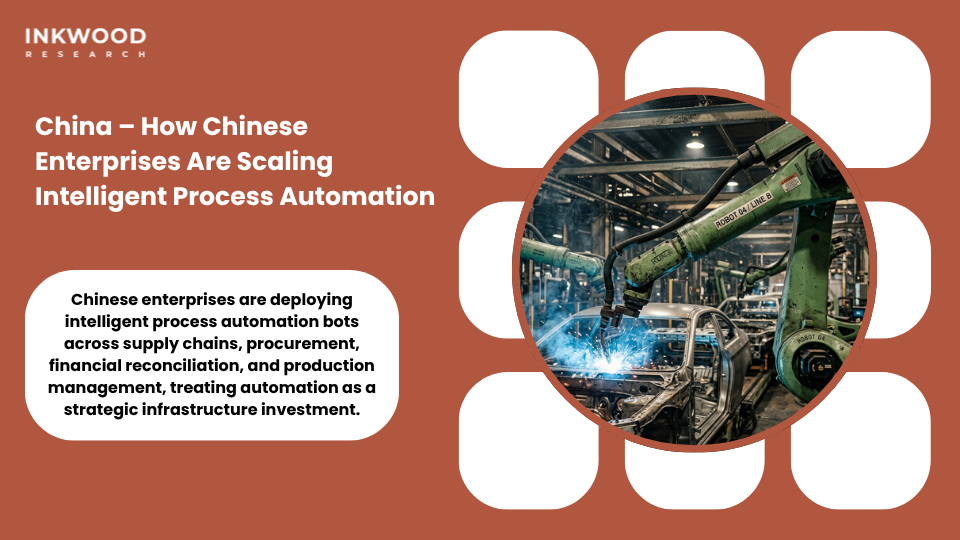
China’s approach to autonomous robotic process automation is notably different from India’s fintech-led model. Here, enterprise adoption is happening at an industrial scale, driven by a combination of government policy, technology investment, and the sheer operational complexity of China’s manufacturing and logistics infrastructure. Chinese enterprises are deploying intelligent process automation bots across supply chains, procurement, financial reconciliation, and production management, treating automation as a strategic infrastructure investment.
As per our analysis, the China autonomous robotic process automation (RPA) bots market size is valued at $184.83 million as of 2026 and is expected to reach $2,390.85 million by 2034, progressing with a CAGR of 37.71% during the forecast years, 2026–2034.
Government support for this trajectory is explicit. The State Council of China has issued multiple policy documents linking intelligent manufacturing and enterprise digital transformation to national competitiveness objectives. Subsequently, this creates a policy environment that actively encourages investment in advanced robotic process automation tools.
How Does Intelligent Process Automation Work Across Chinese Enterprise Sectors?
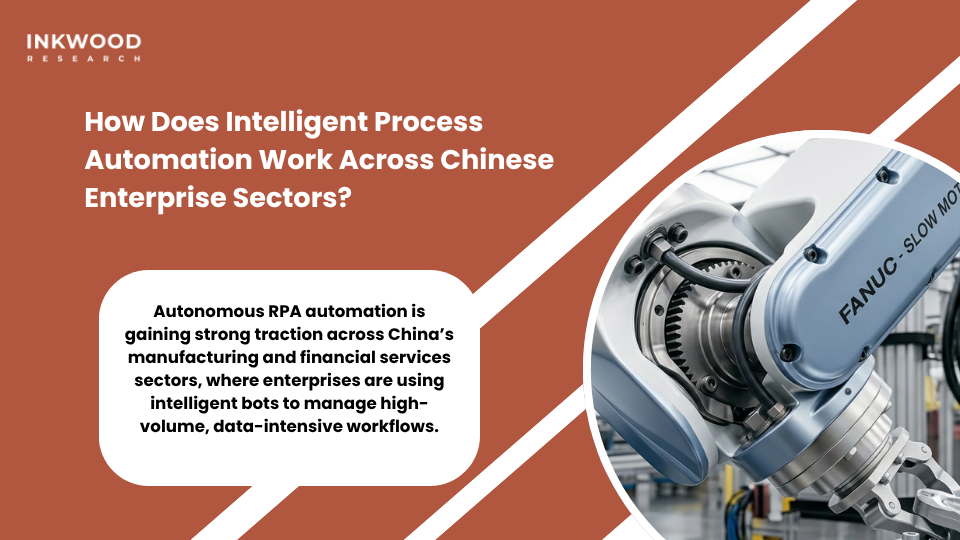
Autonomous RPA automation is gaining strong traction across China’s manufacturing and financial services sectors, where enterprises are using intelligent bots to manage high-volume, data-intensive workflows. By automating routine decision-making and data processing, autonomous RPA solutions are helping Chinese enterprises accelerate operations and focus human expertise on more complex analytical tasks.
- Manufacturing is the most visible deployment area. Chinese factories use autonomous RPA automation to manage production scheduling, quality inspection data processing, and supplier communication. These bots connect ERP systems, IoT sensor networks, and logistics platforms, processing data flows that would overwhelm any manual team. Consequently, production decisions that previously required hours of coordination now happen in near real time.
- Financial services adoption is equally significant. Chinese banks and insurance firms are deploying AI-driven robotic process automation bots for loan processing, claims management, and investment research. Moreover, the integration of autonomous RPA solutions with China’s extensive digital payment infrastructure has created automation pathways that touch billions of transactions annually. Decision-aware automation bots now handle routine transaction exception management, freeing analysts for complex investigative work.
What Are the Latest Developments in China's Autonomous RPA Ecosystem?
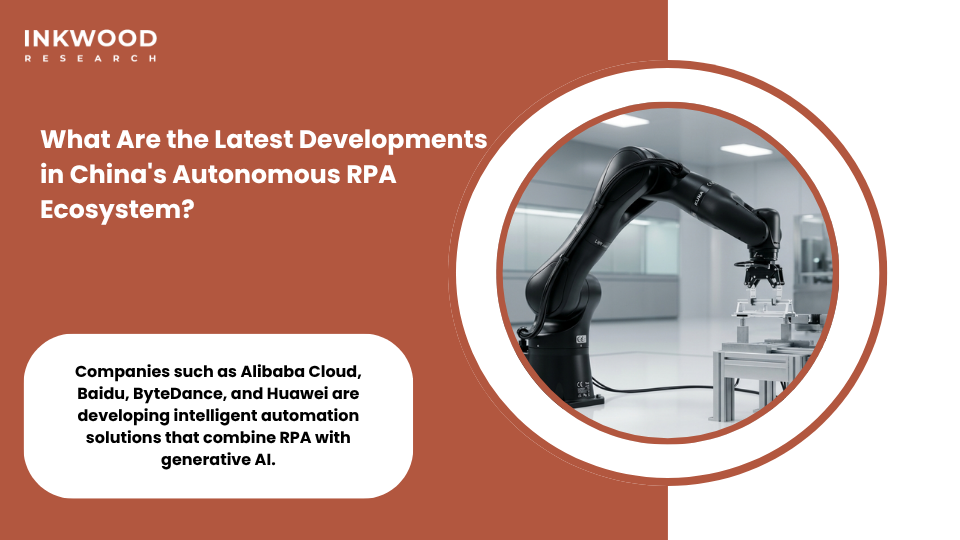
China’s autonomous RPA ecosystem is advancing rapidly as major technology firms integrate AI and large language models into enterprise automation platforms. Companies such as Alibaba Cloud, Baidu, ByteDance, and Huawei are developing intelligent automation solutions that combine RPA with generative AI.
As a result, this enables businesses to automate complex workflows like document processing, customer interaction, financial reporting, and enterprise operations. By embedding self-learning capabilities and natural language task execution into automation systems, these companies are accelerating the adoption of next-generation intelligent process automation across China’s enterprise landscape.
- Alibaba Cloud has expanded its enterprise automation bots platform, integrating large language model capabilities into RPA workflows to enable natural language task specification for business users without coding backgrounds.
- Baidu has launched advanced robotic process automation tools for enterprise clients, combining its ERNIE AI model with workflow automation to create self-learning automation bots for document processing and customer interaction.
- ByteDance has applied AI-powered RPA bots internally across content moderation, HR, and financial reporting operations, and is now commercializing these autonomous RPA solutions for enterprise clients.
- Huawei’s enterprise business division has introduced cognitive robotic process automation capabilities through its FusionInsight platform, targeting banking, manufacturing, and logistics sectors with integrated intelligent process automation solutions.
China’s enterprise automation market benefits from a structural advantage: the density of its digital infrastructure means intelligent RPA bots can integrate across platforms, from WeChat enterprise services to national e-procurement systems, in ways that create compound automation value unavailable in more fragmented markets.
Key Takeaways
- The India autonomous robotic process automation (RPA) bots market size is valued at $66.37 million as of 2026 and is expected to reach $1,033.20 million by 2034, progressing with a CAGR of 40.94% during the forecast years, 2026–2034.
- Indian fintech’s adoption of intelligent RPA bots is driven by the need to serve a massive, newly banked population efficiently while navigating complex, multi-layered financial regulation.
- The China autonomous robotic process automation (RPA) bots market size is valued at $184.83 million as of 2026 and is expected to reach $2,390.85 million by 2034, progressing with a CAGR of 37.71% during the forecast years, 2026–2034.
- China’s industrial-scale deployment of intelligent process automation bots is supported by explicit government policy and deep digital infrastructure integration across manufacturing and financial services.
- Key players, including UiPath, TCS, Alibaba Cloud, and Baidu, are building platforms that go beyond task automation to offer genuine autonomous decision-making capabilities.
- Both markets demonstrate that autonomous digital workforce automation delivers its greatest value when integrated into the full operational context of the enterprise, not deployed as isolated point solutions.
Conclusion
India and China represent two of the most dynamic autonomous RPA markets in the world right now, and the contrast between them is genuinely instructive.
India’s growth is being driven from the bottom up. Fintech firms, facing a newly banked population of hundreds of millions and a regulatory environment that demands both speed and precision, are building intelligent automation infrastructure that legacy financial institutions are now scrambling to match. Companies like UiPath, Infosys BPM, TCS, and Persistent Systems are not simply deploying automation tools. They are rebuilding how financial services workflows are designed from the ground up.
China’s story is driven from the top down. State Council policy, deep digital infrastructure, and the operational complexity of the world’s largest manufacturing economy have created conditions where intelligent process automation bots are treated as national infrastructure rather than enterprise convenience. Alibaba Cloud, Baidu, ByteDance, and Huawei are embedding autonomous RPA capabilities into platforms that already touch billions of transactions and millions of production workflows.
Together, these two markets account for a significant share of the Asia-Pacific autonomous RPA bots market, which is set to expand from US$524.24 million in 2026 to US$6,938.86 million by 2034. For enterprises and investors evaluating where intelligent process automation delivers the most consequential returns, India and China are where that question is being answered in practice.
Inkwood Research provides the market intelligence and strategic analysis needed to act confidently across both markets.
Connect with our team to explore how our insights can support your positioning in India, China, and the broader Asia-Pacific autonomous RPA landscape.
Frequently Asked Questions (FAQs)
Autonomous RPA bots are AI-powered automation systems that handle complex, variable tasks independently, learning from data and adapting without manual reprogramming.
Traditional bots follow fixed rules and fail on unexpected inputs. Autonomous bots use AI to interpret context, handle exceptions, and self-optimize over time.
Indian fintech needs to serve hundreds of millions of digital banking customers while managing multilingual complexity and multi-framework regulatory compliance, tasks requiring AI-powered, not just rule-based, bots.
Manufacturing, financial services, logistics, and insurance are the primary sectors, with State Council policy actively encouraging autonomous RPA automation adoption across the broader economy.
Yes. AI-powered RPA bots use natural language processing, machine learning, and decision-awareness to handle complex, variable workflows that basic automation tools cannot manage reliably.
Reduced manual workload, faster processing at scale, improved compliance accuracy, and the ability to handle unstructured data are the core enterprise benefits of intelligent process automation bots.