Table of Contents
This analysis is brought to you by Inkwood Research, a leading market intelligence firm specializing in European enterprise automation markets, sovereign AI technology strategies, and industrial digitalization ecosystems. Our research team combines extensive experience analyzing Germany’s Mittelstand technology adoption patterns, France’s national AI policy frameworks, and autonomous RPA platforms across European manufacturing, financial services, and public sector institutions. Through strategic partnerships with European automation vendors, industry federations, and digital policy consultants, we deliver actionable insights for organizations navigating Europe’s evolving intelligent process automation landscape.
TLDR
Germany and France are not simply adopting automation, they are actively shaping what it means to deploy it on their own terms. The Germany autonomous robotic process automation (RPA) Bots market is projected to grow from US$157.92 million in 2026 to US$1,567.81 million by 2034 at a 33.23% CAGR. Meanwhile, the France autonomous robotic process automation (RPA) bots market is set to expand from US$89.71 million in 2026 to US$968.32 million by 2034 at an even stronger 34.63% CAGR. Together, these two European industrial economies reflect a broader continental push: scaling autonomous RPA bots with a distinctly European emphasis on sovereignty, engineering precision, and regulatory integrity.
This blog is valuable for enterprise automation leaders and IT strategy teams operating in or entering European markets. Additionally, policymakers tracking sovereign AI initiatives, investors evaluating autonomous RPA solutions for enterprises in Germany and France, and technology vendors building enterprise autonomous RPA platforms for European compliance requirements will find targeted intelligence here.
Why Are Germany and France Approaching Autonomous RPA Differently?
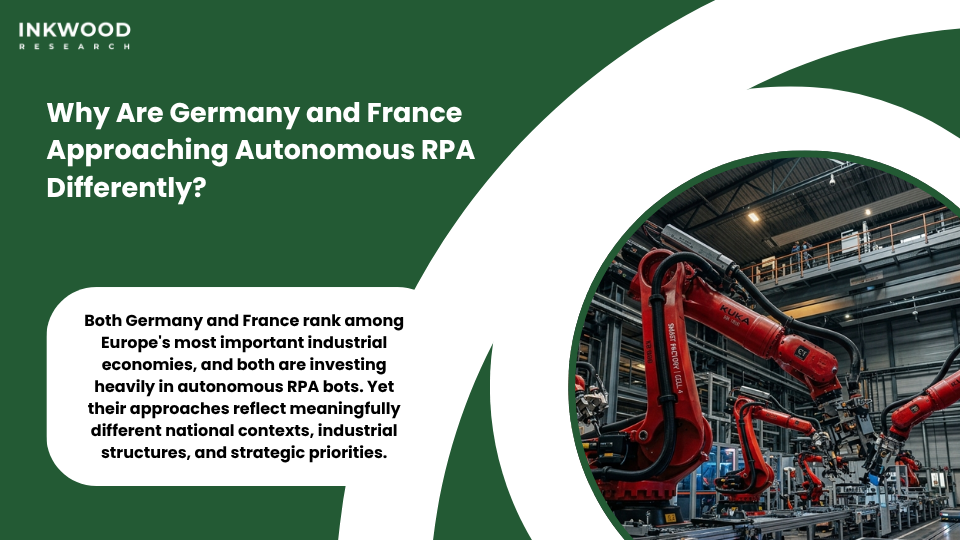
Both Germany and France rank among Europe’s most important industrial economies, and both are investing heavily in autonomous RPA bots. Yet their approaches reflect meaningfully different national contexts, industrial structures, and strategic priorities. Understanding those differences matters for any organization evaluating European enterprise autonomous RPA platforms.
Germany’s automation strategy is rooted in its industrial heritage. The country’s economy is built around the Mittelstand, thousands of mid-sized manufacturing and engineering companies that collectively employ a significant share of the German workforce. For these businesses, AI-powered RPA bots represent a practical operational upgrade rather than a transformation narrative. They adopt automation pragmatically, with an emphasis on reliability, integration with existing systems, and minimal disruption to established processes.
France, by contrast, approaches autonomous automation through a more explicitly strategic lens. The French government has positioned AI sovereignty as a national priority, channeling substantial public investment into domestic AI capabilities through initiatives like the French National AI Strategy. Consequently, the France autonomous robotic process automation (RPA) Bots market is shaped not only by enterprise demand but also by deliberate government effort to build indigenous automation capabilities.
Germany’s Mittelstand: How Engineering Culture Shapes Autonomous RPA Adoption
Germany’s autonomous robotic process automation (RPA) bots market is projected to reach US$1,567.81 million by 2034, growing from US$157.92 million in 2026. This growth trajectory reflects the scale of digital transformation underway across the Mittelstand.
German mid-sized firms are, by reputation, cautious adopters of new technology. They prioritize proven solutions, long vendor relationships, and measurable returns. However, this caution is giving way to a calculated embrace of intelligent RPA bots as competitive pressure from Asian manufacturing rivals intensifies and domestic labor costs continue to rise.
Key Drivers in German Autonomous RPA Adoption
- Manufacturing integration: German manufacturers are embedding autonomous RPA bots directly into production and quality control workflows, connecting them to SAP ERP systems and shop-floor IoT platforms. This deep integration distinguishes German deployment patterns from those in service-sector-dominated markets.
- Skills gap response: Germany faces a structural engineering talent shortage. According to the German Federal Employment Agency, skilled-worker shortages in technical roles remain a persistent challenge. Autonomous automation is therefore increasingly positioned as a workforce multiplier rather than a replacement strategy.
- Regulatory compliance automation: German enterprises operate under demanding regulatory frameworks across environmental, labor, and data protection domains. Advanced robotic process automation tools that automate compliance monitoring and reporting are particularly valued in this environment.
Automotive and Engineering: The Core Adoption Sectors
Germany’s automotive industry represents the most advanced deployment context for autonomous RPA automation in the country. Major OEMs and their supplier networks use intelligent bots to manage procurement, warranty processing, regulatory reporting, and dealer communications at scale. Moreover, the integration of AI-driven robotic process automation bots with connected vehicle data systems is opening entirely new automation use cases in after-sales and predictive maintenance.
The engineering and industrial equipment sector follows closely, with enterprise automation bots handling complex order management, technical documentation, and cross-border supply chain coordination. Consequently, Germany’s Mittelstand is quietly building one of the world’s most sophisticated autonomous automation ecosystems, not through grand transformation programs, but through disciplined, incremental deployment.
Which German Companies Are Leading in Autonomous RPA?
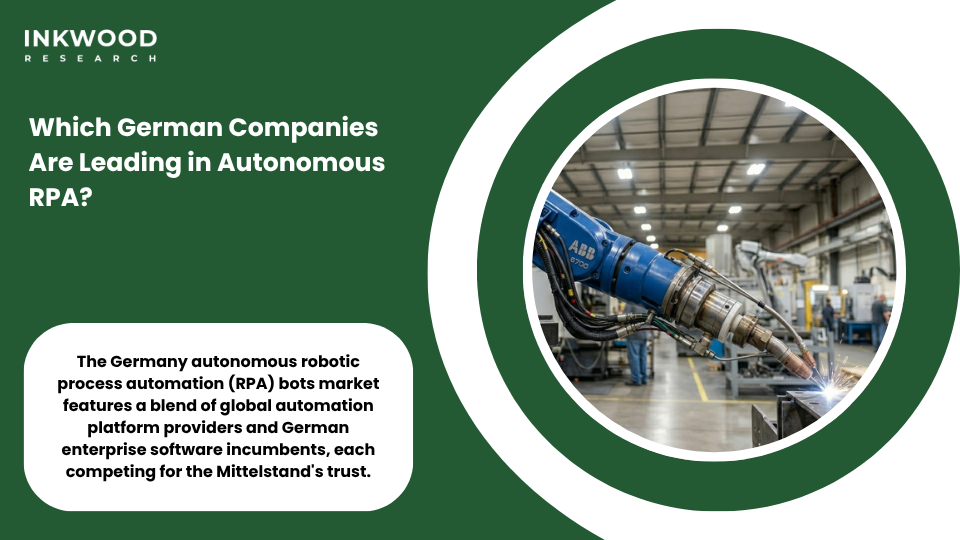
The Germany autonomous robotic process automation (RPA) bots market features a blend of global automation platform providers and German enterprise software incumbents, each competing for the Mittelstand’s trust.
- SAP remains the dominant enterprise software provider across the German industry, and its integration of intelligent RPA bots through SAP Build Process Automation is directly relevant to Mittelstand buyers already running SAP ERP systems. The recent expansion of SAP’s AI capabilities for process automation reinforces its position as the default automation partner for German manufacturers.
- Software AG has built a strong position in German process intelligence and automation, particularly through its ARIS process mining platform, which feeds directly into autonomous bot deployment workflows. Their focus on process transparency aligns closely with German enterprise culture.
- Global platforms, including UiPath and Automation Anywhere, maintain active German presences, competing on the depth of their autonomous RPA solutions for enterprises and their ability to integrate with German-standard ERP and manufacturing execution systems.
France's Sovereign AI Strategy and Its Impact on Autonomous RPA
France’s approach to autonomous RPA bots is inseparable from its broader national AI strategy. The French government’s AI strategy, initially launched in 2018 and substantially reinforced through subsequent investments, explicitly targets the development of sovereign AI capabilities that reduce French dependence on non-European technology providers.
This policy context has a direct impact on how French enterprises evaluate and deploy autonomous RPA platforms. Procurement decisions in the public sector increasingly favor vendors with data residency in France or the European Union, verifiable security certifications, and demonstrated compliance with GDPR and the EU AI Act. Furthermore, the French government has invested in AI research hubs, particularly through the Inria national research institute, which feeds talent and innovation into the domestic automation ecosystem.
The France autonomous robotic process automation (RPA) bots market, growing at 34.63% CAGR, slightly above the global average, reflects this combination of public investment, strong enterprise demand, and a regulatory environment that actively incentivizes European-first technology choices.
How Are French Enterprises Deploying Intelligent RPA Bots?
French enterprise adoption of intelligent RPA bots spans both the private sector and an unusually large public administration, creating distinct deployment patterns compared to Germany.
Financial Services: Compliance-Driven Automation
- France’s large banking and insurance sector is among the most active adopters of AI-powered RPA bots in the country.
- Institutions, including BNP Paribas and AXA, have built substantial internal automation capabilities, deploying intelligent process automation bots across compliance monitoring, regulatory reporting, and customer data management.
- The weight of European banking regulation, from MiFID II to DORA, creates a persistent and growing demand for automation solutions that reduce compliance cost and error rates.
Public Sector: Scaling Service Delivery
- France’s public administration represents a significant and often underappreciated market for autonomous RPA automation.
- Government agencies responsible for tax collection, social benefit administration, and public records management are deploying cognitive robotic process automation to handle high-volume, repetitive workflows that previously required large civil service teams.
- The Direction Interministérielle du Numérique (DINUM) coordinates digital transformation across French government ministries, including automation adoption standards that emphasize data sovereignty and security.
Luxury, Aerospace, and Energy
- Beyond finance and government, France’s luxury goods, aerospace, and energy sectors are emerging deployment verticals for next-generation RPA automation.
- Aerospace firms use autonomous digital workforce automation for supply chain traceability, certification documentation, and parts procurement across complex multi-tier supplier networks.
- Energy companies, particularly in the nuclear sector, are deploying intelligent bots for regulatory compliance documentation, a use case where France’s unique energy infrastructure creates specialized automation requirements.
Which Companies Are Shaping France's Autonomous RPA Market?
The France Autonomous robotic process automation (RPA) Bots market reflects the country’s preference for both global platform leaders and domestic technology champions.
- Atos is one of France’s most significant IT services firms, with a substantial automation practice built around sovereign AI principles. Atos positions its enterprise autonomous RPA platforms with a strong data sovereignty narrative that resonates with both public sector and regulated private sector clients in France.
- Capgemini operates an extensive intelligent automation practice with significant French client relationships across banking, insurance, and utilities. The company’s IntelligentOps offering combines AI-powered RPA bots with process intelligence and organizational change management, reflecting France’s preference for comprehensive rather than point-solution automation.
- Global vendors UiPath and Automation Anywhere maintain strong French presences, competing on platform depth and their ability to meet GDPR and EU AI Act compliance requirements. Additionally, Microsoft Power Automate’s deep integration with Office 365, widely used across French enterprises and public bodies, gives it a structural advantage for entry-level autonomous RPA automation deployments.
Key Takeaways
- The Germany autonomous robotic process automation (RPA) bots market grows from US$157.92 million in 2026 to US$1,567.81 million by 2034 at a 33.23% CAGR, driven by Mittelstand manufacturing digitalization and engineering-sector demand.
- The France autonomous robotic process automation (RPA) bots market expands from US$89.71 million in 2026 to US$968.32 million by 2034 at a 34.63% CAGR, shaped by sovereign AI policy and strong public-sector deployment.
- Germany’s adoption is defined by pragmatic integration with SAP ERP and manufacturing systems, a response to structural talent shortages and competitive pressure from global manufacturing rivals.
- France’s autonomous automation strategy is inseparable from its national AI sovereignty agenda, creating distinctive procurement criteria around data residency, GDPR compliance, and preference for European-origin technology.
- SAP and Software AG lead the German market through existing enterprise relationships; Atos and Capgemini dominate the French landscape through sovereign AI positioning and public-sector expertise.
- Both markets are converging on compliance automation, AI governance, and multi-system integration as the primary value drivers for autonomous RPA solutions for enterprises in regulated European environments.
Conclusion:
Germany and France represent two of Europe’s most consequential markets for autonomous RPA bots, and they illustrate how the same technology takes on different strategic meaning in different national contexts. For vendors, advisors, and enterprises navigating these markets, understanding the Mittelstand’s engineering pragmatism and France’s sovereign AI ambition is as important as understanding the technology itself.
Inkwood Research delivers the market intelligence and regional expertise needed to act confidently across European enterprise automation markets.
Connect with our team to explore how our analysis can support your strategy in Germany, France, and beyond.
Frequently Asked Questions
What is driving Germany's autonomous RPA bots market growth?
Engineering-sector digitalization, Mittelstand SAP integration needs, and structural skilled-worker shortages are the primary growth drivers for autonomous RPA in Germany.
How does France's AI sovereignty strategy affect autonomous RPA adoption?
France mandates data residency and GDPR compliance for public-sector automation, favoring European vendors and creating distinct procurement criteria for autonomous RPA platforms.
Which industries lead autonomous RPA adoption in Germany?
Automotive, precision engineering, and industrial equipment sectors lead German adoption, with bots integrated into SAP ERP and manufacturing execution systems.
What role does France's public sector play in its autonomous RPA market?
France’s large public administration is a major autonomous RPA buyer, deploying intelligent bots for tax, social benefits, and compliance documentation at scale.
How do Germany and France's autonomous RPA growth rates compare globally?
Germany grows at 33.23% CAGR and France at 34.63% CAGR, both aligned with the global average of 34.57%, reflecting strong European enterprise demand.
Which companies dominate the French autonomous RPA bots market?
Atos, Capgemini, UiPath, Automation Anywhere, and Microsoft Power Automate are the leading players in France’s enterprise autonomous RPA platform market.