This analysis is brought to you by Inkwood Research, a leading market intelligence firm specializing in global automotive energy storage, lead-acid battery technologies, and circular economy initiatives across North America, Europe, and Asia-Pacific markets. Our research team combines extensive experience analyzing battery manufacturing ecosystems, environmental compliance frameworks, recycling infrastructure development, and aftermarket distribution channels. Based on our proprietary research methodologies and strategic partnerships with automotive OEMs, battery manufacturers, regulatory agencies, and recycling operators, we deliver actionable insights that empower strategic decision-making for enterprises navigating the evolving automotive power storage landscape.
TLDR
Despite lithium-ion dominance in headlines, automotive lead-acid batteries continue thriving through superior cost-effectiveness and proven reliability. Meanwhile, Europe’s stringent recycling regulations reshape supply chains as manufacturers adapt to 75% recycling efficiency targets. Furthermore, Asia’s aftermarket replacement surge creates hidden revenue streams, while North American producers navigate technological shifts. Consequently, these traditional batteries maintain relevance in conventional vehicles, start-stop systems, and emerging hybrid applications across global markets.
This analysis benefits automotive industry executives evaluating battery procurement strategies, fleet managers optimizing replacement costs, policy professionals tracking European environmental regulations, investment analysts assessing battery manufacturer performance, procurement specialists sourcing reliable energy storage, and sustainability officers managing recycling compliance. Additionally, aftermarket distributors and battery manufacturers seeking strategic insights will discover actionable intelligence on market dynamics across key regions.
The Lithium Paradox: Where Lead-Acid Still Wins
Market Economics Drive Technology Choices
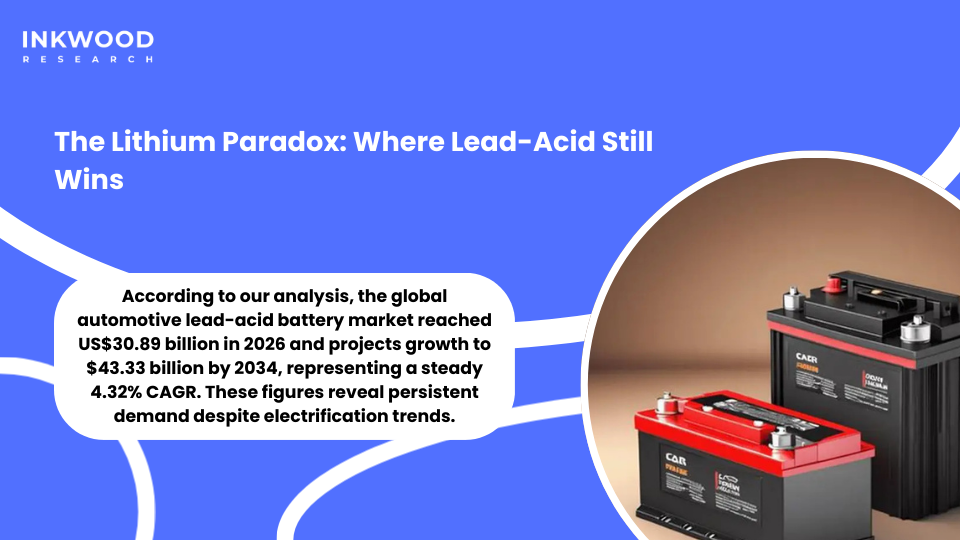
Global automotive manufacturers face critical decisions balancing innovation against economic reality. Although lithium-ion batteries capture headlines, lead-acid technology commands substantial market presence. According to our analysis, the global automotive lead-acid battery market reached US$30.89 billion in 2026 and projects growth to $43.33 billion by 2034, representing a steady 4.32% CAGR. These figures reveal persistent demand despite electrification trends.
Traditional automotive applications require cost-effective solutions delivering reliable performance. Lead-acid batteries excel in starting, lighting, and ignition applications where power delivery matters more than energy density. Moreover, manufacturers appreciate proven technology, reducing production complexity and warranty claims.
The Price Performance Balance
Cost considerations shape purchasing decisions across vehicle segments worldwide. Maintenance-free lead-acid batteries typically cost 60-70% less than equivalent lithium alternatives for conventional applications. This price advantage becomes critical in price-sensitive markets where vehicle affordability determines sales volumes.
However, performance requirements are evolving rapidly with automotive electronics proliferation. Modern vehicles demand batteries supporting advanced driver assistance systems, infotainment platforms, and connectivity features. Consequently, manufacturers develop enhanced flooded batteries and AGM technology meeting these demands while maintaining cost competitiveness.
Start-Stop Technology Adoption
European emissions regulations accelerated start-stop system integration across passenger vehicle fleets. These systems require specialized batteries withstanding frequent charge-discharge cycles. Further, enhanced flooded batteries and AGM variants fulfill these requirements effectively while offering reasonable pricing compared to lithium solutions.
Furthermore, automotive OEMs recognize that start-stop lead-acid batteries provide sufficient performance for mild hybrid applications. As a result, this positions lead-acid technology as a bridge solution during the prolonged transition toward full electrification. Market dynamics suggest this transition extends beyond initial predictions, supporting sustained lead-acid demand.
Europe’s Recycling Revolution Reshapes Supply
Regulatory Framework Drives Industry Transformation
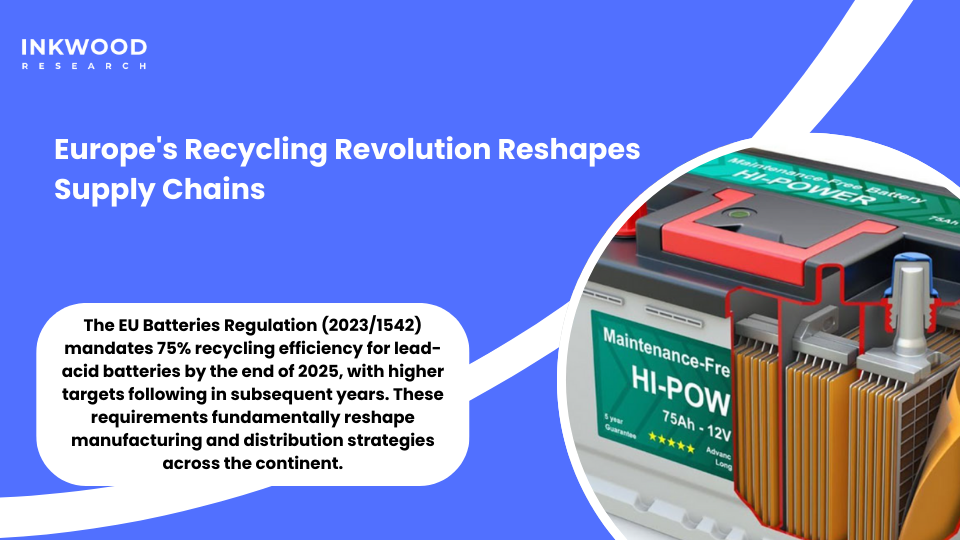
European environmental policy establishes unprecedented standards for battery lifecycle management. The EU Batteries Regulation (2023/1542) mandates 75% recycling efficiency for lead-acid batteries by the end of 2025, with higher targets following in subsequent years. These requirements fundamentally reshape manufacturing and distribution strategies across the continent.
Additionally, the regulation requires 85% recycled lead content in new industrial, SLI, and EV batteries, creating circular economy imperatives for European producers. Consequently, manufacturers invest heavily in collection infrastructure and recycling capabilities to ensure compliance while securing raw material supplies.
Closed-Loop Manufacturing Excellence
Europe demonstrates global leadership in lead-acid battery recycling infrastructure. The recycling rate for automotive starter batteries reaches 99% in the EU, with more than 90% of lead recovered from collected units. Also, this exceptional performance reflects decades of regulatory development and industry cooperation, building comprehensive collection networks.
Moreover, the economic advantages of lead-acid recycling strengthen business cases for continued production. Recycled lead requires significantly less energy than primary production while maintaining equivalent quality. Therefore, European manufacturers position recycling capabilities as a competitive advantage in cost management and sustainability messaging.
Supply Chain Raw Material Pressures
European lead-acid battery manufacturers navigate complex supply chain dynamics, balancing domestic recycling with import dependencies. Although recycling provides substantial lead supplies, market growth and quality requirements necessitate supplementary sources. Subsequently, companies develop strategic partnerships with mining operations and secondary metal processors globally.
Carbon footprint reporting requirements add complexity to sourcing decisions. As a result, manufacturers must calculate and declare emissions across entire production chains, including raw material extraction and processing. These mandates favor domestic recycling operations with lower transportation emissions and established environmental controls.
The European Market Outlook
Our research indicates the Europe automotive lead-acid battery market achieved US$5,968.43 million in 2026, with projections reaching US$8,146.05 million by 2034 at a 3.96% CAGR. This growth reflects mature market dynamics with replacement demand driving volumes rather than new vehicle production expansion.
Nevertheless, regulatory innovation creates opportunities for advanced battery technologies. AGM and enhanced flooded variants gain market share, supporting start-stop and mild hybrid applications. Accordingly, premium battery segments experience faster growth than conventional flooded products as vehicle complexity increases throughout European fleets.
Asia’s Hidden Gold Mine: Aftermarket Replacement Boom

Understanding Replacement Cycle Economics
The Asia-Pacific automotive lead-acid battery market demonstrates remarkable growth momentum, valued at US$14,128.99 million in 2026 and accelerating to US$20,885.08 million by 2034 at a 5.01% CAGR. This expansion reflects both new vehicle production and robust aftermarket replacement demand across diverse economies.
Replacement cycles in Asia-Pacific vary significantly by climate, vehicle usage patterns, and quality tiers. Tropical climates accelerate battery degradation through elevated temperatures, affecting chemical reactions. Meanwhile, dense urban traffic patterns with frequent short trips prevent complete charging, reducing battery lifespan and accelerating replacement demand.
The Aftermarket Distribution Advantage
Aftermarket channels dominate battery sales across most Asia-Pacific markets, contrasting with OEM-heavy patterns in developed regions. Independent repair shops, auto parts retailers, and battery specialty stores serve price-sensitive consumers seeking affordable replacements. As a result, this distribution structure creates opportunities for both international brands and local manufacturers to compete on price and availability.
Moreover, fragmented distribution networks require different marketing and logistics strategies. Manufacturers develop multi-tier product portfolios addressing premium, mid-range, and economy segments simultaneously. Such segmentation enables market share capture across diverse consumer groups with varying quality expectations and budget constraints.
Consumer Behavior Patterns
Asian consumers typically prioritize immediate cost over lifecycle economics when purchasing replacement batteries. This behavior reflects income levels, limited vehicle financing for older cars, and replacement-focused rather than preventive maintenance cultures. Consequently, economy-tier flooded lead-acid batteries maintain strong sales despite the availability of premium AGM alternatives.
However, growing middle-class populations in major markets gradually shift preferences toward quality and durability. Warranty periods become increasingly important purchase criteria as consumers recognize the total cost of ownership benefits. Therefore, manufacturers positioning products with extended warranties gain competitive advantages in evolving markets.
Market Dynamics by Subregion
China’s automotive lead-acid battery market stands as the largest in Asia-Pacific, reaching US$7,756.53 million in 2026 and expanding to US$10,912.46 million by 2034 at a 4.36% CAGR. This substantial market serves both massive domestic vehicle production and extensive replacement demand from the world’s largest vehicle fleet.
India’s market demonstrates even stronger growth momentum. As a result, this accelerated expansion reflects rapid vehicle ownership growth, improving infrastructure, and increasing quality expectations among Indian consumers navigating diverse driving conditions.
North America’s Lead-Acid Battery Evolution
Market Fundamentals and Growth Trajectory
The North America automotive lead-acid battery market encompasses US$6,966.87 million in 2026, projecting growth to US$9,185.97 million by 2034 at a 3.52% CAGR. This measured expansion reflects mature automotive markets where replacement demand and technology upgrades drive volumes rather than fleet growth.
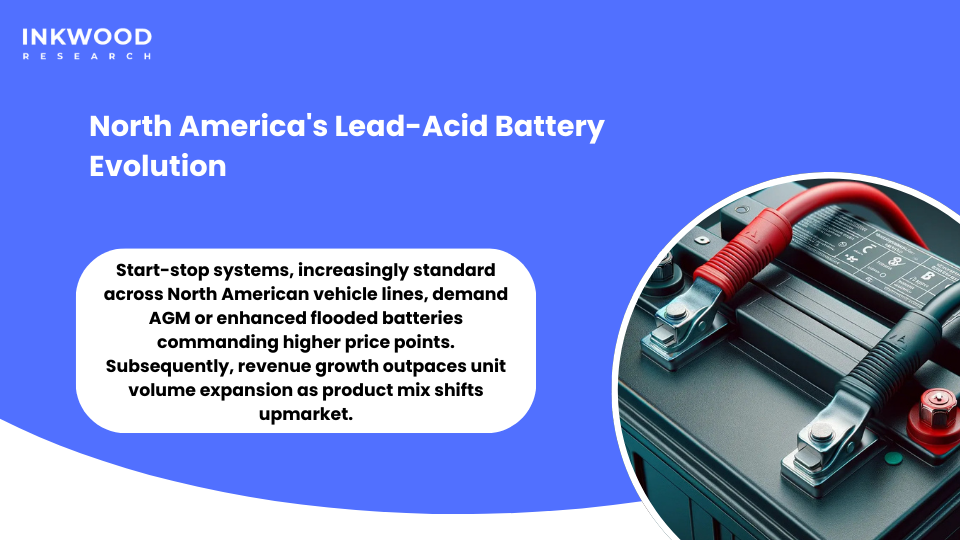
Nevertheless, significant opportunities emerge from advancing vehicle technologies requiring premium battery solutions. Start-stop systems, increasingly standard across North American vehicle lines, demand AGM or enhanced flooded batteries commanding higher price points. Subsequently, revenue growth outpaces unit volume expansion as product mix shifts upmarket.
Manufacturing Landscape Transformation
Major North American producers continue investing in advanced manufacturing capabilities despite lithium-ion battery headlines. Clarios, formerly Johnson Controls Power Solutions, maintains North American market leadership through extensive manufacturing and recycling infrastructure. The company produces over 150 million batteries annually, powering approximately one-third of global vehicles.
Similarly, East Penn Manufacturing operates the world’s largest single-site lead-acid battery facility, emphasizing technological innovation in AGM battery development. These established manufacturers leverage scale advantages, extensive distribution networks, and recycling capabilities, creating barriers against potential entrants.
Technology Innovation Continues
Advanced battery technologies extend lead-acid relevance across evolving automotive applications. Enhanced flooded batteries deliver improved charge acceptance and cycle life for start-stop vehicles at moderate price premiums over conventional batteries. These products represent pragmatic solutions for automakers balancing performance requirements against bill-of-materials costs.
Meanwhile, AGM technology development focuses on power delivery optimization for vehicles with extensive electronic loads. Premium AGM batteries support advanced safety systems, connectivity features, and comfort electronics, becoming standard across mainstream vehicle segments. Consequently, AGM adoption increases steadily throughout North American fleets.
Competitive Dynamics and Market Share
Three major manufacturers dominate North American production: Clarios, East Penn Manufacturing, and Exide Technologies. Clarios maintains leading positions through brand portfolio strength, including OPTIMA, DieHard, and VARTA labels serving diverse market segments. East Penn leverages manufacturing efficiency and private-label partnerships with major retailers.
However, market dynamics shift as consolidation trends continue. Manufacturers pursue vertical integration strategies, controlling recycling operations, securing lead supplies, and optimizing production economics. In turn, this integration creates competitive advantages in cost management while supporting sustainability messaging increasingly important to commercial customers.
Future Outlook and Strategic Considerations
North American market evolution reflects broader industry tensions between electrification trends and persistent conventional vehicle demand. Although battery electric vehicle adoption accelerates, internal combustion engines will require lead-acid batteries for decades, supporting existing fleet maintenance and new vehicle production.
Furthermore, hybrid vehicle growth creates additional demand for conventional 12-volt lead-acid batteries, supplementing high-voltage lithium systems. These applications ensure sustained market relevance even as electrification progresses, supporting manufacturer investment confidence in production capacity and technology development.
Key Takeaways
- Global lead-acid battery markets demonstrate resilience through cost advantages and proven reliability despite lithium-ion competition. The global market’s projected growth from US$14,128.99 million to US$20,885.08 million by 2034 confirms sustained demand across diverse applications and geographies.
- European regulatory leadership reshapes industry practices through stringent recycling requirements and circular economy mandates. The 75% recycling efficiency target and 85% recycled content requirements establish global benchmarks that other regions increasingly adopt.
- Asia-Pacific aftermarket dynamics create significant opportunities beyond OEM supply channels. Replacement demand driven by climate factors, usage patterns, and growing vehicle populations supports market expansion at a 5.01% CAGR through 2034.
- North American manufacturers pursue technology leadership in advanced battery chemistries while maintaining cost competitiveness. Premium products supporting start-stop and advanced electronics drive value growth exceeding unit volume expansion.
- Technology evolution continues within lead-acid chemistry through enhanced flooded batteries and AGM variants meeting modern vehicle requirements. These innovations extend lead-acid relevance, supporting automotive industry transitions toward electrification.
Conclusion
The automotive lead-acid battery industry demonstrates remarkable adaptability, navigating technological disruption and regulatory transformation. However, while lead-acid batteries have a significantly lower initial price, lithium batteries often offer a better total cost of ownership (TCO) over their lifespan due to superior efficiency and longevity. Moreover, cost-effectiveness, proven reliability, and manufacturing maturity create enduring competitive advantages against emerging battery technologies across many applications. Regulatory innovation further drives circular economy excellence, particularly in European markets, establishing global environmental standards.
Looking forward, sustained demand across conventional vehicles, start-stop systems, and hybrid applications ensures market vitality, supporting continued investment and innovation. Battery manufacturers, balancing tradition with technological advancement, position themselves successfully for evolving automotive industry requirements.
If you’re seeking strategic intelligence on automotive lead-acid battery markets, recycling compliance, or aftermarket opportunities, contact Inkwood Research for customized analysis supporting informed decision-making across procurement, manufacturing, and investment initiatives.
Frequently Asked Questions (FAQs)
Lead-acid batteries offer proven reliability and cost-effectiveness for conventional vehicle applications where energy density matters less than starting power. Additionally, established manufacturing infrastructure and recycling ecosystems create economic advantages supporting continued adoption across mainstream vehicle segments.
European mandates establishing 75% recycling efficiency and 85% recycled content requirements influence global manufacturing practices through international companies operating across multiple regions. These standards often become de facto global benchmarks as manufacturers standardize processes and sustainability reporting.
Tropical climates accelerate battery degradation through elevated temperatures, affecting chemical performance. Furthermore, dense urban traffic patterns with frequent short trips prevent complete charging cycles, reducing battery lifespan. Combined with massive vehicle populations across China, India, and Southeast Asia, these factors create substantial replacement demand supporting market growth.