Table of Contents
This analysis is brought to you by Inkwood Research, a leading market intelligence firm specializing in Asia-Pacific agricultural technology, precision farming innovations, and unmanned aerial systems ecosystems. Our research team combines extensive experience analyzing lithium-polymer battery technologies, agricultural modernization programs, and commercial drone adoption patterns across China, India, Japan, Southeast Asia, and Australia. Based on our proprietary research methodologies and strategic partnerships with Asian battery manufacturers, agricultural cooperatives, government agricultural development agencies, and drone technology providers, we deliver actionable insights that empower strategic decision-making for global enterprises navigating Asia-Pacific’s precision farming revolution and agricultural drone market expansion.
TLDR
The Asia-Pacific UAV battery market accelerates toward $2.22 billion by 2032, growing at a 15.68% CAGR as the fastest-growing region globally. Precision farming revolutionizes agriculture across China, India, and Southeast Asia through agricultural drones powered by advanced lithium-polymer batteries. Meanwhile, government subsidies, manufacturing scale advantages, and massive agricultural modernization drive unprecedented adoption. Commercial applications dominate, with crop monitoring, precision spraying, and field mapping transforming traditional farming practices.
Agricultural technology companies, precision farming consultants, drone manufacturers, and battery developers targeting Asia-Pacific markets will find actionable intelligence here. Additionally, agricultural cooperatives, government agricultural agencies, investment firms analyzing agtech opportunities, and supply chain managers seeking regional partnerships will discover strategic insights for market entry and expansion planning.
Asia-Pacific UAV Battery Market Overview

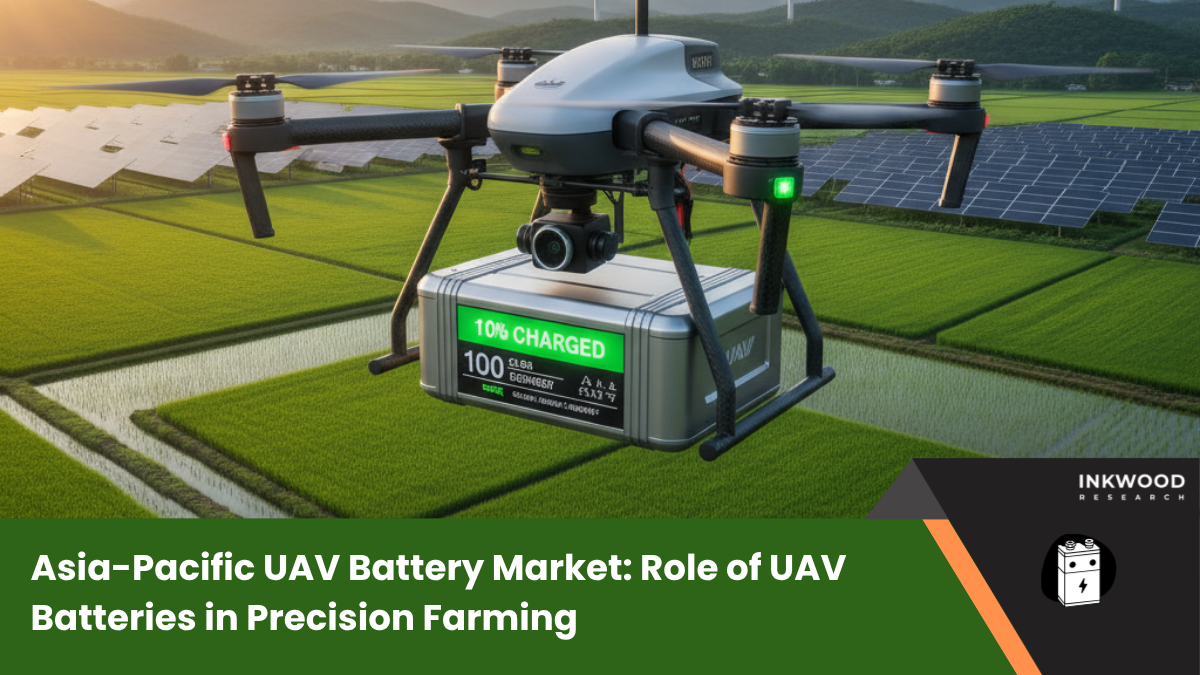
According to Inkwood Research analysis, the Asia-Pacific UAV battery market emerges as the fastest-growing region globally. Market valuation reached $801.04 million in 2025, with projections indicating growth to $2.22 billion by 2032. This represents a remarkable 15.68% CAGR.
Manufacturing Scale Creates Competitive Advantages
Aggressive manufacturing expansion and substantial government investments propel market acceleration. Moreover, China’s dominance in UAV production creates concentrated demand for battery technology supporting domestic consumption and export markets. Regional governments implement favorable policies encouraging drone integration into smart city infrastructure.
The Asia Development Bank initiatives drive infrastructure projects incorporating UAV technology for surveying applications. Moreover, Asia-Pacific’s manufacturing capabilities enable cost-competitive battery production. Consequently, global UAV manufacturers seek supply chain partnerships throughout the region.
Agricultural Modernization Drives Market Expansion
Defense modernization programs across India, Japan, South Korea, and Australia drive procurement of unmanned surveillance systems. However, commercial sectors generate exponential battery demand growth. Precision farming, e-commerce delivery, and energy infrastructure monitoring are rapidly embracing drone technology.
Based on our research, Asia-Pacific’s diverse geography creates varied operational requirements. Urban megacities, extensive agricultural lands, and remote island territories stimulate innovation in battery performance characteristics. Substantial investment in research and development accelerates the advancement of next-generation chemistries.
Precision Farming Revolution Transforms Agriculture
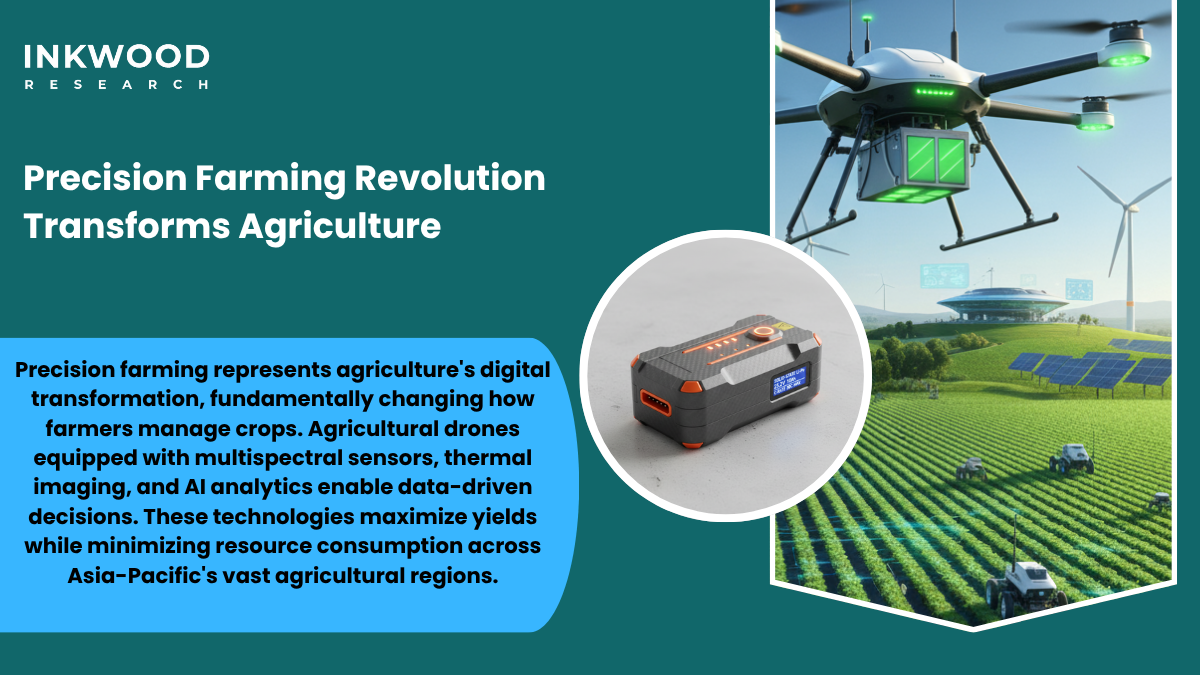
Precision farming represents agriculture’s digital transformation, fundamentally changing how farmers manage crops. Agricultural drones equipped with multispectral sensors, thermal imaging, and AI analytics enable data-driven decisions. These technologies maximize yields while minimizing resource consumption across Asia-Pacific’s vast agricultural regions.
Crop Monitoring Achieves Unprecedented Precision
Farmers now monitor crop health in real-time across hundreds of hectares. Drones capture high-resolution imagery revealing stress indicators invisible to human observation. Consequently, targeted interventions address problems before yield losses occur. This capability transforms traditional reactive farming into proactive management.
According to recent academic research, UAV integration with artificial intelligence enhances efficiency dramatically. Machine learning algorithms analyze sensor data, identifying disease patterns and nutrient deficiencies. Furthermore, automated decision-making systems recommend precise treatments, improving productivity while reducing resource waste.
Variable Rate Application Optimizes Resource Usage
Agricultural drones execute targeted pesticide and fertilizer applications with centimeter-level accuracy. Traditional blanket-coverage methods waste chemicals and harm environmental sustainability. However, precision spraying reduces chemical usage by up to 40% while improving crop health outcomes.
Smart nozzles and GPS guidance deliver treatments only where needed. Battery-powered systems enable multiple daily flights covering extensive territories efficiently. Accordingly, our analysis indicates that medium-weight drones carrying 5-10 liter payloads dominate precision farming applications.
Field Mapping and Data Analytics Transform Planning
Comprehensive field mapping provides farmers with actionable intelligence for seasonal planning. Elevation data, soil moisture analysis, and historical yield information combine into integrated management platforms. Essentially, these systems optimize planting strategies, irrigation scheduling, and harvest timing.
Integration with Internet of Things devices creates fully automated farming ecosystems. Drones connect with soil sensors, weather stations, and irrigation systems. Subsequently, data flows into centralized platforms providing holistic views of farm conditions, further solidifying Asia-Pacific’s global leadership in smart agriculture adoption.
Labor Shortage Solutions Through Automation
Rural labor shortages across Japan, South Korea, and parts of China accelerate drone adoption. Aging farmer populations require technological solutions to maintain productivity. Autonomous systems perform tasks traditionally requiring significant manual labor, from monitoring to spraying.
Agricultural cooperatives share drone services among multiple farms, reducing individual investment requirements. This collaborative approach democratizes access to advanced technologies. Further, government subsidy programs throughout the Asia-Pacific support farmers transitioning to precision agriculture methods.
Lithium-Polymer Batteries Enable Agricultural Innovation
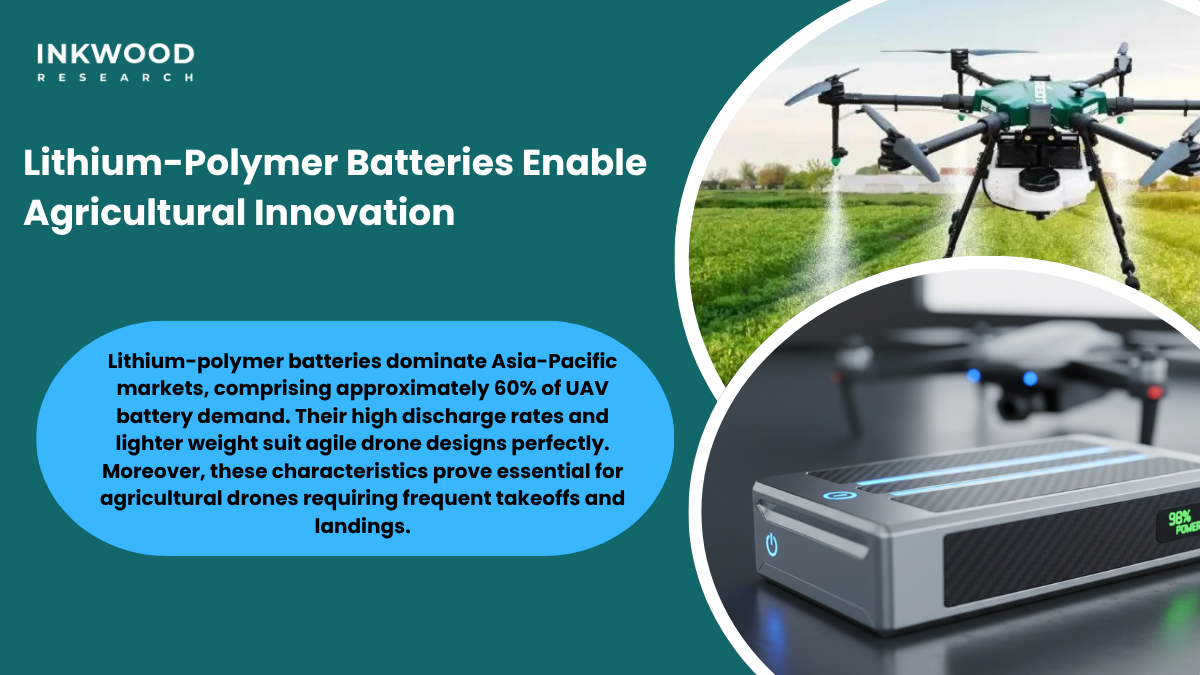
Lithium-polymer batteries dominate Asia-Pacific markets, comprising approximately 60% of UAV battery demand. Their high discharge rates and lighter weight suit agile drone designs perfectly. Moreover, these characteristics prove essential for agricultural drones requiring frequent takeoffs and landings.
Performance Characteristics Match Agricultural Demands
Agricultural applications demand batteries supporting extended area coverage during crop monitoring missions. Flight times reaching 40-60 minutes enable comprehensive field surveys without frequent recharging. Additionally, rapid charging capabilities minimize operational downtime between flights.
Our findings indicate that typical commercial drones require batteries in the 5000-7000 mAh range. Energy density improvements enable these capacities while maintaining manageable weight profiles. Consequently, payload capabilities increase, allowing drones to carry sophisticated sensor packages or spray equipment.
Environmental Adaptability Ensures Reliability
Asia-Pacific’s varied climates present significant battery challenges. Tropical humidity in Southeast Asia, extreme heat in India, and cold conditions in northern China require robust thermal management. Lithium-polymer batteries demonstrate superior performance across these diverse environments.
Advanced battery management systems monitor cell temperatures, preventing thermal runaway risks. Safety features prove particularly important in agricultural settings where equipment operates away from immediate supervision. Furthermore, ruggedized enclosures protect batteries from dust, moisture, and physical impacts.
Cost-Competitive Solutions Drive Mass Adoption
Asia-Pacific’s manufacturing scale advantages enable competitive pricing, crucial for agricultural markets. Vertically integrated supply chains spanning lithium mining, cell production, and battery pack assembly reduce costs significantly. China’s established infrastructure particularly benefits regional manufacturers.
Price-sensitive agricultural operators prioritize total cost of ownership when selecting battery systems. Initial purchase price balances against cycle life and replacement frequency. Moreover, manufacturers compete intensely on value proposition, offering warranties and performance guarantees.
Next-Generation Chemistries Promise Enhanced Capabilities
Research initiatives explore solid-state batteries and lithium-sulfur architectures for agricultural applications. These emerging technologies promise higher energy density, improved safety characteristics, and extended operational life. According to industry analysis, prototype batteries achieving 500+ Wh/kg entered testing phases.
Such advancements could enable longer flight durations covering larger agricultural areas. Additionally, faster charging times would increase daily operational efficiency. Battery manufacturers collaborating with agricultural drone producers accelerate the commercialization of these innovations.
China and India Lead Agricultural Drone Adoption
China: Manufacturing Powerhouse and Innovation Hub
According to the Civil Aviation Administration of China, regulatory frameworks progressively expand permissible drone operations. Technology hubs in Shenzhen and Beijing concentrate battery manufacturing facilities supplying domestic and international markets. Vertically integrated supply chains enable cost advantages that competitors struggle to match. Government initiatives supporting electric vehicle development simultaneously benefit UAV power systems.
Defense programs operated by military forces procure substantial battery volumes for tactical platforms. However, agricultural modernization policies encourage farmers to adopt precision farming drones across vast cultivation areas. Provinces like Henan and Shandong demonstrate particularly strong adoption rates.
Logistics companies pilot autonomous delivery networks requiring high-capacity batteries supporting multiple daily flights. Chinese battery manufacturers lead innovation in automation and quality control processes. Consequently, product reliability improves progressively, meeting both commercial and military specifications.
India: Emerging Market with Explosive Potential
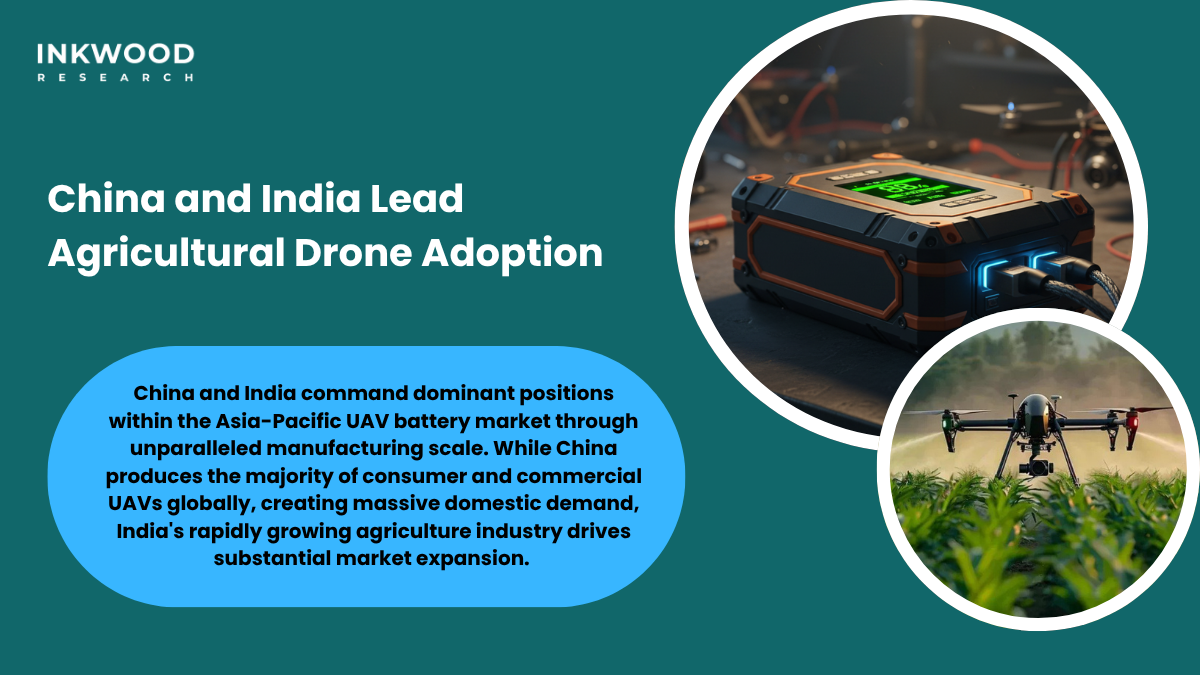
India’s rapidly growing agriculture industry drives substantial market expansion. Government support through subsidies and favorable policies accelerates farmer adoption of drone technologies. Agricultural drones address labor shortages while improving crop yields across diverse farming environments.
Rice cultivation, cotton farming, and vegetable production benefit significantly from precision monitoring capabilities. Furthermore, agricultural cooperatives organize shared drone services among smallholder farmers.
Technology companies like BharatRohan pioneer spectral imaging-based decision support systems. Partnerships with research institutions like ICRISAT advance hyperspectral technology applications. These innovations position India as an agricultural technology leader throughout the Asia-Pacific region.
Japan: Quality and Technological Sophistication
Japan represents a technologically advanced market characterized by premium quality standards. The Ministry of Defense invests strategically in unmanned systems for maritime surveillance. Japanese manufacturers apply automotive-grade quality control processes to UAV battery production.
Industrial policies promote the development of advanced battery technologies, including solid-state chemistries. Commercial sectors leverage drones for infrastructure inspection across extensive rail networks and power transmission systems. Agricultural cooperatives adopt UAV-based crop monitoring to address rural labor shortages.
Despite a smaller market size compared to China, Japan offers opportunities for premium battery solutions. Applications where performance and reliability justify higher pricing include defense and industrial inspection markets. Disaster response operations following earthquakes and typhoons require exceptionally reliable power systems.
Southeast Asia and Australia: Growing Opportunities
Southeast Asian nations, including Vietnam, Thailand, and Indonesia, demonstrate strong growth potential. Palm plantations, rice cultivation, and diverse agricultural operations increasingly adopt drone technologies. Australia’s vast agricultural estates utilize drones for livestock monitoring and crop surveillance.
Commercial Applications Drive Explosive Growth
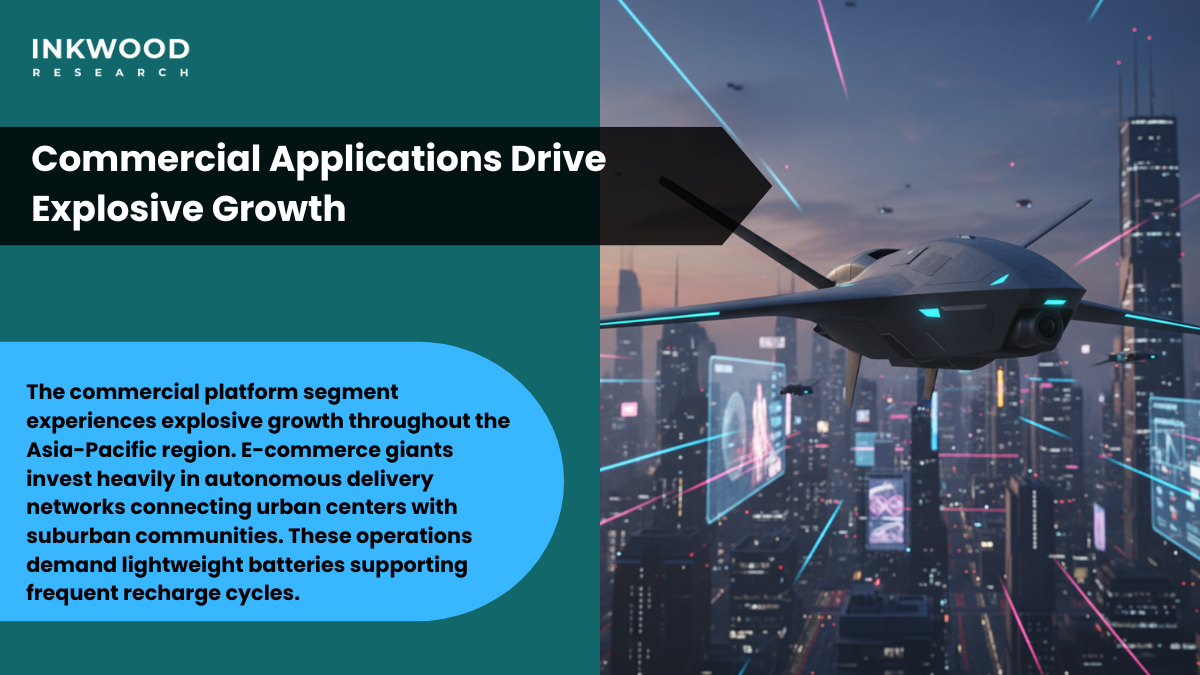
The commercial platform segment experiences explosive growth throughout the Asia-Pacific region. E-commerce giants invest heavily in autonomous delivery networks connecting urban centers with suburban communities. These operations demand lightweight batteries supporting frequent recharge cycles.
Agricultural Enterprises Lead Adoption
Agricultural enterprises spanning rice paddies in Vietnam, palm plantations in Indonesia, and wheat fields in Australia deploy precision farming drones. Power systems optimize for extended area coverage during crop monitoring missions. Battery performance directly impacts operational efficiency and economic viability.
Precision spraying applications require high power output for pump systems while maintaining flight stability. Consequently, batteries balance energy density with discharge rate capabilities. Our research indicates the agricultural segment accounts for the largest commercial battery volume.
Energy Infrastructure Monitoring Expands Rapidly
Energy companies utilize commercial UAVs for pipeline inspections, solar farm maintenance, and offshore platform surveys. These applications generate sustained demand for ruggedized batteries that can withstand harsh environmental conditions.
Extended flight times enable comprehensive infrastructure coverage without frequent battery changes. Integration into smart farming ecosystems requires batteries compatible with IoT connectivity and automated charging systems.
Construction and Surveying Applications
Construction firms leverage drones for site surveying and project monitoring across Asia-Pacific’s infrastructure boom. Real-time progress tracking and volumetric calculations improve project management efficiency. Battery requirements emphasize reliability and consistent performance over extended operational periods.
Delivery and Logistics Innovation
Last-mile delivery applications, particularly in urban areas, require batteries supporting multiple daily missions. Quick turnaround times between flights necessitate rapid charging capabilities. Temperature-controlled delivery for pharmaceuticals and perishables demands batteries that maintain consistent performance.
Commercial operators prioritize total cost of ownership, balancing purchase price against cycle life. Manufacturers compete on value proposition, offering application-specific optimizations. Growth opportunities emerge for vendors developing specialized solutions for particular commercial use cases.
Competitive Dynamics and Market Leaders
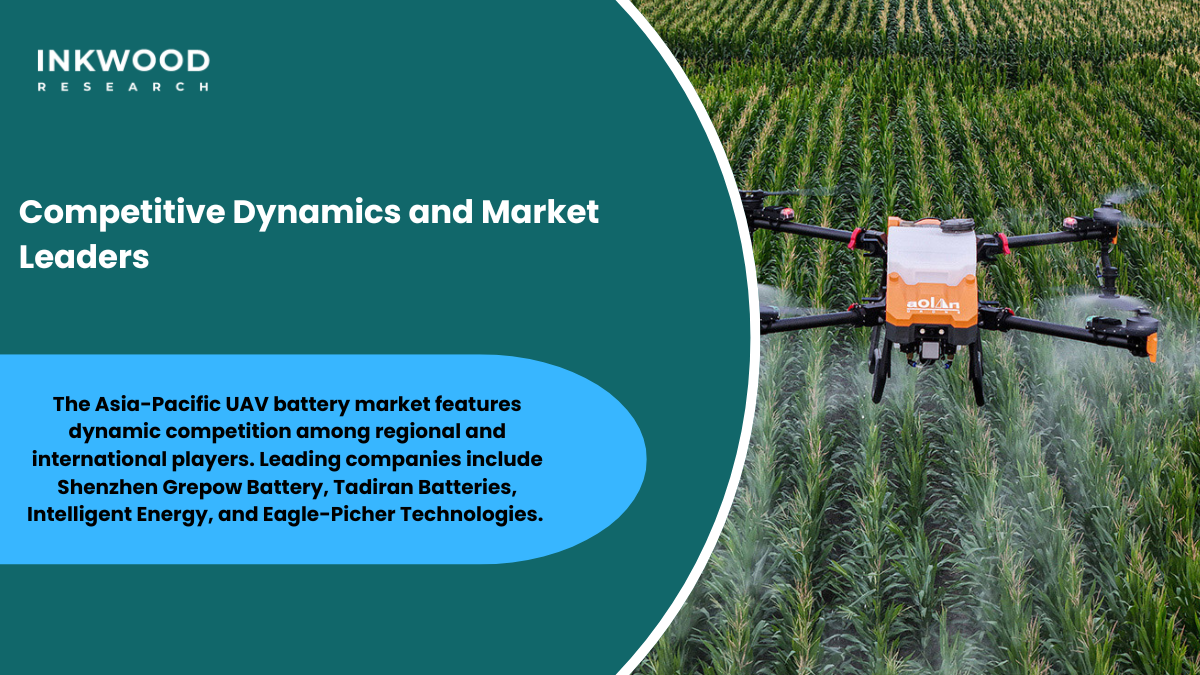
The Asia-Pacific UAV battery market features dynamic competition among regional and international players. Leading companies include Shenzhen Grepow Battery, Tadiran Batteries, Intelligent Energy, and Eagle-Picher Technologies. Each manufacturer pursues distinct strategies to capture market segments.
Shenzhen Grepow Battery: Regional Manufacturing Leader
Shenzhen Grepow Battery maintains a commanding presence through extensive manufacturing capabilities. The company specializes in customized lithium-polymer batteries designed specifically for UAV applications. Engineering teams collaborate closely with drone manufacturers, developing battery configurations optimized for specific airframes.
Product portfolio encompasses power systems ranging from compact cells for consumer drones to high-capacity modules. Manufacturing facilities leverage automated production lines, ensuring consistent quality while maintaining cost competitiveness. Strategic location within China’s electronics manufacturing hub enables rapid prototyping and short lead times.
Technical support services assist UAV producers with battery integration and thermal management design. Established distribution networks throughout the Asia-Pacific facilitate market access for drone manufacturers. Continuous research and development drive improvements in energy density and cycle life.
International Players Strengthen Regional Presence
Tadiran Batteries expands Asia-Pacific operations, leveraging expertise in long-endurance applications. The company targets defense and commercial segments requiring exceptional reliability. Products serve maritime surveillance, border monitoring, and critical infrastructure inspection.
Intelligent Energy brings hydrogen fuel cell technology to regional markets. Hybrid power architectures combining fuel cells with batteries enable extended operational durations. These systems appeal to applications where flight time significantly impacts economic viability.
Recent Product Launches and Innovations
Companies announce breakthrough developments advancing battery capabilities. In May 2025, Yamaha Motor and Mitsubishi Heavy Industries began joint research on developing hybrid-powered medium-sized UAVs. Successful flight tests demonstrated a 200kg payload capacity targeting logistics and disaster response.
September 2024 saw Trimble launch the APX RTX portfolio for direct georeferencing solutions. Integration of CenterPoint RTX technology enables centimeter-level accuracy without base stations. Such innovations enhance agricultural drone capabilities for precision applications.
Strategic Partnerships Drive Market Evolution
Collaborations between battery manufacturers and agricultural technology companies accelerate commercialization. Partnerships focus on developing application-specific solutions addressing unique regional requirements. Joint ventures leverage complementary expertise in battery technology and agricultural operations.
Investment in research facilities throughout the Asia-Pacific strengthens innovation capabilities. Companies establish technical centers collaborating with universities and research institutions. These initiatives advance fundamental battery science while addressing practical deployment challenges.
Key Takeaways
- Fastest Global Growth: Asia-Pacific UAV battery market grows at 15.68% CAGR, reaching $2.22 billion by 2032, driven by agricultural modernization and manufacturing scale
- Agricultural Transformation: Precision farming revolutionizes crop monitoring, pesticide application, and field mapping across diverse agricultural environments throughout the region
- Technology Leadership: Lithium-polymer batteries dominate with 60% market share through optimal discharge rates, energy density, and cost-competitive manufacturing
- Regional Dynamics: China leads manufacturing and consumption, while India demonstrates explosive agricultural adoption growth; Southeast Asia and Japan offer specialized opportunities
- Commercial Dominance: Commercial applications generate the majority of demand, spanning agriculture, delivery services, infrastructure inspection, and energy monitoring
- Innovation Pipeline: Next-generation chemistries, including solid-state architectures and hybrid fuel cell systems, promise revolutionary performance improvements
Conclusion:
The Asia-Pacific UAV battery market represents agriculture’s technological frontier, where innovation meets necessity. Precision farming transforms traditional practices through data-driven insights and automated operations. Agricultural drones powered by advanced lithium-polymer batteries enable farmers to optimize yields while conserving resources.
Regional leadership stems from manufacturing scale advantages, government support, and massive agricultural modernization initiatives. China’s production dominance, combined with India’s explosive adoption growth, creates unprecedented opportunities. Meanwhile, Japan’s technological sophistication and Southeast Asia’s diverse agricultural landscapes drive specialized solutions.
Commercial applications dominate market growth as operators prioritize total cost of ownership and operational efficiency. Battery manufacturers developing application-specific solutions optimized for agricultural environments will capture premium segments. Furthermore, strategic partnerships between technology companies and agricultural cooperatives accelerate widespread adoption.
Looking ahead, the Asia-Pacific’s commitment to agricultural innovation and food security ensures continued market expansion. Emerging battery technologies promise transformative capabilities supporting longer flights, heavier payloads, and improved sustainability. The convergence of agricultural necessity and technological advancement creates fertile ground for investment.
Ready to capitalize on Asia-Pacific’s agricultural technology revolution?
Connect with Inkwood Research for comprehensive market intelligence and strategic consultation supporting your regional expansion plans.
Frequently Asked Questions
How do UAV batteries transform precision farming practices?
UAV batteries enable drones to conduct real-time crop monitoring, targeted pesticide application, and comprehensive field mapping. Advanced lithium-polymer batteries provide 40-60 minute flight times covering extensive agricultural areas. Furthermore, rapid charging capabilities support multiple daily missions, significantly improving operational efficiency compared to traditional farming methods.
Why does Asia-Pacific lead global UAV battery market growth?
Asia-Pacific combines manufacturing scale advantages, aggressive government subsidies, massive agricultural modernization programs, and cost-competitive production capabilities. China’s dominance in UAV manufacturing creates concentrated demand while India’s agricultural sector demonstrates explosive adoption growth. Additionally, diverse geography and varied applications stimulate continuous innovation.
What battery technologies dominate agricultural drone applications?
Lithium-polymer batteries comprise 60% of the market share due to high discharge rates, optimal energy density, and lighter weight profiles. These characteristics suit agricultural requirements for extended area coverage, frequent takeoffs, and varied environmental conditions. Moreover, cost-competitive manufacturing throughout the Asia-Pacific enables mass adoption among price-sensitive farming operations.