Table of Contents
This analysis is brought to you by Inkwood Research, a leading market intelligence firm specializing in Asia-Pacific energy storage, renewable energy, and manufacturing ecosystems. Our research team combines extensive experience analyzing flow battery technologies, regional supply chain dynamics, and government policy frameworks across China, Japan, India, and Southeast Asia. Based on our proprietary research methodologies and strategic partnerships with Asian manufacturers, industry associations, and regulatory authorities, we deliver actionable insights that empower strategic decision-making for global enterprises navigating Asia-Pacific’s rapid energy storage expansion and technological leadership.
TLDR
Asia-Pacific dominates global flow battery market dynamics through unprecedented manufacturing scale and gigawatt-level deployments that dwarf other regions. Chinese companies like Dalian Rongke Power have commissioned the world’s largest projects, including a revolutionary 200MW/1GWh system establishing new benchmarks for vanadium redox flow batteries. This analysis reveals how rapid industrialization, government mandates, and technological breakthroughs position Asia-Pacific as the undisputed leader in flow battery technology innovation. Discover why this region commands over 60% global production capacity and shapes the future of renewable energy storage worldwide through aggressive grid-scale battery deployment strategies.
Manufacturing executives, battery technology companies, and infrastructure investors seeking insights into Asia-Pacific’s dominant role in flow battery commercialization will discover critical market intelligence. Government policymakers, renewable project developers, and supply chain strategists focused on understanding China, India, Japan, and Australia’s long-duration energy storage solutions approaches will gain comprehensive perspectives. Clean energy equipment manufacturers, venture capitalists targeting emerging markets, and grid operators implementing industrial energy storage systems across APAC will find actionable insights on technology leadership, cost structures, and deployment patterns shaping the region’s sustainable energy storage evolution.
Manufacturing Powerhouse: Asia-Pacific’s Flow Battery Dominance
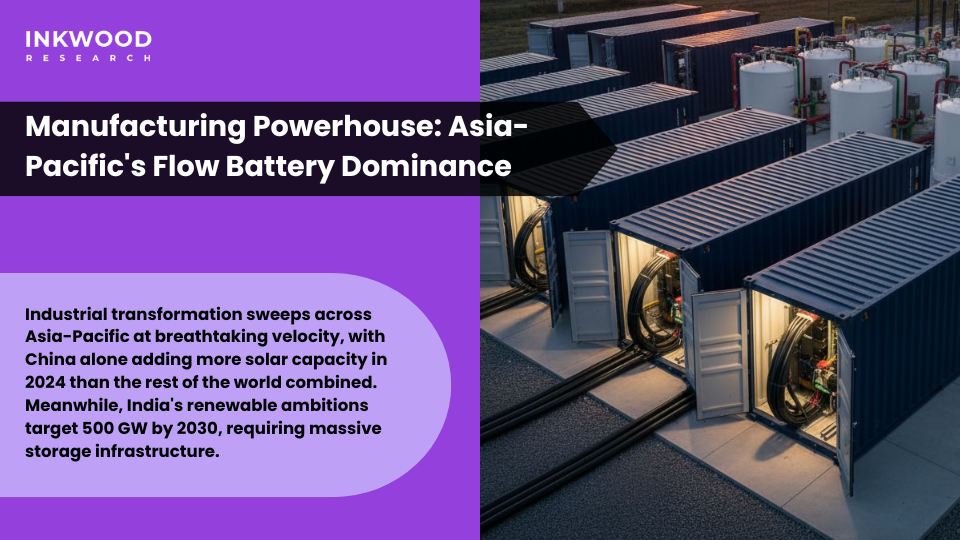
Industrial transformation sweeps across Asia-Pacific at breathtaking velocity, with China alone adding more solar capacity in 2024 than the rest of the world combined. Meanwhile, India’s renewable ambitions target 500 GW by 2030, requiring massive storage infrastructure. Japan revises energy roadmaps mandating that flow batteries comprise 30% of long-term storage by decade’s end. Australia emerges as the third-largest utility battery market globally, surpassing the United Kingdom. Against this backdrop of explosive growth, flow battery technology assumes central importance in powering the region’s clean energy transition.
Asia-Pacific commands over 60% of the global flow battery market production capacity, fundamentally reshaping competitive dynamics worldwide. According to our comprehensive analysis, this regional dominance reflects strategic advantages spanning raw material control, manufacturing expertise, and policy coordination. China controls approximately 67% of global vanadium production, providing critical supply chain leverage for vanadium redox flow batteries. Additionally, manufacturing costs in the region undercut European and North American competitors by 30-40%, accelerating commercial deployment timelines across multiple applications.
The scale of Asia-Pacific projects dramatically exceeds installations elsewhere. Dalian Rongke Power’s 200MW/1GWh facility in Xinjiang represents the world’s first gigawatt-hour-scale vanadium flow battery, dwarfing typical Western deployments. Furthermore, the company’s cumulative installed capacity surpassed 3.5 GWh globally by mid-2025, establishing unprecedented leadership in large-scale energy storage deployments. This manufacturing and deployment velocity creates competitive moats that rivals struggle to match, positioning Asia-Pacific as the epicenter of flow battery market growth for the foreseeable future.
China’s Manufacturing Supremacy and Gigawatt-Scale Projects
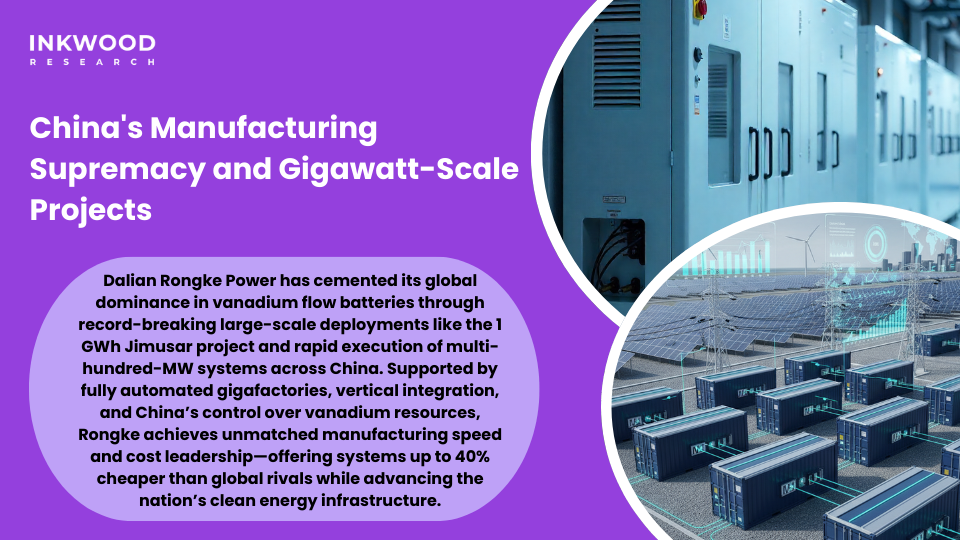
Rongke Power’s Record-Breaking Deployments
Dalian Rongke Power has established undisputed leadership through consecutive record-breaking flow battery deployment achievements. In December 2024, the company completed the 175MW/700MWh Xinhua Ushi project in northwest China, surpassing its previous 100MW/400MWh Dalian installation. Subsequently, in May 2025, Rongke commissioned the 200MW/1GWh Jimusar facility, marking history’s first gigawatt-hour-scale vanadium flow battery deployment. This integrated solar-plus-storage system provides five hours of maximum discharge duration, sufficient to power approximately 390 households annually from a single charge cycle.
These monumental projects demonstrate capabilities unmatched globally. The Jimusar installation forms part of Xinjiang’s broader strategy to establish a national clean energy hub, targeting over 20 GW of new energy storage connected to grids by 2025. Moreover, it represents China’s first integrated “wind-solar-storage-hydrogen” demonstration base, showcasing comprehensive decarbonization infrastructure. Engineering complexities involved in managing GWh-scale redox flow batteries required innovations in system integration, thermal management, and grid synchronization that advance the entire industry’s technical capabilities.
July 2025 brought another milestone when Rongke completed the 100MW/400MWh Hami SDIC project, pushing its cumulative global installations beyond 3.5 GWh. This achievement underscores the manufacturing velocity impossible to replicate outside Asia-Pacific’s industrial ecosystem. Furthermore, the entire Hami project timeline, from contract signing through commissioning, consumed merely three and a half months, setting unprecedented speed records for flow battery manufacturers worldwide. Such rapid execution reflects mature supply chains, experienced workforces, and streamlined regulatory frameworks unique to the region.
Automated Manufacturing and Cost Leadership
Rongke Power operates the world’s first fully digital gigafactory equipped with robotic systems capable of producing 1 GW in battery energy storage systems annually. This facility represents quantum leaps in manufacturing automation compared to Western competitors still relying on semi-manual assembly processes. Additionally, production expansions announced in February 2025 include dedicated electrolyte and bipolar plate manufacturing lines, vertically integrating supply chains and further reducing costs. Consequently, Chinese vanadium flow battery systems undercut international competitors by 40% while maintaining comparable performance specifications.
Resource control amplifies these cost advantages substantially. China dominates global vanadium supply with 67% of production capacity, enabling preferential access to critical raw materials. Dalian Rongke and Beijing Puneng collectively account for 70% of worldwide vanadium flow battery technology manufacturing capacity. Moreover, policy support through 15% corporate income tax exemptions and equipment purchase subsidies reaching 5 million yuan per project enhances economic competitiveness. These structural advantages create formidable barriers protecting Chinese market leadership against international competition attempting to establish footholds.
Government Mandates Driving Explosive Market Growth
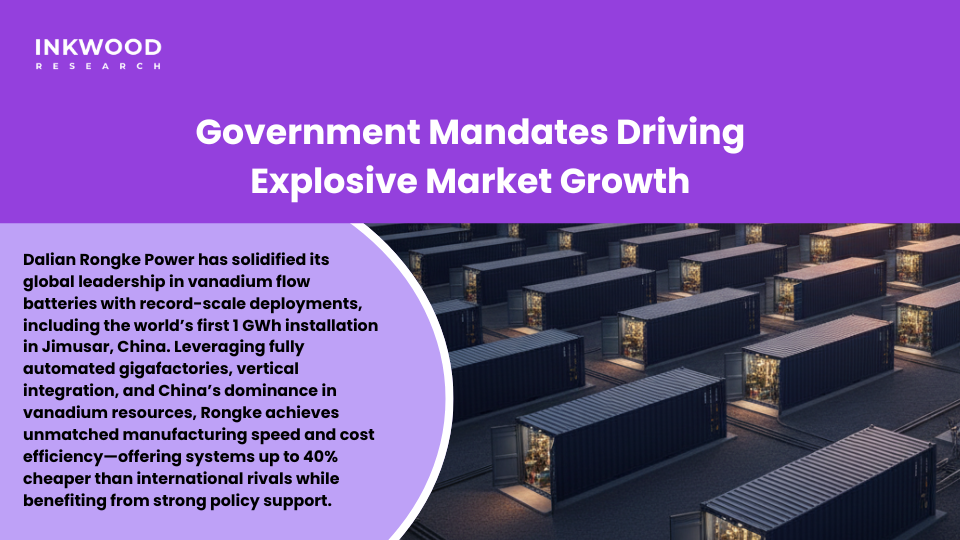
China’s Energy Storage Mandates
Chinese government policies directly mandate renewable energy storage deployment at unprecedented scales. China’s National Development and Reform Commission requires several provinces to integrate battery storage into all new renewable projects, targeting 30 GW of fresh energy storage capacity by 2025. This regulatory approach transforms storage from optional to obligatory, guaranteeing demand regardless of market conditions. Additionally, State Grid Corporation reported deploying over 20 GW of battery storage specifically for grid services during 2023, focusing on integrating wind and solar into national networks.
Provincial implementation demonstrates remarkable execution velocity. Xinjiang province alone aims to connect over 20 GW of new energy storage to grids by 2025, establishing the region as a national clean energy hub. Similarly, other provinces mandate minimum storage ratios ranging from 10-20% of renewable capacity, effectively creating captive markets for grid-scale batteries. These mandates extend beyond utility-scale applications, with industrial and commercial sectors facing similar requirements. Consequently, the Chinese flow battery market expansion occurs at speeds unimaginable under voluntary adoption models prevalent elsewhere.
Regional Policy Coordination
Beyond China’s commanding presence, other Asia-Pacific nations implement supportive frameworks, accelerating flow battery adoption trends. India’s government targets 30% electric vehicle adoption by 2030, primarily electrifying two-wheelers, three-wheelers, and commercial vehicles. This aggressive timeline necessitates advanced energy storage solutions supporting charging infrastructure and grid stability. Meanwhile, the FAME India II Scheme subsidizes 7,090 electric buses alongside charging station development, creating substantial demand for industrial energy storage systems throughout transportation networks.
Japan’s revised Energy Storage Technology Roadmap represents another pivotal policy shift. This framework mandates that flow batteries comprise 30% of long-term storage installed capacity by 2030, explicitly recognizing vanadium redox flow batteries’ advantages for duration-sensitive applications. South Korea’s Ministry of Trade, Industry, and Energy allocated substantial funding supporting domestic battery technology development. Australia implements grid service contracts requiring specific long-duration energy storage solutions capabilities, effectively specifying flow technologies for key applications. These coordinated regional policies create synchronized demand drivers absent in fragmented Western markets.
Cost Innovation and Technology Breakthroughs
Dramatic Cost Reductions
Asia-Pacific manufacturers achieved remarkable cost trajectory improvements, transforming the flow battery market economics fundamentally. All-vanadium liquid flow battery system costs plummeted from $600/kWh in 2018 to approximately $350/kWh by 2023, representing a 42% decline in merely five years. This compression results from manufacturing scale efficiencies, supply chain optimization, and technological refinements, improving materials utilization. Furthermore, current large-scale system costs average $500-700/kWh, positioning vanadium flow batteries competitively against lithium-ion for duration-sensitive applications requiring multi-hour discharge capabilities.
Chinese cost advantages stem from multiple structural factors beyond raw material access. Massive production volumes enable economies of scale impossible at Western manufacturing levels. Additionally, domestic competition among multiple Chinese producers drives continuous improvement and pricing pressure absent in markets with only one or two suppliers. Government subsidies supporting equipment purchases and tax incentives reduce capital recovery periods, improving project economics. Consequently, flow battery efficiency improvements and cost reductions proceed faster in Asia-Pacific than elsewhere, widening competitive gaps over time.
Advanced Technology Development
Regional research institutions drive cutting-edge breakthroughs, advancing flow battery technology innovations. Researchers at Dalian Institute of Chemical Physics developed 70 kW-level vanadium flow battery stacks, achieving 130 kW/m³ volume power density, representing 40% cost reductions compared to current 30 kW-level systems. These advances improve space utilization, critical for land-constrained applications, while reducing installation expenses. Moreover, the institute collaborated with Rongke Power on nearly 40 commercial demonstration projects domestically and internationally, translating laboratory achievements into commercial products faster than Western research-to-market cycles.
Alternative chemistries receive substantial development attention across the region. India’s Delectrik launched a 10 MWh vanadium flow battery energy storage system product in September 2024, demonstrating indigenous technology capabilities supporting regional supply chain diversification. Japanese researchers continue refining solid-state approaches, potentially complementing flow technologies for specific applications. South Korean companies explore hybrid systems combining flow and lithium-ion advantages. This diverse innovation ecosystem ensures the Asia-Pacific maintains technological leadership even as chemistry options proliferate beyond traditional vanadium systems.
India’s Emerging Energy Storage Market
Renewable Integration Requirements
India confronts massive renewable energy storage challenges as solar and wind capacity surges toward 500 GW targets. The current installed renewable capacity generates power intermittently, creating grid stability concerns that traditional generation cannot address economically. Consequently, battery storage becomes essential infrastructure rather than an optional enhancement. India’s renewable ambitions require sophisticated energy storage solutions managing daily and seasonal variability across geographically diverse installations spanning Rajasthan’s solar farms to Tamil Nadu’s wind parks.
Commercial and industrial segments demonstrate particularly strong growth potential. Data centers, hospitals, and manufacturing facilities require uninterrupted power supplies in regions with unreliable grids. Peak demand charges incentivize behind-the-meter storage installations, reducing electricity costs significantly. Furthermore, corporate sustainability commitments drive renewable procurement, necessitating storage to ensure continuous clean energy availability. These applications favor flow battery technology, offering daily cycling capabilities without degradation penalties affecting lithium-ion alternatives.
Manufacturing and Deployment Initiatives
Indigenous manufacturing capabilities expand rapidly across India’s flow battery market ecosystem. Delectrik Systems partnered with Saudi Arabia’s Tdafoq Energy, establishing distribution and manufacturing licenses, positioning Indian technology in Gulf Cooperation Council markets. This November 2022 agreement enables Delectrik to sell vanadium redox products across Kuwait, Bahrain, Oman, Saudi Arabia, Qatar, and the United Arab Emirates. Additionally, plans for local manufacturing facilities in Saudi Arabia demonstrate confidence in Indian engineering capabilities competing internationally.
Government support accelerates domestic adoption through multiple channels. The FAME India II Scheme subsidizes electric vehicle infrastructure, creating immediate demand for grid-scale batteries supporting charging stations. State electricity boards implement storage mandates for new renewable projects similar to Chinese provincial requirements. Tax incentives and accelerated depreciation improve project economics for commercial deployments. These policy frameworks combine with India’s substantial engineering talent pool and cost-competitive manufacturing, creating favorable conditions for sustained flow battery market growth throughout the forecast period.
Japan’s Technology Leadership and Strategic Positioning
Energy Storage Roadmap and Targets
Japan established clear technology priorities through its revised Energy Storage Technology Roadmap, mandating that flow batteries represent 30% of long-duration storage capacity by 2030. This ambitious target reflects government recognition that vanadium redox flow batteries provide unique advantages for grid stability and renewable integration. Moreover, Japan’s Ministry of Economy, Trade, and Industry approved four major R&D projects on all-solid-state battery materials and production, demonstrating a commitment to diverse storage technologies addressing different application requirements.
Historical operational experience provides Japanese companies with invaluable knowledge. Sumitomo Electric’s 15MW/60MWh system, deployed in 2015 in northern Japan, operated successfully for years, validating flow battery efficiency for utility applications. Subsequently, a 51MWh system commissioned in April 2022 maintained performance meeting stringent Japanese quality standards. These long-duration operational track records provide confidence supporting larger investments across both domestic and international markets where Japanese technology enjoys a premium reputation.
Corporate Innovation and Global Expansion
Sumitomo Electric Industries maintains a strong patent portfolio protecting proprietary flow battery technology innovations. The company holds 387 core patents related to vanadium systems, charging Chinese manufacturers licensing fees of $5 per kWh for technology access. This intellectual property strategy generates revenue streams while establishing standards competitors must accommodate. Additionally, Sumitomo’s 30-year lifespan systems unveiled in March 2025 set new durability benchmarks, providing 15% higher energy density while reducing costs by approximately 30% compared to previous generations.
Japanese manufacturers target international expansion, leveraging quality advantages. Sumitomo operates demonstration projects across North America, including California installations participating in wholesale electricity markets. Technology transfer agreements with regional partners accelerate global footprint expansion without requiring massive direct capital investment. Furthermore, Japanese government initiatives support overseas deployments through concessional financing and diplomatic channels, positioning flow batteries as infrastructure exports supporting energy transition partnerships. These strategic approaches enable Japanese firms to compete against larger Chinese competitors through technology leadership rather than volume dominance.
Australia's Grid Transformation and Storage Boom
Record-Breaking Market Growth
Australia achieved the third-largest global ranking for utility-scale battery capacity with 14 GW/37 GWh at or nearing financial close, overtaking the United Kingdom. This remarkable ascent reflects favorable policy environments, excellent renewable resources, and sophisticated electricity market designs rewarding storage capabilities. Additionally, Australia became the first nation to surpass 1 GWh of utility battery capacity per million population, establishing per-capita leadership far exceeding China and the United States. The project pipeline expanded 45 GW in twelve months from 109 GW in August 2024 to 154 GW by 2025, demonstrating unprecedented momentum.
Investment in new storage capacity by 2030 is expected to exceed AUD 21 billion ($14 billion), supported by the Capacity Investment Scheme providing revenue certainty for developers. Local utilities dominate investment alongside select international developers establishing significant Australian presences. Companies like Neoen energized its 270 MW/540 MWh Western Downs project six weeks ahead of schedule in September 2025. Meanwhile, Akaysha Energy maintains a 4 GWh portfolio under construction plus 13 GWh in development, including the $1 billion 850 MW/1.6 GWh Waratah Super Battery representing Australia’s largest single industrial energy storage systems project.
Flow Battery Pilot Projects
While lithium-ion dominates Australian deployments currently, flow battery technology is gaining traction for applications requiring extended discharge durations. CellCube formed R&D partnerships in Australia during September 2022, anticipating long-duration energy storage market entry. The collaboration aims to integrate vanadium redox systems meeting 24/7 low-carbon energy demands, commencing with a pilot 2 MW/8 MWh installation. Australian Vanadium Limited advanced projects toward design phases targeting modular, scalable systems addressing specific grid service requirements.
Australia’s sophisticated electricity markets create revenue opportunities for long-duration energy storage solutions participating in multiple value streams simultaneously. Grid service contracts reward capabilities, stabilizing frequency and voltage, generating income independent of energy arbitrage. Additionally, renewable integration requirements expand as coal plants retire, with 11 GW of closures scheduled, including major facilities like New South Wales’s 2.8 GW Eraring station. These retirements create capacity gaps that flow batteries for grid applications address effectively, positioning the technology for significant market share gains as developers diversify beyond lithium-ion for risk management and technical optimization.
Key Takeaways
- Asia-Pacific’s flow battery market dominance stems from coordinated advantages spanning manufacturing, policy, and technology domains. Chinese companies, particularly Dalian Rongke Power, established unprecedented leadership through gigawatt-scale projects like the 200MW/1GWh Jimusar facility and cumulative global installations exceeding 3.5 GWh. Manufacturing automation, vanadium supply control, and government subsidies enable cost structures 30-40% below international competitors, creating formidable competitive moats protecting regional leadership.
- Government mandates transform energy storage solutions from optional to obligatory across major Asia-Pacific markets. China’s provincial requirements for storage integration with renewables guarantee sustained demand growth. Japan’s roadmap mandating 30% flow battery composition of long-duration capacity by 2030 provides a clear technology direction. India’s electric vehicle targets and charging infrastructure subsidies create immediate applications. Australia’s Capacity Investment Scheme provides revenue certainty, supporting AUD 21 billion investment through 2030.
- Cost reductions demonstrate remarkable trajectories with all-vanadium systems declining from $600/kWh (2018) to $350/kWh (2023), representing 42% improvements in five years. Technology breakthroughs from institutions like Dalian Institute of Chemical Physics achieve 40% stack cost reductions through enhanced power density. Sumitomo Electric’s 30-year lifespan systems combine 15% energy density improvements with 30% cost reductions, setting new global benchmarks. These advances ensure Asia-Pacific maintains technological leadership complementing manufacturing dominance.
- Regional dynamics create distinct opportunities across major markets. China leads through sheer scale and policy mandates. India emerges as manufacturing hub with substantial domestic demand. Japan contributes technology leadership and quality premium positioning. Australia demonstrates sophisticated market designs maximizing storage value. Collectively, these factors position Asia-Pacific for sustained growth as the global epicenter of flow battery technology innovation, manufacturing, and deployment throughout the forecast horizon.
Conclusion: Asia-Pacific’s Commanding Market Position
Asia-Pacific has established unchallengeable leadership in global flow battery market development through convergent advantages that competitors cannot easily replicate. Manufacturing scale achieved by companies like Dalian Rongke Power, producing 1 GW annually from automated gigafactories, enables cost structures impossible at Western production volumes. Vertical integration, controlling vanadium supply chains and component manufacturing, creates end-to-end advantages that compound over time. Government mandates guaranteeing demand remove market uncertainty plaguing voluntary adoption models elsewhere, accelerating deployment timelines dramatically.
Technology leadership increasingly shifts toward Asia-Pacific research institutions and manufacturers. Breakthrough innovations in stack design, electrolyte formulations, and system integration originate from Dalian Institute of Chemical Physics and corporate R&D centers. Japanese companies maintain quality advantages and patent portfolios, yet Chinese competitors rapidly close performance gaps while maintaining substantial cost leadership. Indian engineering capabilities expand manufacturing footprints regionally and internationally. Australian market sophistication drives operational innovation, maximizing storage value creation through multiple revenue streams.
Strategic implications for global stakeholders demand careful consideration. Western manufacturers confronting 30-40% cost disadvantages must pursue differentiation through technology, service, or niche applications rather than competing on price. Project developers increasingly source equipment from Asia-Pacific suppliers regardless of installation location, recognizing economic imperatives. Policymakers seeking domestic manufacturing capabilities face substantial challenges in establishing competitive cost structures without comparable scale and integration. The flow battery market evolution ultimately reflects broader patterns of industrial capacity concentration in Asia-Pacific, suggesting sustained regional dominance reshaping global energy storage landscapes for decades ahead.
Frequently Asked Questions
Why does Asia-Pacific dominate global flow battery manufacturing?
Asia-Pacific commands over 60% of the global flow battery market production through structural advantages spanning raw materials, manufacturing scale, and policy support. China controls 67% of worldwide vanadium production, providing critical supply chain leverage for vanadium redox flow batteries. Companies like Dalian Rongke Power operate automated gigafactories producing 1 GW annually, achieving economies of scale impossible at Western volumes.
How do government policies drive Asia-Pacific flow battery adoption?
Government mandates transform renewable energy storage from optional to obligatory across major Asia-Pacific markets. China’s National Development and Reform Commission requires provincial storage integration with all new renewable projects, targeting 30 GW capacity by 2025. Japan’s Energy Storage Technology Roadmap mandates that flow batteries comprise 30% of long-duration storage by 2030, explicitly prioritizing technology deployment. India’s FAME II Scheme subsidizes 7,090 electric buses alongside charging infrastructure, creating immediate grid-scale battery demand.