Table of Contents
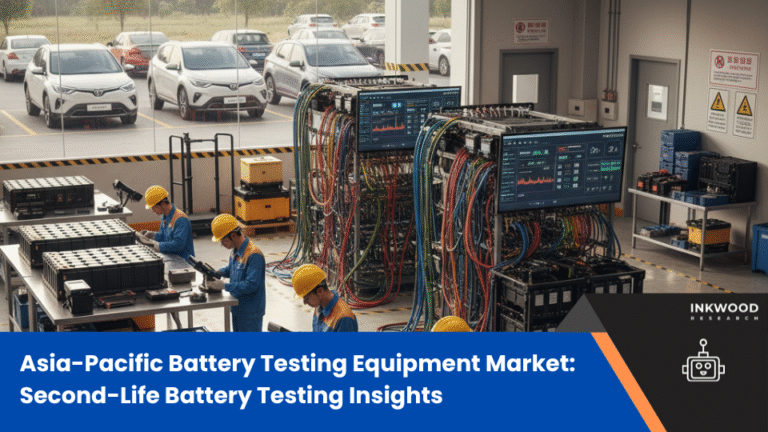
This analysis is brought to you by Inkwood Research, a leading market intelligence firm specializing in Asia-Pacific battery technology ecosystems, electric vehicle supply chains, and energy storage innovation. Our research team combines extensive experience analyzing second-life battery testing equipment market developments, gigafactory quality assurance protocols, and regulatory compliance frameworks across China, Japan, India, South Korea, and Southeast Asia. Based on our proprietary research methodologies and strategic partnerships with Asian battery manufacturers, testing laboratory networks, government certification agencies, and automotive technology providers, we deliver actionable insights that empower strategic decision-making for global enterprises navigating Asia-Pacific’s battery testing infrastructure expansion.
TLDR
The Asia-Pacific battery testing equipment market is experiencing explosive growth driven by the region’s dominance in lithium-ion production. China, Japan, and South Korea control over 70% of global battery manufacturing capacity. Consequently, stringent regulatory frameworks like China’s CCC certification and export controls create unprecedented demand for advanced testing infrastructure. Meanwhile, massive electric vehicle adoption and renewable energy storage deployments further accelerate market expansion. The region’s focus on second-life battery applications presents significant opportunities for specialized state-of-health assessment technologies.
This analysis serves C-suite executives at automotive OEMs and battery manufacturers navigating Asia-Pacific compliance requirements. Additionally, investment analysts evaluating opportunities in gigafactory testing infrastructure will benefit from market intelligence. Furthermore, testing laboratory operators and equipment suppliers expanding into Chinese, Japanese, and Indian markets gain strategic insights. Quality assurance professionals implementing second-life battery assessment programs find actionable guidance throughout this comprehensive examination.
Evaluating Used EV Batteries for Repurposing
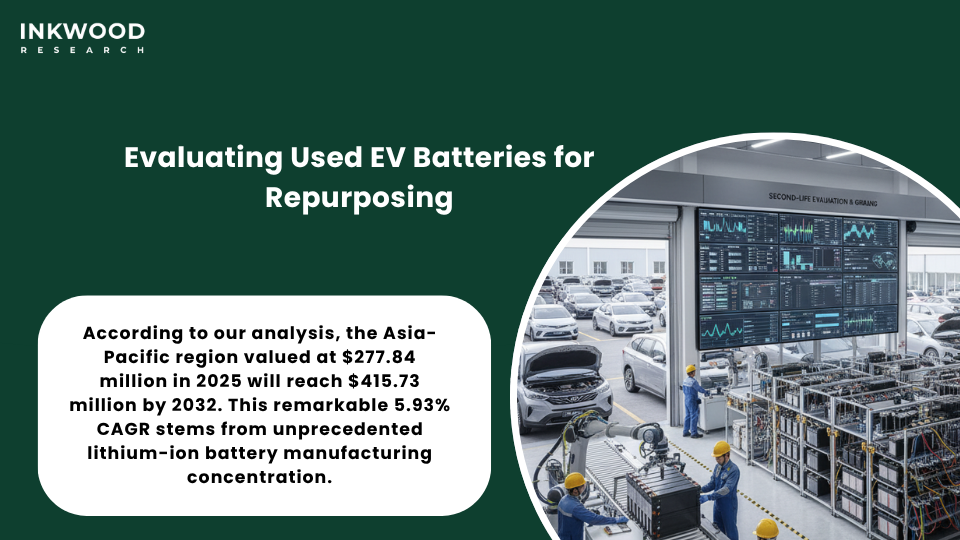
The transformation sweeping through the Asia-Pacific battery testing equipment market represents a fundamental shift in how industries approach battery lifecycle management. Electric vehicle batteries reaching 70-80% capacity no longer face immediate recycling. Instead, second-life applications offer compelling economic and environmental value propositions.
According to our analysis, the Asia-Pacific region valued at $277.84 million in 2025 will reach $415.73 million by 2032. This remarkable 5.93% CAGR stems from unprecedented lithium-ion battery manufacturing concentration. Moreover, China alone commands approximately 60% of global production capacity, creating extraordinary infrastructure demands.
However, second-life battery testing introduces unique technical challenges requiring specialized equipment capabilities. Unlike first-life validation protocols, repurposing assessments must accurately determine remaining useful life under diverse degradation patterns. Therefore, advanced diagnostic technologies become essential for economic viability.
Understanding Second-Life Battery Market Dynamics
Retired electric vehicle batteries present substantial opportunities beyond automotive applications. Stationary energy storage systems require less demanding performance specifications than transportation uses. Consequently, batteries no longer meeting EV standards effectively serve residential, commercial, and grid-scale installations.
Research from Frontiers in Chemistry indicates batteries generally lack uniform state-of-health assessments when reaching end-of-life. Thus, robust testing becomes critical for optimizing second-life applications. Furthermore, variable performance characteristics necessitate sophisticated monitoring throughout repurposed service periods.
The certification landscape remains nascent yet rapidly evolving. UL 1974 provides foundational guidelines for repurposing evaluation, establishing standardized approaches for assessing used battery viability. Meanwhile, facilities must demonstrate rigorous sorting and grading processes, ensuring only suitable batteries enter second-life markets.
Technical Requirements for Second-Life Testing
Effective repurposing requires comprehensive evaluation beyond simple capacity measurements. Thermal stability assessments identify potential safety concerns from degraded thermal management systems. Additionally, internal resistance profiling reveals cell-level inconsistencies affecting pack-level performance.
Importantly, battery management system data accessibility becomes paramount for efficient assessment. Historical charging patterns, temperature excursions, and cycle counts enable rapid viability determinations. Subsequently, analysis reduces extensive testing costs while improving economic feasibility.
State-of-charge harmonization presents another critical consideration. Modules within repurposed packs must demonstrate compatible degradation characteristics. Otherwise, performance imbalances accelerate further deterioration and compromise system reliability.
Asia-Pacific Regulatory Landscape Driving Testing Demand
Stringent certification requirements throughout Asia-Pacific create substantial testing infrastructure investments. China’s mandatory CCC certification, implemented in August 2024, requires comprehensive safety validation before market entry. Similarly, Japan’s JIS standards establish rigorous quality benchmarks throughout battery lifecycles.
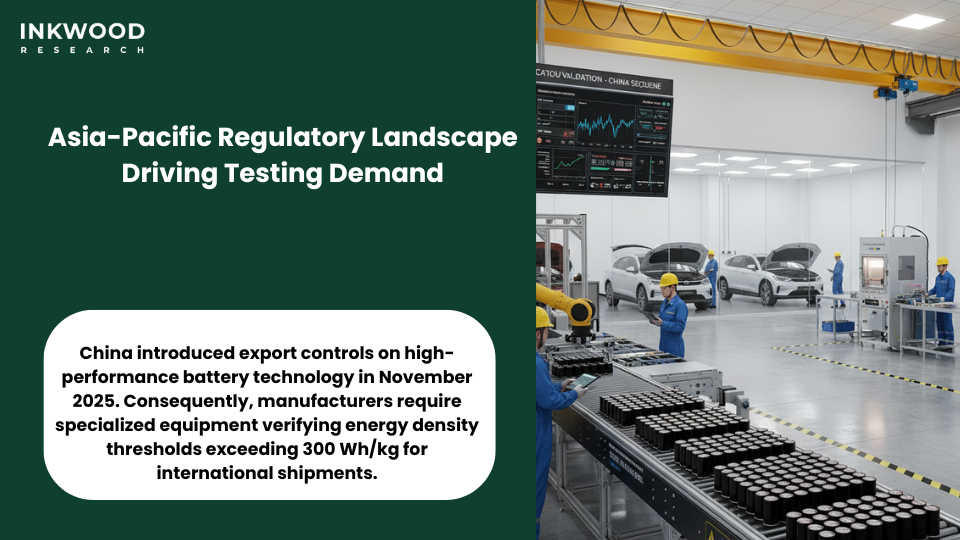
China introduced export controls on high-performance battery technology in November 2025. Consequently, manufacturers require specialized equipment verifying energy density thresholds exceeding 300 Wh/kg for international shipments. These regulatory developments significantly expand testing capacity requirements across the region.
China’s Manufacturing Dominance and Testing Infrastructure
China’s battery production capacity exceeded 800 gigawatt-hours in 2024, according to industry reports. Furthermore, plans target doubling this capacity by 2027, creating massive inline testing system demands. Major producers, including CATL, BYD, EVE Energy, and Gotion High-Tech, supply global automotive manufacturers.
These gigafactories validate millions of cells monthly through automated testing lines. Moreover, CCC requirements mandate eight comprehensive safety tests, including overcharge, short circuit, thermal runaway, and mechanical shock evaluations. Therefore, manufacturers invest heavily in automated infrastructure meeting stringent standards.
China’s emphasis on second-life applications for energy storage creates additional testing demands. State-of-health assessment equipment evaluating retired EV batteries determines repurposing viability. Meanwhile, grid-scale installations require extensive validation, ensuring reliable performance in renewable energy integration applications.
Japan’s Quality-Focused Approach
Japanese manufacturers maintain strategic positions through advanced engineering expertise and pioneering battery research. Companies including Panasonic, TDK, and Murata manufacture premium batteries serving diverse applications globally. Consequently, JIS certification frameworks establish comprehensive quality benchmarks throughout product lifecycles.
Japan’s automotive industry invests substantially in solid-state battery development. Toyota, Honda, Nissan, and Mitsubishi commit significant resources toward next-generation technologies. However, these innovations require specialized testing protocols beyond conventional lithium-ion evaluation methods.
Additionally, Japan’s aging population and disaster preparedness priorities accelerate residential energy storage adoption. Portable testing solutions enable distributed battery system validation. Furthermore, export-oriented manufacturing requires equipment certified for international standards, including UN 38.3 transportation safety protocols.
Automotive Industry Leading Testing Equipment Adoption
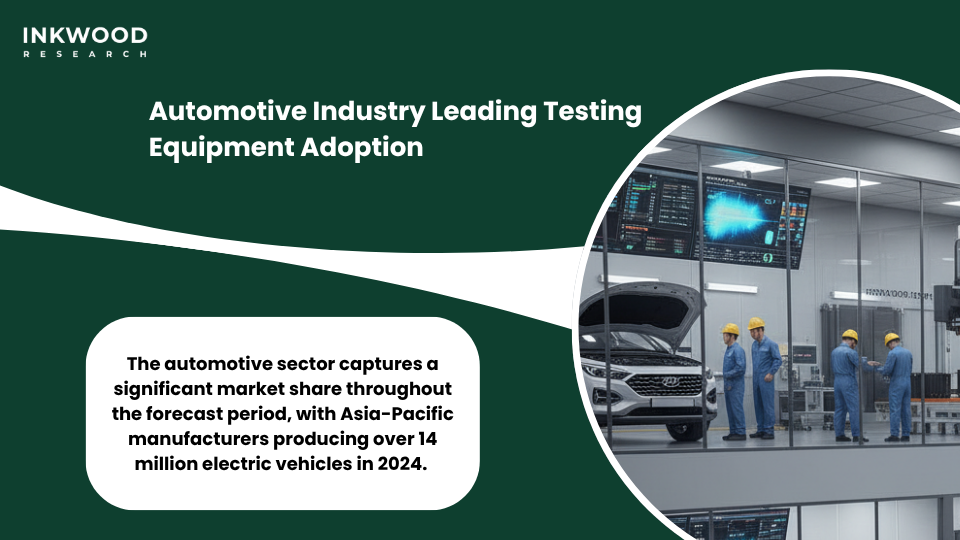
The automotive sector captures a significant market share throughout the forecast period, with Asia-Pacific manufacturers producing over 14 million electric vehicles in 2024. China contributed approximately 9.5 million units, requiring comprehensive battery validation before vehicle integration.
Each electric vehicle battery pack undergoes extensive protocols, including capacity verification, thermal management validation, crash safety simulations, and cycle life assessments. Automotive OEMs establish dedicated testing facilities within manufacturing complexes, reducing quality assurance cycle times and maintaining production schedules.
Standardized Testing Methodologies
Industry consolidation around fewer battery architectures enables standardized testing approaches across multiple vehicle platforms. Consequently, equipment investments deliver broader applicability and improved return on investment. Furthermore, Japanese automakers pioneering solid-state technologies invest significantly in specialized evaluation capabilities.
Korean manufacturers, including Hyundai and Kia, expand domestic testing infrastructure supporting localization strategies. This development reduces import dependencies while strengthening regional supply chain resilience. Additionally, automotive applications extend beyond passenger vehicles, encompassing commercial trucks, buses, and two-wheelers.
Battery warranty obligations typically spanning 8-10 years necessitate accelerated aging protocols. These tests predict long-term degradation patterns under realistic duty cycles. Therefore, sophisticated systems capable of thermal cycling, calendar aging, and power fade characterization become essential investments.
Second-Life Assessment Integration
Forward-thinking automotive manufacturers recognize second-life battery opportunities. Mercedes, Volvo, Volkswagen, and BMW test in-house circular value chain solutions according to Arthur D. Little‘s analysis. These initiatives create additional testing requirements throughout vehicle lifecycles.
OEMs must evaluate end-of-life batteries for repurposing viability before recycling decisions. Consequently, testing facilities require dual capabilities, validating both first-life performance and second-life potential. Moreover, data collected during vehicle operation informs more efficient assessment processes.
The integration of battery passport requirements under emerging regulations further emphasizes comprehensive testing documentation. Therefore, equipment must generate detailed reports tracking performance throughout entire lifecycles. This transparency enables efficient repurposing while supporting regulatory compliance.
Competitive Landscape and Key Market Players
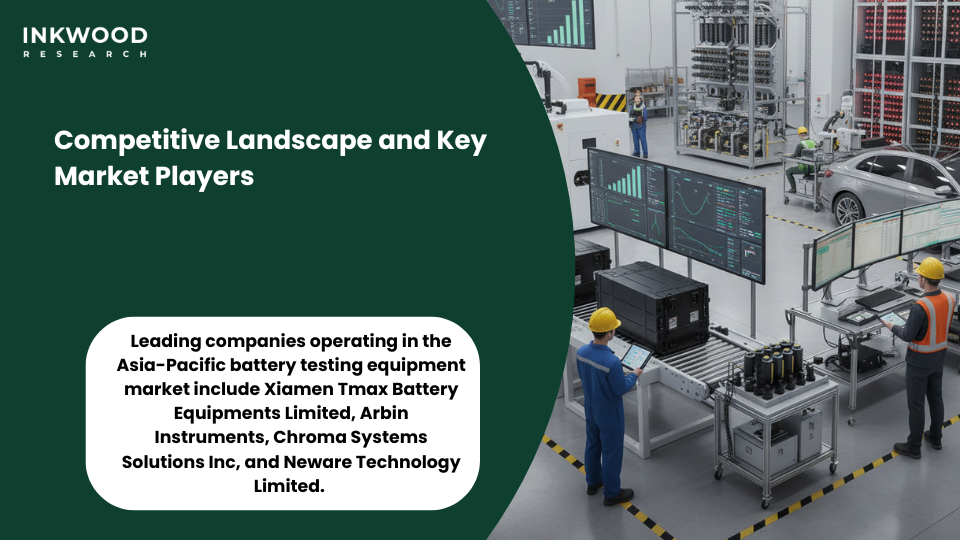
Leading companies operating in the Asia-Pacific battery testing equipment market include Xiamen Tmax Battery Equipments Limited, Arbin Instruments, Chroma Systems Solutions Inc, and Neware Technology Limited. These manufacturers provide comprehensive solutions supporting battery research and production operations throughout the region.
Xiamen Tmax Battery Equipments Limited
Xiamen Tmax represents a significant domestic manufacturer headquartered in Fujian Province, China. The company specializes in lithium battery manufacturing equipment, testing systems, and laboratory instruments. Furthermore, Tmax operates manufacturing facilities exceeding 200,000 square feet with over 230 employees.
The product portfolio encompasses testing systems for cylindrical, prismatic, and pouch cell configurations. Additionally, Tmax supplies formation equipment, charge-discharge cyclers, and performance validation instruments. Moreover, complete turnkey production lines serve customers across Eastern Europe, South Asia, South America, Australia, and New Zealand.
Tmax maintains offices in the United States, India, Korea, and Thailand, providing local technical support. This geographic presence enables responsive after-sales service tailored to regional requirements. Consequently, competitive positioning emphasizes integrated capabilities combining equipment supply with technology transfer and process consulting.
Arbin Instruments Global Reach
Arbin Instruments delivers advanced testing solutions serving research institutions and manufacturing facilities worldwide. The company’s equipment supports various applications from fundamental research through production quality assurance. Moreover, Arbin systems accommodate diverse battery chemistries and form factors.
Sophisticated software platforms enable comprehensive data analysis and reporting capabilities. Therefore, researchers and engineers gain detailed insights into battery performance characteristics. Additionally, modular architectures allow staged capacity expansion, matching evolving business requirements.
Arbin’s presence throughout Asia-Pacific provides critical local support for expanding gigafactory operations. Furthermore, partnerships with regional testing laboratories facilitate technology adoption and capability development. This collaborative approach strengthens the overall testing ecosystem, supporting battery industry growth.
Energy Storage Sector Creating Additional Demand

Asia-Pacific, led by China, installed the largest share of new energy storage capacity worldwide in 2024. This tremendous growth creates sustained testing infrastructure demands beyond automotive applications. Consequently, stationary systems require different validation approaches accounting for extended service lives and grid integration requirements.
Government incentives across India, Indonesia, Vietnam, and Thailand accelerate domestic battery manufacturing investments. Each facility necessitates extensive testing capabilities, ensuring product quality and safety compliance. Furthermore, renewable energy integration drives stationary storage deployments requiring grid-scale battery testing facilities.
Grid-Scale Testing Requirements
Utility applications demand rigorous long-term performance validation. Batteries must demonstrate reliable operation over 10-20 year service periods. Therefore, accelerated aging protocols become essential for predicting degradation under grid cycling profiles.
Additionally, grid interconnection requirements impose specific performance standards. Systems must respond rapidly to frequency regulation signals while maintaining voltage stability. Consequently, testing equipment must validate dynamic response characteristics under various operating scenarios.
Second-life batteries increasingly serve grid storage applications. However, used battery integration requires careful matching and extensive validation. Therefore, specialized assessment equipment determining compatibility between modules from different sources becomes critically important.
Residential and Commercial Applications
Distributed energy storage systems present unique testing challenges. Residential installations require compact, affordable batteries with simplified operation. Meanwhile, commercial systems demand higher capacity and reliability. Consequently, testing approaches must accommodate diverse requirements across market segments.
Safety becomes paramount for residential applications. Equipment must thoroughly validate thermal management under realistic conditions, including high ambient temperatures. Furthermore, user interaction scenarios require evaluation, ensuring safe operation by non-technical personnel.
The growth in solar-plus-storage installations creates additional demand for integrated testing capabilities. Systems must validate both solar input management and grid interaction functionality. Therefore, comprehensive testing solutions become essential for manufacturers serving this expanding market.
Key Takeaways
- Asia-Pacific dominates global lithium-ion battery production with over 70% manufacturing capacity, creating extraordinary testing infrastructure demands.
- Second-life battery applications represent significant market opportunities requiring specialized state-of-health assessment capabilities beyond traditional testing protocols.
- China’s CCC certification and export controls drive substantial investments in advanced testing equipment, validating safety and performance standards.
- Automotive industry consolidation around standardized architectures enables more efficient testing methodologies across multiple vehicle platforms.
- Energy storage sector growth creates additional testing demands for both new batteries and repurposed EV battery systems.
- Comprehensive battery lifecycle documentation, increasingly required under emerging regulations, necessitates sophisticated testing and reporting capabilities.
Conclusion
The Asia-Pacific battery testing equipment market stands at a transformative inflection point. Second-life battery applications create unprecedented opportunities for specialized testing capabilities. However, success requires sophisticated assessment technologies to determine repurposing viability efficiently and accurately.
Regulatory frameworks continue evolving, establishing more stringent requirements throughout battery lifecycles. Consequently, manufacturers and testing facilities must invest in comprehensive infrastructure supporting both first-life validation and second-life evaluation. Furthermore, data transparency requirements drive demand for detailed testing documentation and reporting systems.
Organizations navigating this complex landscape benefit from expert guidance. Inkwood Research provides strategic intelligence supporting informed decision-making across the battery testing ecosystem stakeholders.
Contact our team to discuss how our insights can accelerate your success in Asia-Pacific’s dynamic battery testing equipment market.
Frequently Asked Questions
What makes second-life battery testing different from new battery validation?
Second-life testing evaluates remaining useful life and safety after automotive use. Unlike new battery protocols, assessments must account for diverse degradation patterns and predict performance in less demanding applications.
How do China's export controls affect battery testing requirements?
Export controls require specialized equipment to verify energy density thresholds exceeding 300 Wh/kg. Consequently, manufacturers need additional testing capabilities beyond standard safety and performance validation.
What role does battery management system data play in second-life assessment?
BMS data, including charging history and temperature excursions, enables rapid viability determinations. Therefore, accessible historical data dramatically reduces testing costs and improves repurposing economic feasibility.