This analysis is brought to you by Inkwood Research, a leading market intelligence firm specializing in strategic business intelligence, AI-driven research methodologies, and enterprise market analysis. Our research team combines extensive experience in consumer insights, predictive analytics, and data-driven decision-making across North America, Europe, and Asia-Pacific. Through partnerships with global enterprises and investment firms, we deliver actionable intelligence that empowers confident, forward-looking business decisions.
TLDR
AI tools are transforming how businesses collect and process data, but they cannot replace the strategic depth that market research delivers. In 2026, the combination of AI-powered market research and human analytical intelligence is reshaping how companies make decisions. This blog explores why market research remains indispensable, how AI enhances rather than replaces it, and what forward-thinking businesses need to understand about the future of market research in today’s data-saturated world.
This blog is essential reading for founders, C-suite executives, and product strategists evaluating their research investments. Additionally, consultants navigating AI-powered market research solutions, investors weighing human intelligence vs artificial intelligence in research, and business analysts assessing the limitations of AI in market research will find targeted, evidence-grounded insights here. Whether you run a startup or a global enterprise, this analysis supports better decisions.
What Is Changing About Market Research in the Age of AI?

The conversation about AI in market research has moved well beyond hype. Today, AI tools can scan millions of data points, identify patterns in real time, and generate reports in minutes, tasks that once took research teams several weeks.
Consequently, many business leaders are asking a fair question: if AI can do all of this, why invest in market research in the age of AI at all?
The answer lies in understanding what AI actually does, versus what strategic market research is fundamentally built to deliver. Speed and scale are not the same as strategic insight, and that distinction matters more in 2026 than it ever has before.
The Rise of AI-Powered Market Research Tools
AI-powered market research platforms have genuinely changed the speed and scale of data collection. Tools now automate survey analysis, social listening, and sentiment classification with impressive accuracy. Moreover, natural language processing has made it far easier to extract themes from large qualitative datasets, something that previously required significant human hours and expert judgment.
Here is where these tools add the most value:
- Automated data collection across digital touchpoints and social platforms
- Real-time sentiment analysis and trend detection at scale
- Pattern recognition across large consumer datasets
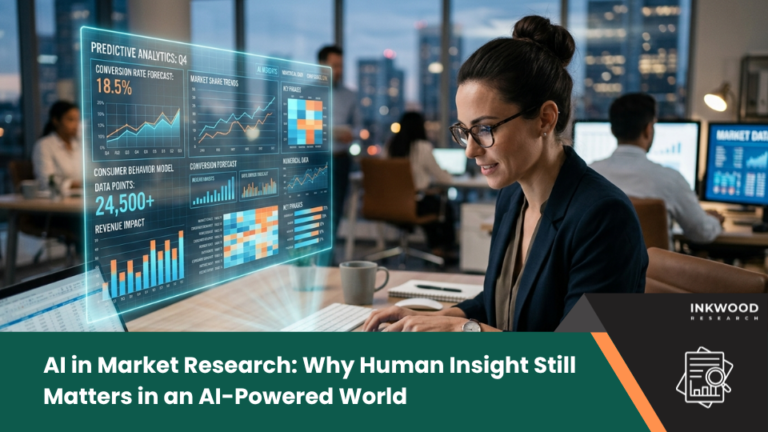
- Predictive analytics for demand forecasting and scenario modelling
However, speed and scale are not the same as insight. Gathering data faster does not automatically produce better strategic decisions; it simply produces more of them, faster.
Where AI Genuinely Helps, and Where It Falls Short
AI genuinely excels at processing the what in data, identifying what consumers are doing, what competitors are charging, and what topics are trending. Furthermore, when embedded into a broader research methodology, AI dramatically improves team efficiency. The critical distinction, however, is that AI handles the what while market research handles the why, and in most strategic decisions, the why is everything.
Does AI Replace Market Research? Here’s the Reality

The short answer is no, and the evidence is telling. According to the U.S. Bureau of Labor Statistics, employment of market research analysts is projected to grow (yes, not shrink) 8% from 2023 to 2033, faster than the average for all occupations. This growth signals something important: as AI tools proliferate, demand for human-led research expertise is rising alongside them, not declining.
Understanding human vs AI market research means recognising where each genuinely adds value, and where each has real limits.
Dimension | AI Tools vs. Human-Led Research |
Speed of data collection | AI is faster; humans are slower but more selective |
Contextual understanding | AI is limited; human analysts go deep |
Strategic interpretation | AI is weak; market research is the core strength |
Qualitative nuance | AI misses cultural and emotional context; humans catch it |
Bias identification | AI inherits training bias; researchers critically interrogate it |
The Limitations of AI in Market Research
The limitations of AI in market research are structural, not temporary. AI models work with historical data, they identify what has happened and extrapolate patterns forward. Additionally, they struggle with the following challenges that human researchers navigate every day:
- Interpreting why consumer behaviour is changing, not just that it is
- Navigating ambiguous or culturally specific market signals
- Accounting for disruptive events that fall outside historical patterns
- Translating raw data into strategic, actionable business recommendations
Moreover, AI tools are only as good as the data they are trained on. Biased or incomplete training datasets produce unreliable outputs, sometimes confidently so. Market research mitigates this through rigorous methodology, cross-validation, and expert judgment that no algorithm can replicate independently.
Here’s a real-life example of when AI got it a bit wrong. A mid-sized consumer electronics brand used AI tools to analyse purchase data and concluded that demand for a product category was declining. Before pulling investment, they engaged Inkwood Research for a strategic deep-dive. Our qualitative fieldwork revealed that consumers were not entirely abandoning the category; they were shifting to a different purchase channel that the AI data had not captured. The brand redirected its distribution strategy rather than exiting the market entirely. While AI provided the alert, market research provided the answer.
Why the Importance of Market Research Has Grown in 2026

Paradoxically, the proliferation of AI tools has made strategic market research more important, not less. When everyone has access to the same AI platforms and the same publicly available data, the competitive advantage shifts to who can generate better questions, deeper context, and more precise strategic framing. That is precisely what market research is designed to deliver, and what no AI tool can do without human direction.
Strategic Market Research vs. AI Automation
Consider the difference between two approaches to a product launch decision:
- AI automation approach: Feed sales data, social media sentiment, and competitor pricing into a model. Receive a summary report with probability estimates.
- Strategic market research approach: Design a research programme that tests assumptions, engages target consumers directly, evaluates regulatory and competitive context, and translates findings into a clear go/no-go recommendation with risk mitigation options.
Both have value. However, only one produces the kind of decision intelligence that senior executives can act on with genuine confidence. Furthermore, market research for startups and enterprises alike requires asking the right questions before collecting data, something AI tools cannot do independently.
Additionally, the role of market research in the AI era has evolved to include validating AI outputs. Many organisations now commission custom market research services specifically to audit and pressure-test conclusions generated by automated tools, treating AI outputs as hypotheses rather than conclusions.
How to Combine AI and Market Research Effectively

The most effective approach in 2026 is not AI versus market research; it is AI plus market research. Forward-thinking organisations are combining both in ways that maximise the strengths of each while compensating for their respective limitations. Here is how the most effective hybrid models work:
- Use AI for scale: Deploy AI tools for data collection, social listening, and preliminary trend analysis across large datasets.
- Use market research for depth: Apply qualitative and quantitative methodologies to interpret findings and generate strategic recommendations.
- Validate AI outputs: Treat AI-generated insights as hypotheses, not conclusions. Market research confirms, refines, or challenges them.
- Combine predictive analytics with expert judgment: AI can project what is likely; market research explains what it means for your specific business strategy.
Moreover, the future of market research lies in these hybrid models, where AI handles high-volume processing and human analysts focus on strategic synthesis. This combination produces faster, more reliable, and more actionable business intelligence than either approach alone. The businesses that recognise this early will have a structural advantage over those still treating AI and research as competing alternatives.
Key Takeaways
- AI in market research accelerates data collection and pattern recognition, but cannot replace strategic interpretation.
- According to the U.S. Bureau of Labor Statistics, demand for market research analysts is growing alongside AI adoption, not declining.
- The limitations of AI in market research include contextual blindness, training data bias, and inability to generate independent strategic recommendations.
- Human vs AI market research is not a competition, it is a collaboration. The most effective organisations deploy both in complementary ways.
- The importance of market research in 2026 is amplified by AI noise. Cutting through that noise requires human expertise and rigorous methodology.
- Custom market research services deliver the decision intelligence that AI tools alone simply cannot produce.
Conclusion
The AI era has not diminished the value of market research; it has redefined it. As AI-powered market research tools become more capable and more accessible, the competitive edge shifts to the quality of strategic thinking behind the data. Businesses that understand this will invest in market research, not instead of AI, but alongside it.
Inkwood Research helps organisations build that capability, combining proprietary research methodologies with advanced analytics to deliver the insights that drive confident, informed decisions.
Connect with our team to explore how our analysis can support your strategy in the evolving landscape of market research in the age of AI.
Frequently Asked Questions (FAQs)
No. AI handles data processing at scale, but strategic market research delivers the contextual interpretation and decision intelligence that automated tools cannot replicate.
AI struggles with qualitative context, cultural nuance, training data bias, and translating data patterns into actionable strategic recommendations for specific business situations.
Use AI for data collection and trend detection, then apply market research methodologies to validate, interpret, and translate findings into executable strategy.
Human analysts identify what AI misses, strategic implications, cultural context, and the research design that produces reliable, decision-ready business intelligence.
It involves using NLP, machine learning, and predictive analytics within the research process to improve the speed and scale of data collection and initial analysis.
By ensuring decisions rest not just on what data shows, but on a thorough understanding of why those patterns exist and what they mean for your specific business context.