Table of Contents
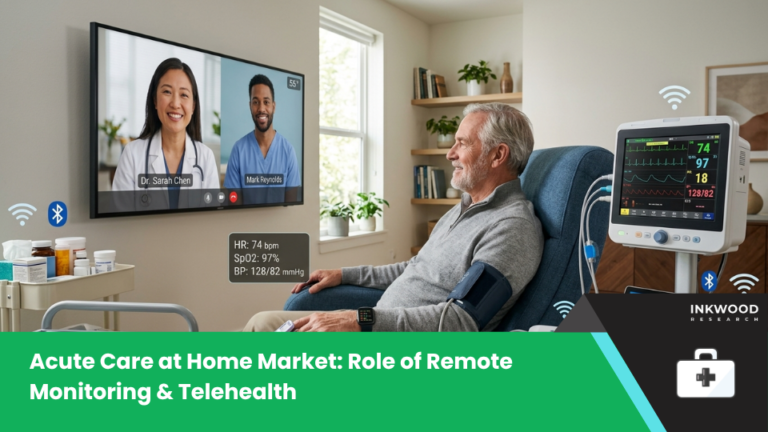
This analysis is brought to you by Inkwood Research, a leading market intelligence firm specializing in global healthcare technology, remote patient monitoring ecosystems, and home-based acute care delivery models. Our research team draws on deep expertise in telehealth infrastructure, value-based care frameworks, and hospital at home program dynamics across North America, Europe, and the Asia-Pacific. We deliver actionable insights that empower strategic decision-making for healthcare executives navigating the global acute care at home market.
TLDR
The global acute care at home market is undergoing a fundamental transformation, powered by remote patient monitoring, telehealth, and mounting pressure on overburdened hospital systems worldwide. According to our analysis, the market is projected to grow from US$15.23 billion in 2026 to US$62.20 billion by 2034, at a remarkable CAGR of 19.23%. Across North America, Europe, and Asia-Pacific, health systems are discovering that clinical-grade acute care can be delivered safely, cost-effectively, and with strong patient satisfaction, right in the patient’s home.
This blog is essential reading for healthcare system executives, telehealth platform providers, remote patient monitoring vendors, and home health technology investors. Additionally, hospital administrators evaluating hospital at home programs, policymakers shaping reimbursement frameworks, and venture analysts tracking the global acute care at home market will find targeted, evidence-grounded intelligence to support strategic decisions in this rapidly evolving space.
What Is Driving the Global Acute Care at Home Market?

The idea of receiving hospital-level care from home once seemed far-fetched. Today, however, it is becoming standard practice across the world’s most advanced healthcare systems. The global acute care at home market is forecast to grow from US$15.23 billion in 2026 to US$62.20 billion by 2034, at a CAGR of 19.23%, reflecting a fundamental rethink of where serious medical care can and should be delivered.
Aging populations are placing unprecedented strain on hospital capacity worldwide. Moreover, chronic conditions, including heart failure, COPD, and sepsis, are expanding the number of patients who need intensive, ongoing monitoring. Consequently, health systems are turning to remote patient monitoring and telehealth platforms to manage these patients safely outside hospital walls, at lower cost and with greater patient comfort.
The financial case reinforces the clinical one. Hospital stays are expensive, and payers worldwide are actively incentivizing home-based acute care models that deliver equivalent outcomes at lower cost. Furthermore, patient preference is shifting decisively toward home settings, where recovery environments are familiar, infection risk is reduced, and family involvement in care is far easier.
Technology: The Foundation of the Acute Home Healthcare Market
None of this growth is possible without robust technology infrastructure. Remote patient monitoring platforms now allow clinicians to track vital signs, oxygen saturation, and cardiac rhythms in real time from patients’ homes. Meanwhile, integrated telehealth platforms enable daily video visits, medication reviews, and care escalation protocols, all without a patient ever leaving their home.
Additionally, AI-powered analytics are helping clinical teams identify deteriorating patients earlier, enabling faster intervention before a situation becomes critical. Together, these technologies form the operational backbone of the acute care at home market, making it possible to replicate hospital-level care in residential settings safely and at scale.
A North American remote patient monitoring company engaged Inkwood Research to evaluate expansion opportunities within the global acute care at home market. Our analysis identified the highest-potential regions, mapped regulatory requirements, and assessed competitor positioning across 12 countries. Armed with these insights, the client prioritized three key markets for Phase 1 expansion, significantly reducing both time-to-market and capital exposure.
How Is North America Leading the Acute Care at Home Revolution?

North America holds the largest share of the global acute care at home market. The North America acute care at home market is projected to grow from US$6,653.42 million in 2026 to US$24,231.43 million by 2034, at a CAGR of 17.53%. The United States has been the clear epicenter of hospital at home market innovation, with major health systems pioneering care models now being studied and replicated globally.
Programs at institutions such as Mayo Clinic, Mass General Brigham, and Intermountain Health demonstrated that patients admitted for conditions including pneumonia, heart failure, and urinary tract infections can be safely treated at home. These programs consistently recorded superior patient satisfaction scores and clinical outcomes equivalent to traditional inpatient care. They laid the foundation for what is now a rapidly scaling industry across the North America acute care at home market.
Policy Support and the Reimbursement Infrastructure
Policy has been a critical enabler across the region. The Centers for Medicare and Medicaid Services (CMS) launched its Acute Hospital Care at Home (AHCAH) waiver during the COVID-19 pandemic, and Congress has extended and expanded it through subsequent legislation. This reimbursement infrastructure has given health systems the financial confidence to invest in home-based acute care programs at scale, removing the revenue uncertainty that previously constrained growth.
Beyond the US, Canada is developing comparable frameworks, with provincial health authorities exploring hospital at home services as a structural solution to chronic hospital capacity constraints. The regulatory momentum across the North America acute care at home market is clearly building, and health systems investing early are establishing meaningful first-mover advantages.
What Is Powering Europe’s Acute Care at Home Market Growth?
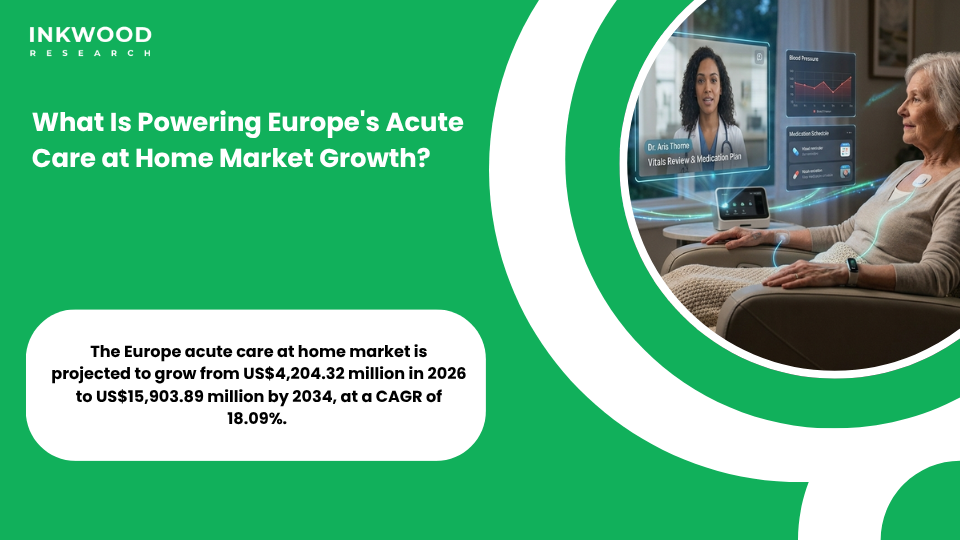
Europe is building its own distinct path in the global acute care at home market. The Europe acute care at home market is projected to grow from US$4,204.32 million in 2026 to US$15,903.89 million by 2034, at a CAGR of 18.09%. Across the continent, governments are investing actively in digital health infrastructure and integrated care models as part of broader healthcare modernization agendas.
The European Commission’s Health Data Space initiative, alongside national digital health strategies across the UK, France, Germany, and the Netherlands, has created a policy environment that actively supports remote patient monitoring and telehealth-enabled acute care at home services. Furthermore, Europe’s universal healthcare frameworks mean that cost containment incentives are powerful drivers of innovation, and the Europe acute care at home market is responding accordingly.
Country-Level Leaders and the Next Wave of Growth
The UK’s NHS has been particularly progressive. According to NHS England, virtual ward capacity has grown substantially since 2022, enabling thousands of patients to receive hospital-level care at home each week. France, Germany, and the Netherlands are building comparable frameworks, while Scandinavian countries are integrating acute home care directly into their value-based care models.
Southern and Eastern European markets represent the next wave of opportunity. As governments in these regions begin investing in digital health infrastructure, the Europe acute care at home market is set to expand well beyond its current frontrunners. The cost advantages of home-based acute care make it particularly attractive in systems facing sustained budget pressure, and that environment describes most of Europe today.
Why Is Asia-Pacific the Fastest-Growing Region for Acute Home Healthcare?
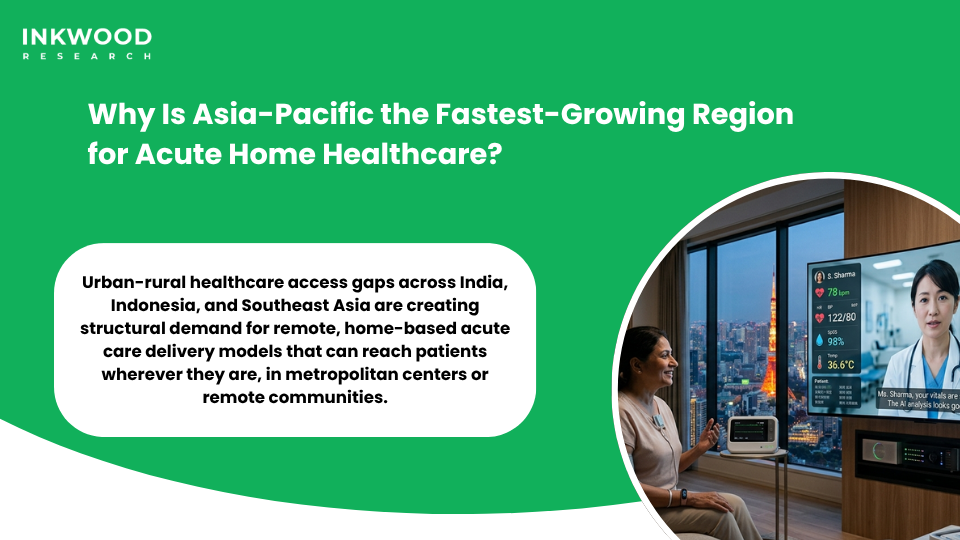
If North America and Europe represent the established leaders, Asia-Pacific is the region to watch most closely. The Asia-Pacific acute care at home market is projected to grow from US$3,281.57 million in 2026 to US$17,348.91 million by 2034, at a CAGR of 23.14%, the fastest of any major region in the global acute care at home market. This extraordinary trajectory reflects both the scale of unmet need and the remarkable pace of technology adoption across the region.
Asia-Pacific is home to the world’s largest and fastest-aging populations. Additionally, countries like Japan, South Korea, and China face demographic pressures that are pushing hospital infrastructure to its limits. Urban-rural healthcare access gaps across India, Indonesia, and Southeast Asia are creating structural demand for remote, home-based acute care delivery models that can reach patients wherever they are, in metropolitan centers or remote communities.
Government Investment and Digital Health Infrastructure in APAC
Governments across the region are investing heavily in enabling frameworks. China’s Internet Plus Healthcare initiative, Japan’s Society 5.0 health technology program, and India’s Ayushman Bharat Digital Mission are all creating the regulatory and digital environments that support hospital at home market expansion. Furthermore, the region’s high smartphone penetration and rapidly growing digital health literacy mean that patients are well-positioned to engage with telehealth-enabled acute care home services.
Private sector players are also moving quickly. Technology companies and healthcare platforms across the region are partnering with hospitals and health networks to build scalable acute home healthcare market delivery models. Together, these public and private investments are positioning Asia-Pacific as the most dynamic frontier in the global acute care at home market, and the CAGR figures reflect exactly that momentum.
An Asia-Pacific digital health company engaged Inkwood Research to understand growth dynamics across three key markets for their home healthcare acute care platform. Our analysis revealed meaningful differences in reimbursement structures, technology adoption rates, and competitive positioning across China, India, and Japan. The client used these insights to design tailored market entry strategies for each country, avoiding a one-size-fits-all approach that would have limited their penetration.
Which Companies Are Shaping the Hospital at Home Market?
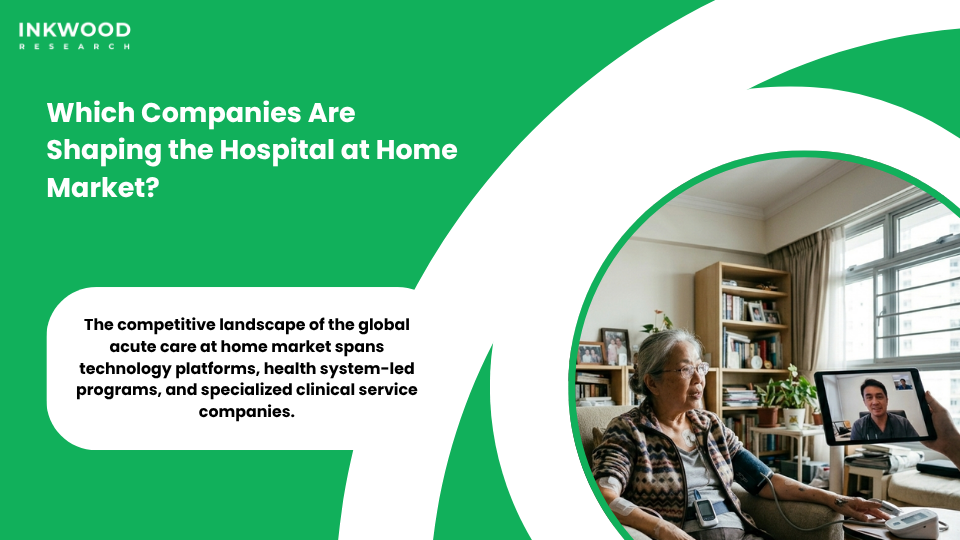
The competitive landscape of the global acute care at home market spans technology platforms, health system-led programs, and specialized clinical service companies. Several major players are establishing strong positions across each region:
- Medically Home (US): A technology and services platform enabling health systems to deliver hospital-level care at home, with partnerships across leading US academic medical centers, including Massachusetts General Hospital.
- Dispatch Health (US): Deploys mobile acute care teams to patient homes and integrates with major US payers and health systems, scaling rapidly with improved reimbursement certainty.
- Philips (Netherlands): A global leader in remote patient monitoring and connected care infrastructure, with integrated platforms supporting hospital at home programs across North America, Europe, and APAC.
- Biofourmis (US/Global): An AI-driven remote care company whose digital therapeutics platform supports hospital at home programs across multiple health systems globally, with predictive deterioration analytics.
- Current Health (UK/US, acquired by Best Buy Health): A wearable continuous monitoring platform enabling remote monitoring acute care services, with growing deployment across UK and US health systems.
Additionally, major health systems including Mayo Clinic, Mass General Brigham, and Intermountain Health have built proprietary hospital at home programs that set industry standards and demonstrate scalable clinical models for the broader acute care home treatment market.
Key Takeaways
- The global acute care at home market is projected to grow from US$15.23 billion in 2026 to US$62.20 billion by 2034 at a 19.23% CAGR, driven by telehealth, remote patient monitoring, and value-based care incentives.
- North America leads in absolute value, with the North America acute care at home market growing from US$6,653.42 million to US$24,231.43 million by 2034 at a 17.53% CAGR.
- Europe is expanding steadily at an 18.09% CAGR, with NHS Virtual Wards and national digital health strategies anchoring the Europe acute care at home market at US$15,903.89 million by 2034.
- Asia-Pacific is the fastest-growing region at a 23.14% CAGR through 2034, making the Asia-Pacific acute care at home market the most dynamic frontier globally.
- AI analytics, wearable sensors, and integrated telehealth platforms are making hospital at home programs clinically safe, operationally scalable, and financially viable.
- Companies including Medically Home, Dispatch Health, Philips, Biofourmis, and Current Health are building the infrastructure that will define the home-based acute care market for years to come.
Conclusion
The expansion of acute care at home is not a passing trend; it is a structural transformation of how healthcare is delivered worldwide. Remote patient monitoring and telehealth platforms have removed the clinical barriers that once made hospital-level home care a niche concept. As policy frameworks, reimbursement models, and technology infrastructure continue to align, the global acute care at home market is poised for sustained, significant growth across every major region.
For healthcare organizations, technology providers, and investors navigating this landscape, the strategic window is wide open. Inkwood Research provides the market intelligence and strategic analysis needed to act with confidence. Connect with our team to explore how our insights can support your positioning in the evolving acute care at home market.
Frequently Asked Questions (FAQs)
Acute care at home delivers hospital-level medical treatment in a patient’s residence, using remote monitoring and telehealth platforms to maintain continuous clinical oversight.
Aging populations, rising chronic disease burden, healthcare cost pressures, and advances in remote patient monitoring technology are the primary growth drivers globally.
Asia-Pacific leads with a 23.14% CAGR through 2034, driven by demographic pressure, government digital health investment, and rapid technology adoption.
Remote monitoring lets clinicians track vital signs, cardiac rhythms, and oxygen levels in real time, enabling safe acute care delivery outside hospital settings.
Medically Home, Dispatch Health, Philips, Biofourmis, and Current Health are among the key platform providers shaping the global acute care at home market.
Coverage varies by country and payer. In the US, CMS has established reimbursement through its Acute Hospital Care at Home program; European health systems are developing comparable frameworks.