Table of Contents
This analysis is brought to you by Inkwood Research, a leading market intelligence firm specializing in pharmaceutical manufacturing technologies, additive manufacturing ecosystems, and advanced drug delivery innovation. Our research team combines deep expertise in FDA and EMA regulatory pathways, pharmaceutical R&D trends, and clinical manufacturing across North America, Europe, and Asia-Pacific. Through strategic partnerships with pharmaceutical manufacturers, biotech innovators, and drug delivery specialists, we deliver actionable insights for enterprises navigating the rapidly evolving pharmaceutical 3D printing market.
TLDR
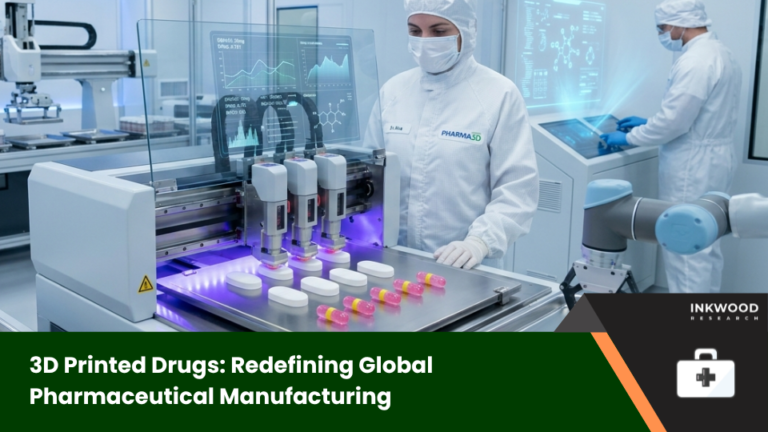
The pharmaceutical 3D printing market is shifting from niche experimentation to mainstream drug production. According to our analysis, the global pharmaceutical 3D printing manufacturing market is projected to grow from US$580.69 million in 2026 to US$1,858.27 million by 2034, at a 15.65% CAGR. North America currently leads in market value, while Asia-Pacific is growing fastest at an 18.46% CAGR. Personalized medicine, controlled-release formulations, and on-demand drug manufacturing are the three forces fundamentally reshaping how pharmaceuticals are designed and produced.
This blog is essential reading for pharmaceutical executives, drug delivery scientists, and biotech investors evaluating additive manufacturing strategies. Additionally, regulatory affairs professionals tracking FDA and EMA guidance, hospital pharmacists exploring point-of-care drug printing, and healthcare investors monitoring the global pharmaceutical 3D printing manufacturing market will find evidence-backed strategic intelligence here.
What Is Pharmaceutical 3D Printing and Why Does It Matter?
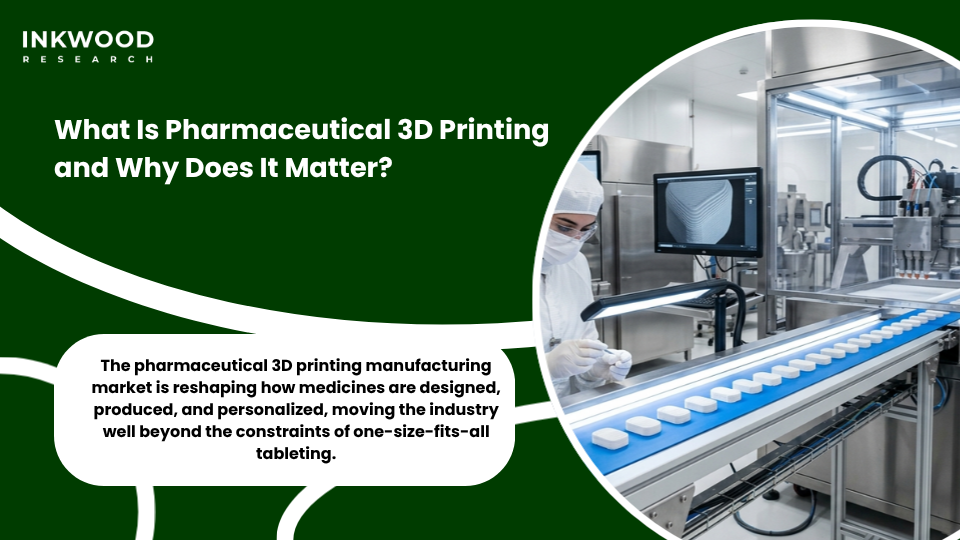
Something is changing at the heart of modern drug manufacturing, and it starts with a printer. The pharmaceutical 3D printing manufacturing market is reshaping how medicines are designed, produced, and personalized, moving the industry well beyond the constraints of one-size-fits-all tableting. At its core, pharmaceutical additive manufacturing builds drug products layer by layer using precise digital blueprints, a process that delivers structural complexity far beyond what conventional tablet presses can achieve.
Conventional drug manufacturing compresses pre-mixed powders into fixed-dose tablets at high volumes. Pharmaceutical 3D printing, by contrast, engineers each tablet or capsule with programmable geometry, dose calibration, and release architecture. Consequently, the technology is not just a faster way to make pills; it is a fundamentally different approach to drug design.
From Powder to Pill: The Core Technologies in 3D Printing Drug Manufacturing
Several distinct technologies power the pharmaceutical 3D printing manufacturing market, each suited to different formulation needs:
- Binder jetting: Deposits a binding agent onto pharmaceutical powder layers, creating tablets with controlled porosity, ideal for rapid-dissolve drug formulations.
- Fused deposition modeling (FDM): Extrudes thermoplastic filaments loaded with active pharmaceutical ingredients (APIs) to produce solid oral dosage forms with precise drug loading.
- Stereolithography (SLA): Uses light-cured pharmaceutical-grade resins to build complex drug delivery structures with exceptional dimensional accuracy.
- Selective laser sintering (SLS): Fuses pharmaceutical powders with a laser, enabling porous, fast-disintegrating tablets without requiring binding agents or solvents.
The landmark moment for this technology came in 2015, when the FDA approved Spritam (levetiracetam) by Aprecia Pharmaceuticals, the world’s first 3D printed drug cleared for clinical use. Using binder jetting, Spritam dissolves almost instantly in the mouth, offering a critical advantage for epilepsy patients who struggle with swallowing. That approval established proof of concept; the industry has been building on it ever since.
How Big Is the Global Pharmaceutical 3D Printing Manufacturing Market?
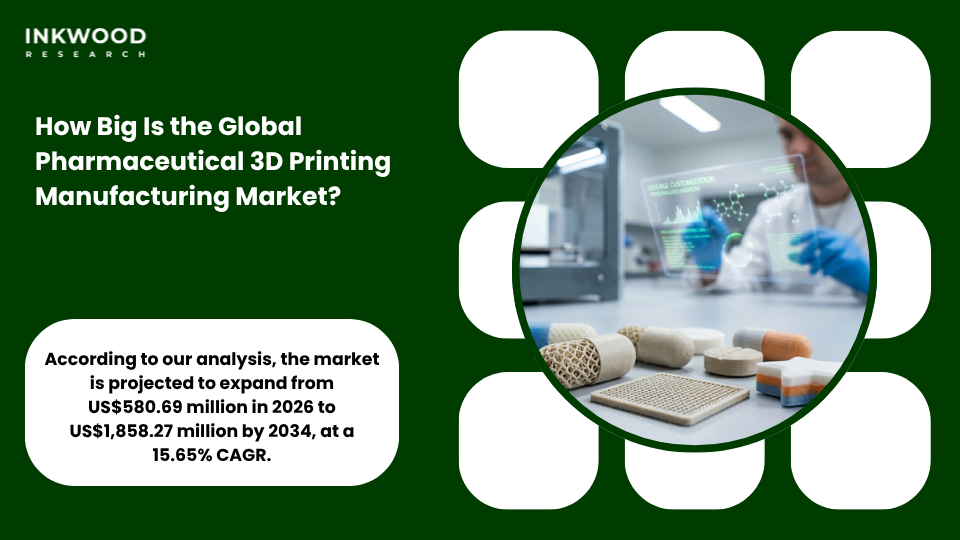
The global pharmaceutical 3D printing manufacturing market size reflects strong and sustained commercial confidence. According to our analysis, the market is projected to expand from US$580.69 million in 2026 to US$1,858.27 million by 2034, at a 15.65% CAGR. That rate of growth places pharmaceutical additive manufacturing among the fastest-expanding segments in the broader pharma technology landscape.
North America Pharmaceutical 3D Printing Manufacturing Market
North America currently holds the leading position, with the North America pharmaceutical 3D printing manufacturing market projected to grow from US$236.73 million in 2026 to US$683.21 million by 2034, at a 14.17% CAGR. This leadership reflects a combination of FDA regulatory clarity, deep pharmaceutical R&D infrastructure, and a concentration of biotech companies willing to invest in next-generation drug manufacturing.
Furthermore, the FDA’s Technical Considerations for Additive Manufactured Medical Devices guidance has provided a regulatory framework that gives manufacturers the confidence to invest in 3D printing drug manufacturing at a commercial scale. That regulatory clarity is a genuine competitive advantage for the North American market.
Europe and Asia-Pacific: Two Distinct Growth Paths
Meanwhile, the Europe pharmaceutical 3D printing manufacturing market is growing from US$171.95 million in 2026 to US$518.09 million by 2034, reflecting a 14.78% CAGR. The European Medicines Agency’s progressive stance on advanced manufacturing, combined with a strong pharmaceutical chemistry heritage, underpins this expansion. Germany, in particular, plays an anchor role within Europe’s pharmaceutical additive manufacturing ecosystem.
Perhaps most striking, however, is Asia-Pacific. The Asia-Pacific pharmaceutical 3D printing manufacturing market is the fastest-growing globally, expanding from US$136.25 million in 2026 to US$528.40 million by 2034 at an 18.46% CAGR. Government-backed pharmaceutical modernization programs across China, Japan, South Korea, and India are accelerating adoption at a rate that will reshape the global competitive balance within this decade.
What Makes 3D Printed Drugs Different From Traditional Medicines?
How Does Personalized Medicine Using 3D Printing Work?
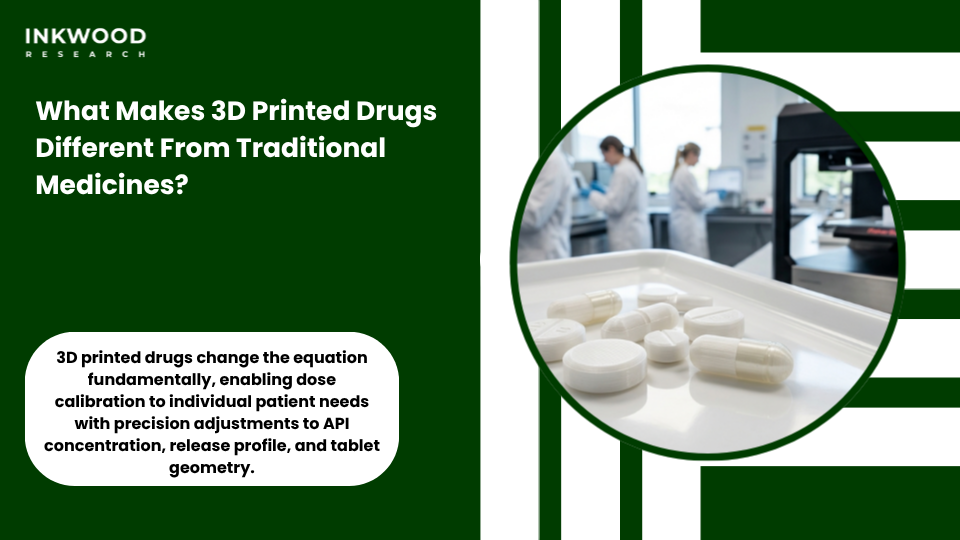
The most transformative promise of 3D printing in pharmaceuticals is personalized medicine. Traditional manufacturing produces standardized doses, the same 500mg tablet for a 60kg adult and a 90kg patient alike. 3D printed drugs change the equation fundamentally, enabling dose calibration to individual patient needs with precision adjustments to API concentration, release profile, and tablet geometry.
Accordingly, this capability matters most in pediatric and geriatric care. Children frequently require fractional adult doses, while elderly patients often need multiple drugs consolidated into a single daily intake, a clinical concept known as the polypill. Additionally, patients with rare diseases who lack commercially viable standard dosing options represent a critical and underserved population that pharmaceutical 3D printing can directly reach.
Controlled Release Drug Manufacturing: Beyond the Standard Tablet
Beyond personalization, controlled release drug manufacturing through 3D printing enables formulation complexity that conventional tableting simply cannot replicate. Multi-compartment structures can be engineered to release different APIs at different rates, a single tablet delivering an immediate-release dose followed by a sustained-release phase hours later.
Moreover, multi-drug pills, tablets combining several APIs in precise spatial arrangements, are becoming a realistic prospect for patients on complex therapeutic regimens. The adherence benefits are significant: fewer tablets, more predictable plasma levels, and better chronic disease management outcomes. For pharma companies, these advanced drug formulations create meaningful differentiation and patent protection in competitive therapeutic categories.
Who Is Leading the Pharmaceutical 3D Printing Market Today?
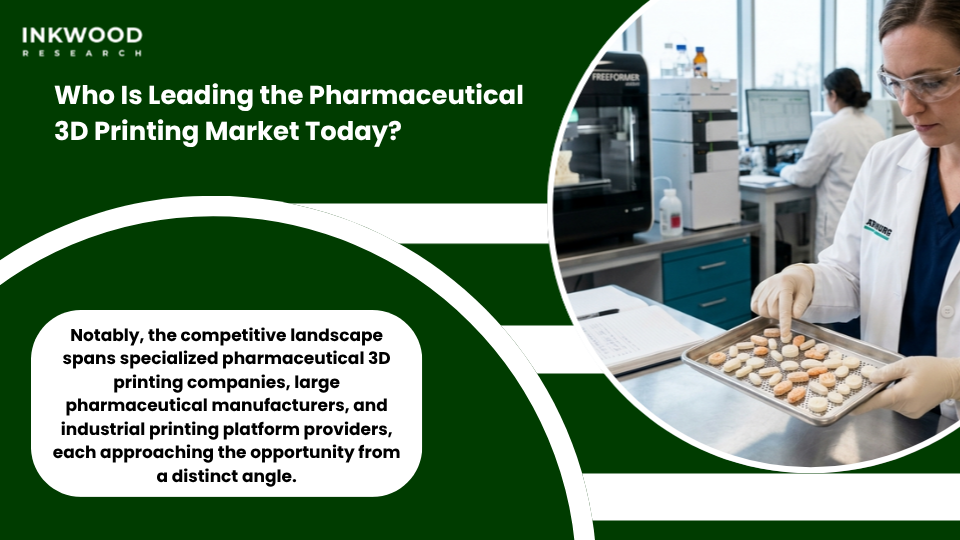
Several companies are establishing competitive leadership within the global pharmaceutical additive manufacturing market. Notably, the competitive landscape spans specialized pharmaceutical 3D printing companies, large pharmaceutical manufacturers, and industrial printing platform providers, each approaching the opportunity from a distinct angle.
- Aprecia Pharmaceuticals (USA): The benchmark innovator, having commercialized the world’s first FDA-approved 3D printed drug and continuing to advance its ZipDose technology for rapid-dissolve formulations across multiple therapeutic areas.
- Triastek Inc. (China): A major innovator in melt extrusion 3D printing for pharmaceuticals, achieving FDA Investigational New Drug (IND) acceptance for 3D printed drug candidates, a significant milestone demonstrating regulatory credibility in the Asia-Pacific market.
- FabRx Ltd. (UK): Focused on personalized medicine, developing pharmaceutical 3D printing platforms for hospital pharmacies across Europe, including its commercially deployed Printlets platform for point-of-care drug printing.
- GlaxoSmithKline (GSK): Investing in additive manufacturing across its manufacturing innovation centers in the UK and Belgium, with a focus on small-batch clinical trial supply and advanced drug formulation.
Merck KGaA: Expanding R&D investment in continuous pharmaceutical manufacturing, with additive manufacturing integrated as a core component of its digital pharma strategy across European production facilities.
What Are the Regulatory Challenges in 3D Drug Manufacturing?
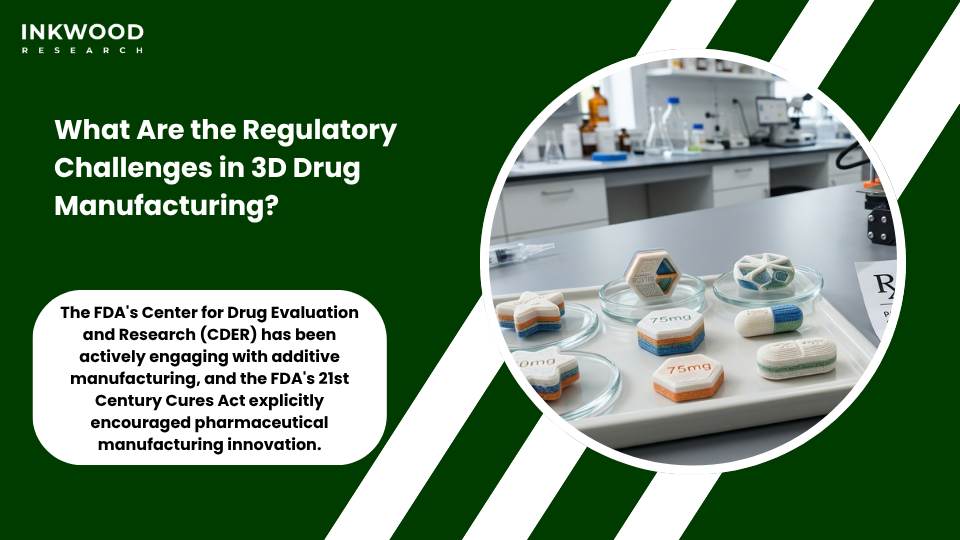
No technology transition in pharma proceeds without regulatory scrutiny, and pharmaceutical 3D printing is no exception. The FDA’s Center for Drug Evaluation and Research (CDER) has been actively engaging with additive manufacturing, and the FDA’s 21st Century Cures Act explicitly encouraged pharmaceutical manufacturing innovation. Nevertheless, standardized guidance specific to 3D printed drugs remains an area of active regulatory development.
Key challenges currently facing the pharmaceutical 3D printing manufacturing market include:
- Process validation: Each 3D printed batch carries unique variability that differs from conventional mass production. Regulators require robust, reproducible validation frameworks before approving commercial-scale manufacturing.
- Quality control: Real-time monitoring of layer-by-layer drug deposition is technically complex and requires sophisticated analytical tools not yet standardized across the industry.
- Scalability: Moving from research-scale printing to commercial-volume production while maintaining dose uniformity and regulatory compliance remains the central engineering challenge for the sector.
Despite these hurdles, the trajectory is clearly positive. The European Medicines Agency (EMA) has been progressively developing frameworks for advanced pharmaceutical manufacturing. As regulatory guidance matures, adoption barriers will continue to descent, particularly for companies with strong clinical data packages supporting their pharmaceutical additive manufacturing programs.
Key Takeaways
- The global pharmaceutical 3D printing manufacturing market is projected to grow from US$580.69 million in 2026 to US$1,858.27 million by 2034, at a 15.65% CAGR.
- North America leads in market value, while Asia-Pacific is the fastest-growing region at an 18.46% CAGR, driven by pharmaceutical modernization programs across China, Japan, South Korea, and India.
- Binder jetting, FDM, SLA, and SLS are the four core technologies enabling pharmaceutical additive manufacturing, each suited to different drug formulation objectives.
- Personalized medicine and controlled-release drug formulations represent the highest-value near-term clinical applications for 3D printed drugs across all major markets.
- Regulatory engagement from the FDA and EMA is advancing, though fully standardized guidance for 3D printed drug approval remains in development, creating both uncertainty and a first-mover opportunity.
- Aprecia Pharmaceuticals, Triastek, FabRx, GlaxoSmithKline, and Merck KGaA are the leading commercial players moving pharmaceutical 3D printing from R&D into scaled production.
Conclusion
The pharmaceutical 3D printing market has reached an inflection point where technology maturity, regulatory engagement, and commercial investment are all converging. From personalized pediatric dosing to on-demand drug manufacturing for rare diseases, the clinical applications being unlocked today will define pharmaceutical production over the next decade. The question for executives, investors, and regulators is no longer whether pharmaceutical additive manufacturing belongs in drug manufacturing; it is how quickly the industry can scale it responsibly.
Inkwood Research provides the market intelligence and strategic frameworks needed to navigate this rapidly evolving landscape.
Connect with our team to explore how our insights can support your positioning in the global pharmaceutical 3D printing manufacturing market.
Frequently Asked Questions (FAQs)
Spritam (levetiracetam) by Aprecia Pharmaceuticals, approved in 2015, is the first FDA-cleared 3D printed drug, using binder jetting for near-instant oral dissolution. It is designed to treat epilepsy.
3D printing allows precise dose calibration, custom release profiles, and multi-drug combinations tailored to individual patient needs, capabilities beyond conventional tableting.
Asia-Pacific leads growth at an 18.46% CAGR from 2026 to 2034, driven by government pharmaceutical modernization programs across China, Japan, South Korea, and India.
Binder jetting, fused deposition modeling (FDM), stereolithography (SLA), and selective laser sintering (SLS) are the four principal technologies in pharmaceutical 3D printing.
Process validation, real-time quality control during layer deposition, and scalability to commercial volumes are the primary regulatory and manufacturing hurdles.
Aprecia Pharmaceuticals, Triastek, FabRx, GlaxoSmithKline, and Merck KGaA are the leading companies advancing pharmaceutical 3D printing from research into commercial production.